Blower Door Test: Why Your Maine Home Needs One
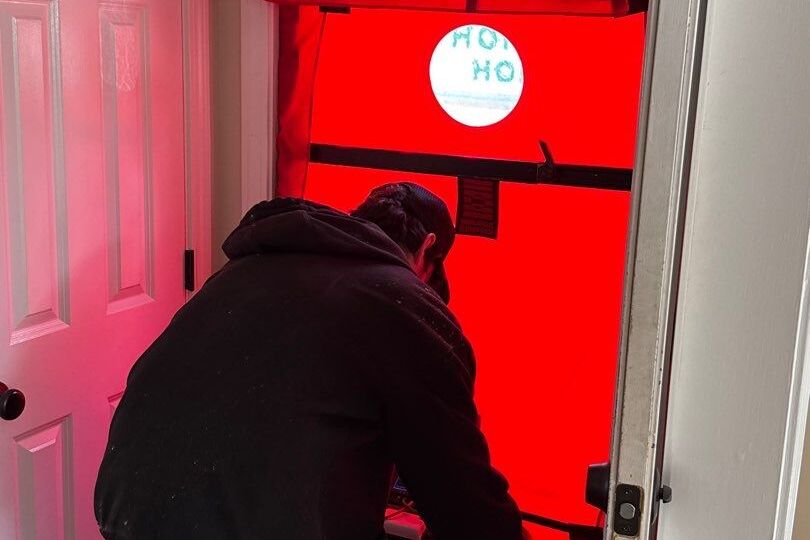
We were setting up for an insulation job in a 1920's Deering Center home last week and the homeowner asked us something we hear often: "What is that big red fan thing?" That big red fan is a blower door, and the test it performs is the single most useful diagnostic tool in home energy work. It tells us, in precise numbers, how leaky your house is.
If you have been researching insulation, air sealing, or weatherization in Maine, you have probably seen the term "blower door test" mentioned. Here is what it actually is, how we use it as part of every insulation and air sealing project, and what the results mean for your home and your heating bills.
How a Blower Door Test Works
Every insulation and air sealing project we do starts and ends with a blower door test. The pre-test tells us how leaky your home is before we begin. The post-test, after the work is complete, measures exactly how much we improved it.
The setup is simple. We mount a calibrated fan and pressure gauge into an exterior door frame using an adjustable panel. The fan pulls air out of the house, lowering the indoor air pressure slightly (to 50 Pascals, roughly the equivalent of a 20 mph wind hitting every side of your house at once).
With the house depressurized, outside air rushes in through every crack, gap, and hole in the building envelope. The fan measures exactly how much air is moving through those leaks, expressed as CFM50 (cubic feet per minute at 50 Pascals of pressure).
The whole test takes about 10 minutes. It is non-invasive and does not require any modification to your home.
What the Numbers Mean
The CFM50 number is essentially the size of all the leaks in your house combined into one measurement. Think of it as the equivalent of a single hole in your wall. A home with 3,000 CFM50 has the equivalent of a hole roughly 2 square feet in size, open to the outside, 24 hours a day, all winter long.
Here is what we typically see across Greater Portland. Important: these ranges depend heavily on the size of your home. A 2,000 CFM50 reading is excellent for a 2,400-square-foot Colonial but would be leaky for a 1,200-square-foot ranch. That is why we also calculate ACH50 (see below), which adjusts for home size.
- 600 to 1,200 CFM50: Very tight for a small to mid-size home. New construction built to current energy codes, or an older home that has been professionally air sealed. For a large home, this range is exceptionally tight.
- 1,200 to 2,500 CFM50: Moderate for a typical 1,500 to 2,000-square-foot home. Some air sealing has been done, or the home was built with reasonable attention to the envelope. For a smaller Cape or ranch, this could still mean significant leakage.
- 2,500 to 4,000 CFM50: Leaky for most homes under 2,500 square feet. Common in pre-1980 Maine homes that have not been weatherized. This is where air sealing delivers the biggest return. For a large 3,000+ square-foot home, this range may be moderate.
- 4,000 to 8,000+ CFM50: Very leaky for nearly any home. Balloon-frame Victorians, homes with uninsulated additions, or houses with major penetrations (unsealed attic hatches, whole-house fans, recessed lights). These homes are expensive to heat no matter what fuel you use.
Most of the homes we assess in the Portland area fall in the 2,500 to 5,000 range. That is not unusual for Maine's housing stock, which is among the oldest in the country. The raw CFM50 number is a starting point, and your home's size determines whether that number is a problem or not.
ACH50: The Other Number That Matters
Your auditor might also reference ACH50, which stands for Air Changes per Hour at 50 Pascals. This adjusts the raw CFM50 number for your home's size.
The formula: CFM50 x 60 / house volume in cubic feet.
A 2,000-square-foot home with 8-foot ceilings has 16,000 cubic feet of volume. If the blower door measures 3,200 CFM50, the ACH50 is 12 (3,200 x 60 / 16,000). That means the entire volume of air in the house is replaced with outside air 12 times per hour at test pressure.
For reference, Maine's building code (climate zone 6) requires new construction to achieve 3 ACH50 or less. Most older Maine homes we test are between 8 and 15 ACH50.
What We Find and Fix During Our Work
The blower door does more than produce a number. While it runs, we use an infrared camera to scan walls, ceilings, and floors. The camera reveals temperature differences on surfaces, making insulation gaps and air leaks visible as distinct cold (or warm) patterns. This guides exactly where we focus our insulation and air sealing work.
The most common leaks we find in Maine homes:
- Attic bypasses. Gaps around plumbing stacks, electrical wiring, and chimney chases that connect the heated living space directly to the attic. These are often the largest single source of air leakage.
- Rim joists. The band of framing where the foundation meets the first floor. In most older homes, these are completely uninsulated and unsealed.
- Recessed lights. Older "can" lights punch holes directly through the ceiling into the attic. Each one is a leak.
- Attic hatches and pull-down stairs. Rarely insulated, rarely sealed. Essentially an open hole to the attic.
- Exterior wall penetrations. Electrical outlets, cable entries, dryer vents, and hose bibs.
Seeing these leaks on the infrared camera while the blower door runs is often the most eye-opening part of the process for homeowners. The cold blue streaks on the camera make invisible problems obvious, and then we get to work fixing them.
Why Air Leakage Costs You Money
Here is the practical impact. In a typical Maine winter, a home with 4,000 CFM50 is losing heated air at a rate that adds hundreds of dollars per year to heating costs. The exact amount depends on your fuel type, local temperatures, and how many hours per day the heating system runs. But the Department of Energy estimates that reducing air leakage through sealing can lower heating costs by 10 to 20 percent.
For a Maine homeowner spending $3,000 per year on heating oil or propane, that is $300 to $600 in annual savings from air sealing alone, before adding any insulation.
Air leakage also affects comfort. A leaky home has drafts, cold spots, and rooms that never seem to warm up. The heating system runs constantly but cannot keep up because conditioned air is escaping as fast as it is produced.
Start with a free energy assessment to discuss insulation and air sealing. This first visit is a visual walkthrough only, with no diagnostic testing. Blower door testing happens during the insulation and air sealing job, at the start and after the work is complete.
How Blower Door Testing Fits Into Our Process
The blower door test is built into every insulation and air sealing project we do. It is not an add-on or a separate service. Here is how it works in practice:
Before the work begins, we run the pre-test. The results guide exactly where we focus our air sealing effort, targeting the biggest leaks first and working from the attic down:
- Attic air sealing. We seal all penetrations in the attic floor (top plates of interior walls, plumbing and electrical chases, chimney gaps, recessed light housings) before adding insulation. Insulation without air sealing is like wearing a sweater with no windbreaker.
- Rim joist sealing. Rigid foam and caulk at the rim joist area in the basement.
- Basement and crawlspace sealing. Foundation wall penetrations, sill plate gaps, bulkhead doors.
- Living space details. Weatherstripping, outlet gaskets, and other small but cumulative leaks.
After the work is complete, we run a second blower door test (the "post-test") to measure exactly how much we improved your home's envelope. This before-and-after documentation is required by Efficiency Maine for rebate qualification, and it is included in every project we do.
We routinely see reductions of 30 to 50 percent in air leakage after a full air sealing job. That translates directly to lower heating bills and better comfort.
Built-In Rebate Qualification
Because we run blower door tests before and after every insulation and air sealing project, your Efficiency Maine rebate qualification is handled automatically. You do not need to schedule a separate assessment or hire a third party.
Frequently Asked Questions
How long does a blower door test take? The test itself takes about 10 minutes. We run it at the start of your project and again at the end, so it adds minimal time to the overall job.
Does it damage my home? No. The fan creates a gentle pressure difference (similar to a moderate breeze). There is no risk of damage. We close all windows and exterior doors before running the test.
Do I need to prepare anything? Make sure one exterior door is accessible for the fan setup. Close all windows and exterior doors. Everything else can stay as-is.
Is blower door testing included in the project cost? Yes. Pre-test and post-test blower door testing is included in every insulation and air sealing project. There is no separate charge.
What is a "good" blower door number? It depends entirely on your home's size. A 1,500 CFM50 result is tight for a 1,600-square-foot Cape but only moderate for a 3,000-square-foot Colonial. ACH50 (air changes per hour) is a better comparison because it accounts for home volume. Under 5 ACH50 is good for an older Maine home; under 3 ACH50 is current code for new construction.
Does the blower door test qualify me for Efficiency Maine rebates? Yes. Our pre-test and post-test results are exactly what Efficiency Maine requires to document improvement and qualify for weatherization rebates. We handle the paperwork.
Start Planning Your Air Sealing Project
Every home has air leaks. The question is how many and how much they cost you. A blower door test replaces guessing with data, and every insulation and air sealing project we do includes one.
Request your free energy assessment for your Greater Portland home. We will discuss your drafts, look at visible insulation and air sealing conditions, and help you prioritize improvements. The visit is a visual walkthrough only, with no diagnostic testing or obligation. Blower door testing takes place during the insulation and air sealing job.
Have questions about how testing fits into a project? Contact our team or call (207) 221-3221.
Find our guides faster: add Horizon Homes as a preferred source on Google.
Free Home Energy Assessment
Ready to Lower Your Energy Bills?
We identify the improvements that will have the biggest impact on your home's energy use, with clear pricing and rebate estimates.
- Free walkthrough, no equipment, no disruption
- Efficiency Maine rebates identified for you
- Written improvement plan with pricing
Schedule Your Free Assessment
We call within 1 business day.