What Is a Condensing Boiler and How It Works
Editor's note (August 2026): The federal 25C tax credits referenced in this article expired December 31, 2025 and are only available for qualifying work completed before that date. Efficiency Maine rebates remain available for qualifying insulation and heat pump upgrades. Boiler installations do not currently qualify for a comparable state rebate.
Here's a number most homeowners have never checked: their boiler's AFUE rating. If you have a cast iron boiler that was installed in the 1990's or earlier, there's a good chance it's operating at 78-82% efficiency. That means for every dollar you spend on natural gas or propane, somewhere between 18 and 22 cents goes straight up the chimney as waste heat.
You'd notice if someone took a quarter out of every dollar in your wallet. But because boiler inefficiency happens invisibly, most homeowners just accept their heating bills as a fixed cost of living in Maine.
Modern wall-hung condensing boilers operate at 95-98% AFUE. That's not a small improvement - it's a fundamentally different approach to how a boiler extracts heat from fuel. Understanding how condensing technology works helps explain why these systems perform so much better and when they make sense for your home.
The Basics: What AFUE Means
AFUE stands for Annual Fuel Utilization Efficiency. It measures what percentage of the fuel your boiler burns actually becomes usable heat for your home. An 80% AFUE boiler converts 80 cents of every fuel dollar into heat. A 95% AFUE condensing boiler converts 95 cents.
For context, federal minimum efficiency standards require new boilers to meet at least 80% AFUE. That's the floor, not the ceiling. Condensing boilers exceed that minimum by 15-18 percentage points.
How a Conventional Boiler Works
A conventional boiler burns natural gas or propane in a combustion chamber. Hot combustion gases transfer heat to water flowing through a heat exchanger. That heated water circulates through your home's distribution system - baseboard radiators, radiant floor tubing, or a combination - releasing heat into your rooms before returning to the boiler to be reheated.
After passing through the heat exchanger, the combustion gases still contain significant heat energy. In a conventional boiler, these gases vent out through a chimney at 300-500F. All that residual heat is lost to the atmosphere.
This is the fundamental limitation. Conventional boilers can only extract heat down to the "dew point" of the combustion gases (around 130-140F for natural gas). Going below that temperature causes condensation inside the heat exchanger, which in cast iron leads to corrosion and premature failure. So conventional boilers deliberately keep flue gas temperatures high. Safe for the equipment, wasteful with your fuel.
What Makes a Condensing Boiler Different
A condensing boiler is designed to do what a conventional boiler cannot: extract heat from combustion gases all the way down below the dew point, intentionally causing condensation in the process.
Here's how it works, step by step:
Stage 1: Primary heat exchange
Like a conventional boiler, combustion gases first pass through a primary heat exchanger where they transfer heat to the circulating water. So far, the process is the same.
Stage 2: Secondary heat exchange (the condensing stage)
This is where the technology diverges. The combustion gases then pass through a secondary heat exchanger - typically made of stainless steel, which resists the corrosive effects of condensation. In this stage, the gases cool below 130F, causing water vapor in the exhaust to condense from gas back into liquid.
When water vapor condenses, it releases latent heat - the energy that was originally used to evaporate it. This latent heat is captured by the secondary heat exchanger and transferred to your heating water. This "free" heat recovery is what pushes condensing boiler efficiency above 90%.
Stage 3: Condensate management
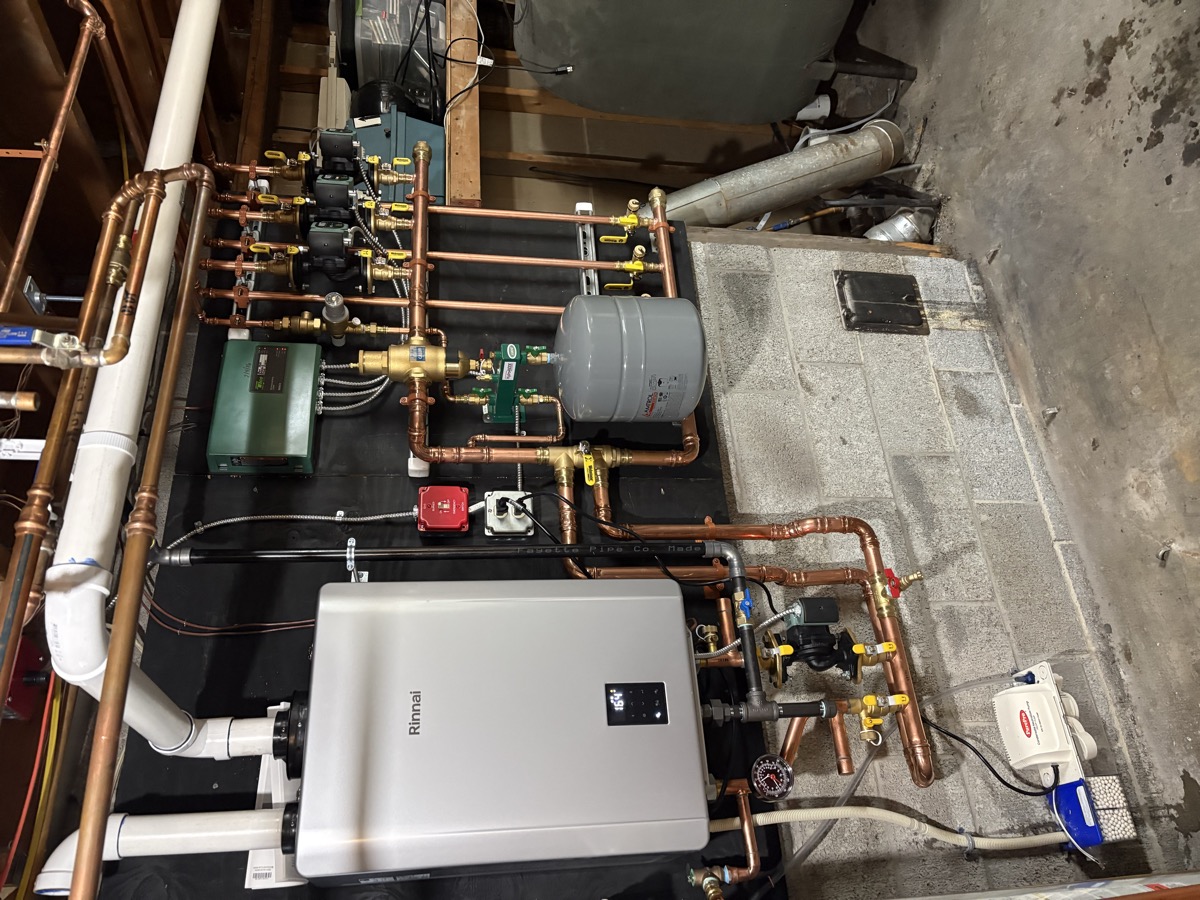
The condensation process produces acidic water (condensate) that must be drained. Modern condensing boilers include built-in condensate management and drain the liquid through a small PVC line, typically to a floor drain or condensate pump.
Stage 4: Low-temperature venting
Because the exhaust gases exit the boiler at such low temperatures (100-130F instead of 300-500F), condensing boilers don't need a traditional chimney. They vent through PVC or polypropylene pipe, which can run horizontally through an exterior wall. This eliminates the need for a dedicated chimney and makes installation more flexible.
The 130F Threshold: Why Return Water Temperature Matters
Here's a detail that many homeowners - and some contractors - don't fully appreciate: a condensing boiler only condenses (and achieves its highest efficiency) when the return water temperature coming back from your distribution system is below approximately 130F.
When return water temperature stays above 130F, the flue gases don't cool below the dew point, condensation doesn't occur, and the boiler operates more like a conventional high-efficiency unit - better than an old cast iron boiler, but not reaching its full potential.
This is why condensing boilers pair best with certain distribution systems. Our hydronic heating system guide explains how each distribution type moves heat and what water temperature it needs:
- Radiant floor heating - Operates at very low water temperatures (typically 90-120F), keeping the boiler in condensing mode most of the time. This is the ideal pairing.
- Properly sized baseboard radiators - When baseboard is sized correctly for the heat load, it can operate at lower water temperatures than most homeowners realize. Many systems run hotter than necessary simply because the old boiler was oversized.
- Fan-assisted radiators or convectors - These use a fan to improve heat transfer, allowing lower water temperatures.
- Oversized traditional baseboard - Homes with more baseboard length than strictly necessary (common in older installations) can often run at lower temperatures.
Even when operating outside of full condensing mode, a wall-hung condensing boiler still delivers significant advantages over a conventional system. The modulating burner, sealed combustion, and superior heat exchange design mean efficiency stays well above 90% in most real-world conditions.
Wondering whether a condensing boiler fits your home's distribution system? Schedule a free energy assessment or call (207) 221-3221 to discuss your options.
Wall-Hung vs. Floor-Standing
Traditional cast iron boilers sit on the floor and can weigh 400-600 pounds. Wall-hung condensing boilers mount to the wall and typically weigh 70-100 pounds. The size difference is dramatic.
Beyond saving floor space, wall-hung units offer practical advantages:
- Modulating burner - Instead of running at full capacity or shutting off, a condensing boiler modulates its output to match the heating demand. On a mild day, it might run at 20% capacity. On the coldest night, it ramps to 100%. This reduces temperature swings and minimizes energy waste from cycling.
- Sealed combustion - The boiler draws combustion air from outside through a dedicated intake pipe, rather than using room air. This improves efficiency and eliminates backdrafting risks.
- Quiet operation - Modern condensing boilers are significantly quieter than their cast iron predecessors.
- Built-in diagnostics - Digital controls monitor performance, flag issues, and simplify maintenance.
Natural Gas vs. Propane
Condensing boilers are available for both natural gas and propane (LP). The technology works the same way with either fuel. The key differences are practical:
- Natural gas - Piped directly to your home. Consistent pricing (though it fluctuates seasonally). Available in Portland, South Portland, Westbrook, and some surrounding communities where gas lines exist.
- Propane (LP) - Delivered by truck to an on-site tank. More common in rural areas around Greater Portland where natural gas lines don't reach. Propane typically costs more per BTU than natural gas, which makes the efficiency gains from a condensing boiler even more valuable.
If your home currently has natural gas or propane service and an existing hydronic distribution system (baseboard, radiant floor, or both), a condensing boiler upgrade is a straightforward project. The new unit connects to your existing distribution system, and the switchover is typically completed in a single day.
When a Condensing Boiler Makes Sense
Not every home needs a boiler upgrade, and a condensing boiler isn't the right answer for every situation. Here's when it makes the most sense:
- Your current boiler is 20+ years old - Even if it's still running, it's operating well below modern efficiency standards and parts are becoming harder to find.
- You're spending $2,500+ per year on heating fuel - The efficiency improvement from 80% to 95% translates to meaningful annual savings - typically 15-25% of your current fuel costs.
- You have existing hydronic distribution - If your home already has baseboard radiators or radiant floor heating, a condensing boiler connects directly to your existing system.
- You value the distribution system you have - Some homeowners prefer the even, radiant heat that hydronic systems provide. A condensing boiler lets you keep that comfort while dramatically improving efficiency.
- A full heat pump conversion isn't right for your situation - Maybe your home's layout makes heat pump placement difficult, or you prefer to keep your hydronic system as primary heat. A condensing boiler delivers significant efficiency gains without changing your distribution system.
Condensing Boilers and the Whole-Home Approach
At Horizon Homes, we install both condensing boilers and cold-climate heat pumps. Many of our customers use both - a condensing boiler as the primary heating system with heat pumps handling cooling and shoulder-season heating in specific zones.
The right combination depends on your home's distribution system, insulation level, fuel costs, and comfort preferences. That's why we start every project with a free energy assessment - not to sell you one system or the other, but to understand your home and recommend what actually fits.
Insulation and air sealing make any heating system work better by reducing the load it has to carry. A well-insulated home with a properly sized condensing boiler can deliver the same comfort at significantly lower fuel costs than an oversized conventional boiler in a drafty house.
What a Boiler Upgrade Costs
Condensing boiler installations in the Greater Portland area typically fall in the $8,000-$15,000 range depending on the unit and installation complexity. Federal tax credits under 25C cover 30% of costs for qualifying high-efficiency boilers, up to $600.
We provide transparent, line-item estimates that break down equipment, labor, and any additional work.
Getting Started
If your boiler is aging, your heating bills are higher than they should be, or you're curious whether condensing technology would work with your home's distribution system, the first step is a conversation.
Schedule your free energy assessment or call us at (207) 221-3221. We'll look at your current system, evaluate your distribution, and give you a clear recommendation - whether that's a condensing boiler, a cold-climate heat pump, a combination of both, or simply better insulation to make your existing system work harder. No pressure, no obligation - just straight answers about what makes sense for your home.
Find our guides faster: add Horizon Homes as a preferred source on Google.
Free Home Energy Assessment
Ready to Lower Your Energy Bills?
We identify the improvements that will have the biggest impact on your home's energy use, with clear pricing and rebate estimates.
- Free walkthrough, no equipment, no disruption
- Efficiency Maine rebates identified for you
- Written improvement plan with pricing
Schedule Your Free Assessment
We call within 1 business day.