High-Efficiency Boiler Installation in Maine
Your boiler is running. You can hear it. The problem is that it seems to run all the time, and your propane deliveries keep getting larger, and the house still takes forty-five minutes to warm up on a cold morning.
If this sounds familiar, there is a good chance you are heating your home with a boiler that was installed in the 1990s or early 2000s. These cast iron floor-standing units were the standard of the time. They were built to last, and many of them have. But lasting and performing efficiently are two different things.
An older boiler operating at 78-82% AFUE (Annual Fuel Utilization Efficiency) sends 18-22 cents of every fuel dollar straight up the chimney as waste heat. On a $3,500 annual propane bill, that is $630-$770 per year you are paying for heat that never reaches your living space.
Modern wall-hung condensing boilers operate at 95-98% AFUE. They are smaller, quieter, more responsive, and they extract nearly every BTU from the fuel you buy. For homes with existing hydronic distribution - baseboard radiators, radiant floors, or a combination - upgrading the boiler is one of the most straightforward efficiency improvements available.
What Makes a Condensing Boiler Different
The word "condensing" is the key. Here is what it means in practical terms.
When natural gas or propane burns, it produces heat and water vapor. In a traditional boiler, that water vapor (along with a significant amount of heat) exits through the chimney as exhaust. The exhaust is hot - typically 300-500F - which tells you how much energy is leaving the building instead of heating it.
A condensing boiler has a secondary heat exchanger that captures heat from the exhaust gases before they exit the unit. It cools the exhaust so much that the water vapor in it condenses into liquid - hence the name. This condensation releases additional heat energy (called latent heat) that the old boiler would have sent up the chimney.
The result: exhaust temperatures of 100-130F instead of 300-500F. Nearly all the heat in the fuel goes into your home. The exhaust is cool enough to vent through PVC pipe rather than a traditional masonry or metal chimney, which simplifies installation and eliminates the need to maintain a chimney flue.
The Installation Process: What to Expect
Boiler replacement is a common job for us at Horizon Homes, and the process is well-established. Here is what a typical installation looks like from start to finish.
Assessment and Sizing
Every project starts with an evaluation of your home's heating needs. We look at:
- The size and layout of your home
- Your existing distribution system (baseboard type, pipe sizes, radiant zones)
- Current fuel consumption and costs
- The condition of your existing boiler, piping, and controls
- Insulation and air sealing status (because envelope conditions affect heating load)
Proper sizing matters. An oversized boiler short-cycles - it fires up, heats the water too quickly, shuts off, and repeats. This wastes fuel and causes uneven comfort. An undersized boiler cannot keep up on the coldest days. We calculate the actual heating load for your specific home rather than just matching the old boiler's capacity, which was often oversized to begin with.
Removal of the Old System
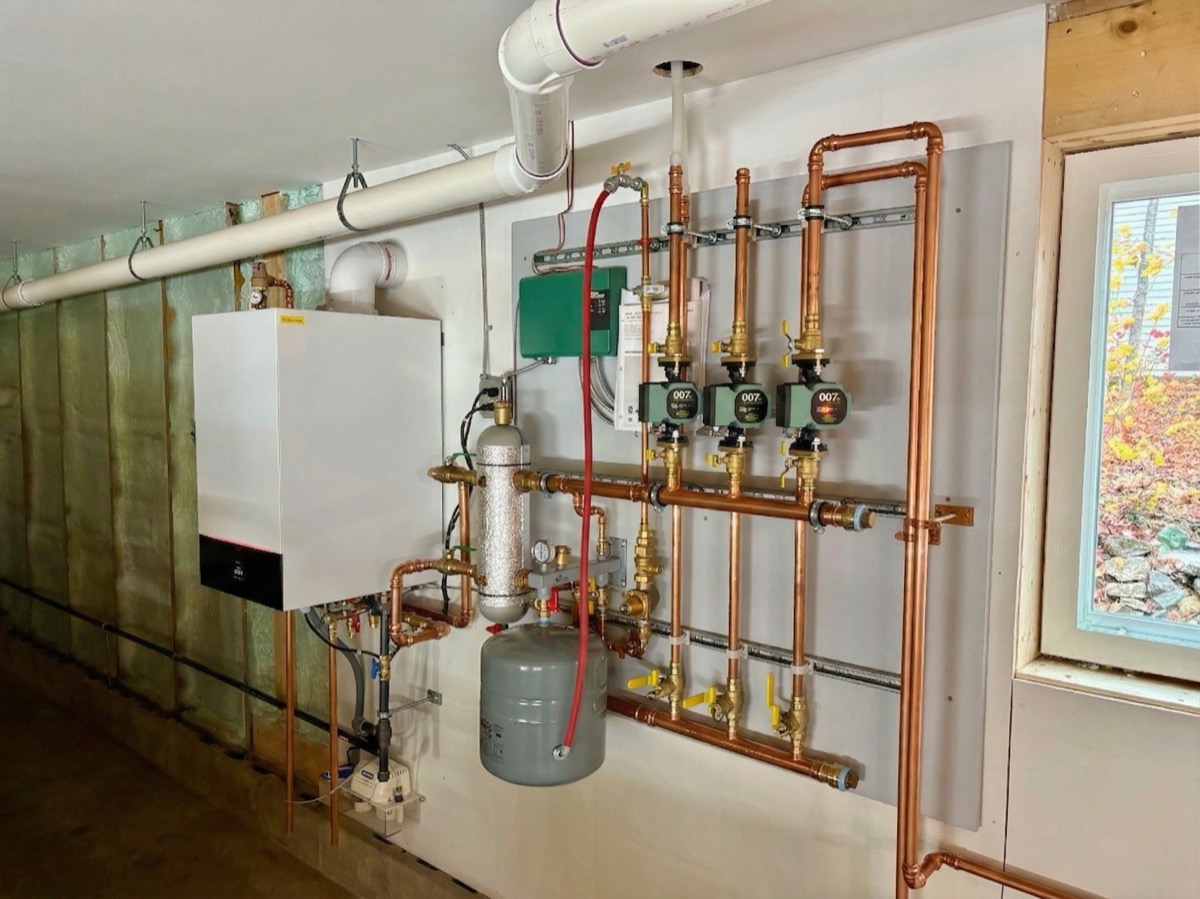
The old floor-standing boiler gets disconnected and removed. In many cases, this frees up significant floor space in the basement or utility room. A cast iron boiler the size of a washing machine gets replaced by a wall-hung unit the size of a small suitcase.
If your home currently has an oil boiler, the old oil tank can also be removed or decommissioned, eliminating a potential environmental liability. We coordinate tank removal when needed.
New Boiler Installation
The condensing boiler mounts on the wall, typically in the same mechanical space where the old unit stood. We connect it to your existing hydronic piping, install new PVC exhaust venting (routed through an exterior wall rather than up through a chimney), connect the condensate drain, and wire the new controls.
For natural gas installations, we verify the gas line sizing meets the new unit's requirements. For propane, we confirm adequate supply from the tank and regulator.
Controls and Optimization
This is where modern boilers separate themselves from old technology. We install:
- Outdoor reset controls - The boiler automatically adjusts water temperature based on outdoor conditions. When it is 40F outside, it sends cooler water to the radiators. When it is -5F, it sends hotter water. This maximizes condensing efficiency because the unit condenses most when running at lower water temperatures
- Modulating burner controls - The boiler adjusts its firing rate from roughly 20% to 100% based on demand. On a mild day, it runs at low fire, sipping fuel. On the coldest night, it ramps up to full capacity. No more blast-on, blast-off cycling
- Zone controls - If your home has multiple heating zones, we ensure each zone valve or circulator works properly with the new boiler's modulating operation
Startup and Verification
After installation, we fire the boiler, verify combustion efficiency with gas analysis equipment, check all safety controls, and confirm proper operation of every zone. We walk you through the controls and make sure you understand how to adjust settings.
The entire installation typically takes one day for a straightforward replacement, or two days for more complex projects involving significant piping changes or the addition of new zones.
Natural Gas vs. Propane: What Changes
Condensing boilers are available for both fuels, and the installation process is similar. The main differences:
Natural gas is available in many Greater Portland neighborhoods through the local utility. It is generally cheaper per BTU than propane, which means the payback on a boiler upgrade is faster. If you have gas service, a condensing boiler upgrade is one of the most cost-effective improvements you can make.
Propane serves homes outside the gas service area. While propane costs more per BTU, the efficiency jump from an old 80% boiler to a new 95% unit still saves $400-$700 annually on a typical heating budget. Propane condensing boilers are also a strong option for homeowners who want to improve efficiency while keeping a familiar fuel source.
What It Costs
A wall-hung condensing boiler installation typically runs $8,000-$14,000 in the Greater Portland area. The range depends on:
- The size (BTU output) of the unit
- Whether existing piping is compatible or needs modification
- The number of heating zones
- Whether chimney liner removal or other cleanup is needed
- Whether an oil tank needs to be removed
Efficiency Maine offers rebates on qualifying high-efficiency heating equipment, including boilers. Rebate amounts are income-dependent and change periodically, so we check current availability as part of your project planning. We apply rebates directly to your invoice - you do not have to wait for reimbursement.
The Maine Green Bank also offers low-interest financing for qualifying energy improvements, which can make a boiler upgrade cash-flow positive from month one when the loan payment is less than the fuel savings.
The Numbers: Old Boiler vs. New
Here is a simplified comparison for a home currently spending $3,500 per year on natural gas with an 80% efficient boiler:
| Old Boiler (80% AFUE) | Condensing Boiler (96% AFUE) | |
|---|---|---|
| Annual fuel cost | $3,500 | $2,900-$3,050 |
| Annual savings | - | $450-$600 |
| Typical installation cost | - | $8,000-$12,000 |
| Simple payback | - | 13-20 years on fuel savings alone |
The payback period on fuel savings alone is long. But the calculation changes when you factor in:
- Avoided repair costs on an aging boiler that is past its expected lifespan
- Increased home value from modern, efficient equipment
- Improved comfort from modulating operation and outdoor reset
- Stacking with insulation and air sealing improvements that reduce the heating load further
For homeowners facing a $4,000-$6,000 repair on an old boiler, the upgrade math shifts significantly. Replacing rather than repairing an aging system often makes more financial sense when the repair cost is more than half the price of a new unit.
The Whole-Home Factor
A boiler upgrade is most effective when paired with improvements to the building envelope. This is the approach we take at Horizon Homes - evaluating the entire building as a system, not just the mechanical equipment.
Air sealing and insulation reduce your home's heating load by 20-40%. When you combine that with a condensing boiler upgrade, the total reduction in fuel consumption is substantially more than either improvement alone. The boiler runs at lower output for more hours (which is exactly how condensing technology works best), and you need less fuel overall.
For some homes, improving the envelope changes the equipment recommendation entirely. Once a home is well-insulated and air sealed, the reduced heating load may make cold-climate heat pumps a viable primary heating system where they were not before. This is why we start with an assessment of the whole building rather than jumping straight to equipment recommendations.
Why Horizon Homes for Boiler Installation
We are one of the few contractors in Greater Portland that installs both high-efficiency boilers and cold-climate heat pumps. That means our recommendation is based on what your home actually needs, not what we happen to sell.
If a boiler upgrade is the right move, we will tell you. If heat pumps make more sense, we will tell you that instead. If a hybrid approach fits your home, we will recommend a boiler for primary heat with cold-climate heat pumps for cooling and supplemental heat.
We have been serving homeowners in Portland, South Portland, Westbrook, Scarborough, Falmouth, Cape Elizabeth, and surrounding communities since 2006, and we are an Efficiency Maine Top Contractor for 10+ years.
Start with a Free Assessment
Not sure whether a boiler upgrade, heat pumps, or a combination is the right path for your home? Schedule a free energy assessment and we will evaluate your building envelope, your existing heating system, and your distribution to give you a clear picture of all your options.
Call (207) 221-3221 or book online. No cost, no obligation - just a clear understanding of what your home needs and what it will cost.
Find our guides faster: add Horizon Homes as a preferred source on Google.
Free Home Energy Assessment
Ready to Lower Your Energy Bills?
We identify the improvements that will have the biggest impact on your home's energy use, with clear pricing and rebate estimates.
- Free walkthrough, no equipment, no disruption
- Efficiency Maine rebates identified for you
- Written improvement plan with pricing
Schedule Your Free Assessment
We call within 1 business day.