Maine Energy Efficient Heating Options Compared
October in Maine. The leaves are turning, the nights are dipping into the 30s, and you just turned the heat on for the first time since April. If your first thought was "here we go again" - followed by a mental calculation of what this winter is going to cost - you are not alone.
Heating accounts for 50-60% of energy costs in a typical Maine home. The choice of heating system has a bigger impact on your annual bills than almost any other decision you make about your house.
The challenge is sorting through the options. Cold-climate heat pumps, condensing boilers, hybrid systems, heat pump water heaters - each has a place, and none is the right answer for every home.
At Horizon Homes, we install both cold-climate heat pumps and high-efficiency boilers. We are one of the few contractors in Greater Portland that does both, which means we do not have a financial incentive to push one over the other. We recommend what fits the house.
Here is an honest comparison of the options available to Maine homeowners heading into heating season.
The Most Energy-Efficient Heating in Maine: What Each Fuel Actually Costs
The single most useful way to compare heating systems is not the sticker efficiency of the equipment, it is what it costs to deliver the same amount of usable heat. Heating is measured in BTUs, so the fair comparison is dollars per million BTU (MMBtu) of heat actually delivered into your rooms, after accounting for how efficiently each system turns fuel into heat.
Using the Maine Governor's Energy Office fuel prices from July 2026 and typical system efficiencies, here is roughly where each option lands:
| Heating source | Recent Maine price | Assumed efficiency | Approx. cost per MMBtu delivered |
|---|---|---|---|
| Cold-climate heat pump | $0.107/kWh | COP ~2.5 (seasonal) | $12-13 |
| Cordwood | $355/cord | wood stove | ~$16 |
| Wood pellets | $357/ton | pellet stove/boiler | ~$22 |
| Natural gas (condensing boiler) | ~$1.60/therm | 95% AFUE | ~$15-20 |
| Electric baseboard | $0.107/kWh | 100% | ~$31 |
| Heating oil (#2) | $4.42/gallon | 85% AFUE | ~$37 |
| Propane | $3.17/gallon | 85% AFUE | ~$41 |
| Kerosene | $5.31/gallon | 85% AFUE | ~$46 |
The numbers move with the market, and your real cost depends on your equipment and your home, but the ranking is stable winter to winter: a cold-climate heat pump delivers heat for roughly a third of what oil or propane costs, because it moves heat rather than burning fuel to make it. That is the core reason heat pumps are the most energy-efficient heating option for most Maine homes, even in a cold winter. Wood is competitive on fuel cost alone but carries the labor, storage, and air-quality trade-offs that go with it.
Fuel prices this year ran higher than the year before: Maine's statewide heating oil average sat above $4 a gallon through the 2025-2026 heating season and spiked near $5 in March. That volatility is exactly the exposure a heat pump reduces, since electricity pricing in Maine has been steadier than spot-market delivered fuels.
Cold-Climate Heat Pumps (Mini-Splits)
How They Work
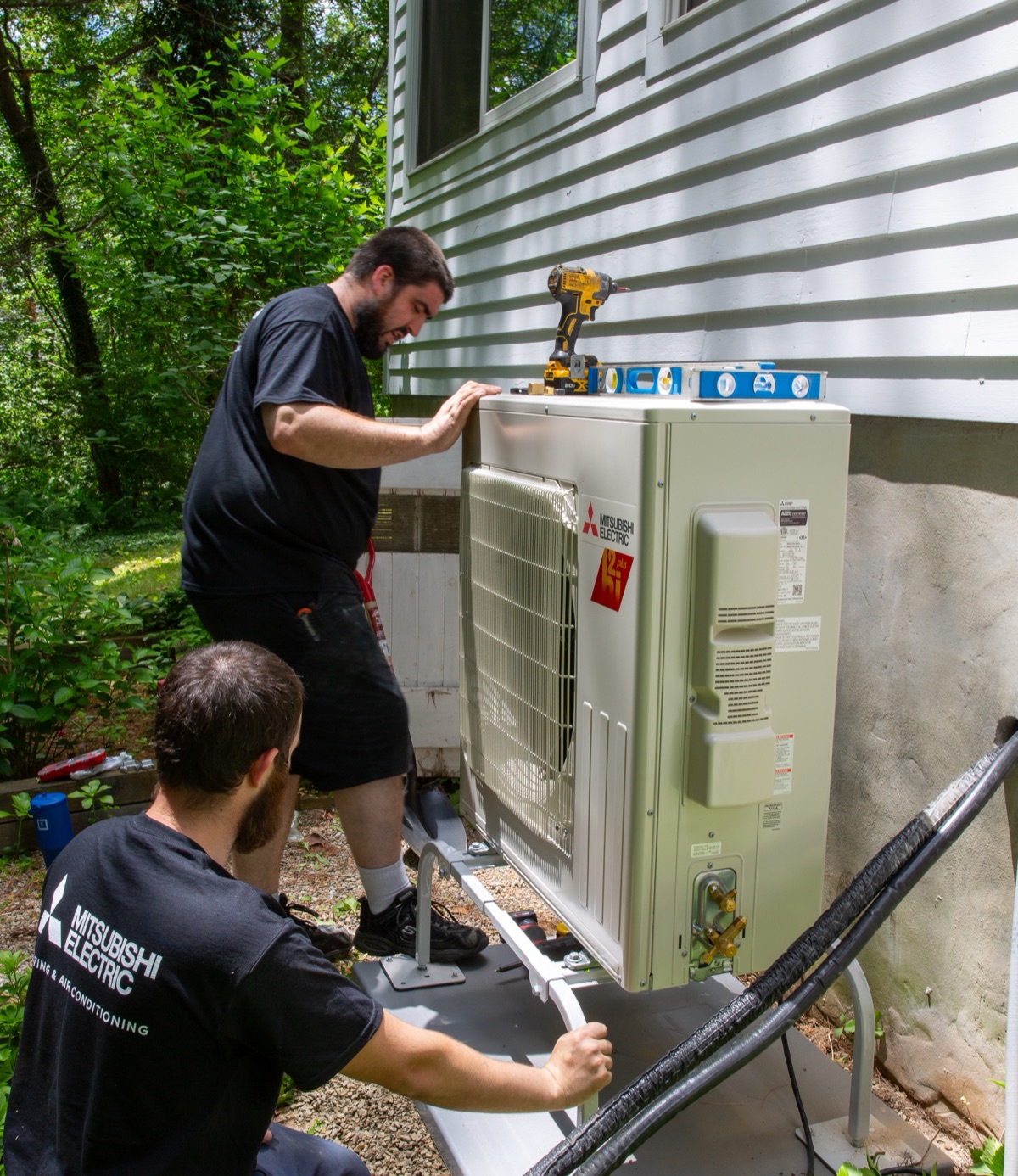
A cold-climate heat pump extracts heat from outdoor air and moves it inside. Even when it is 0F outside, there is still extractable heat in the air. Modern cold-climate units - primarily Mitsubishi in our installations - are rated to perform down to -15F, which covers all but the most extreme Maine nights.
The key metric is COP (Coefficient of Performance). At 30F outside, a cold-climate heat pump delivers roughly 3 units of heat for every 1 unit of electricity consumed. At 0F, that drops to about 1.5-2.0 COP. Even at reduced efficiency in extreme cold, the unit is still more efficient than any combustion system, which maxes out at 1:1.
A Note on the 2025 Refrigerant Change (R-454B)
If you are shopping for a heat pump in 2026, you will see a new refrigerant on the spec sheet. Under an EPA rule that took effect January 1, 2025, manufacturers stopped building new residential equipment with R-410A and moved to lower-impact refrigerants, primarily R-454B. The new refrigerant has roughly one-fourth the global warming potential of R-410A while delivering the same cold-climate heating performance.
For homeowners, the practical points are simple. New systems we install are R-454B and meet the current standard. If you already own an R-410A heat pump or AC, it is not obsolete and is legal to keep running and service, though R-410A refrigerant is getting scarcer and more expensive to buy for repairs, which is one more reason to weigh repair against replacement on an aging unit. The efficiency and rebate picture is unchanged by the switch.
Pros
- Hedge against fuel price volatility - Electricity prices in Maine are set through standard offer service and have historically been more predictable than spot-market heating fuels. A heat pump reduces exposure to fuel price spikes.
- Heating and cooling - One system handles both seasons. No separate AC needed
- Zone control - Each indoor head controls its own area independently. Heat the rooms you use, reduce output in rooms you do not
- Strong rebates - Efficiency Maine rebates range from $1,000-$3,000 per unit depending on income, up to a $9,000 lifetime maximum for income-eligible households, with a $500 whole-home bonus running through the end of 2026. Check current rebate amounts - amounts are income-dependent. Note that the federal 25C tax credit expired December 31, 2025, so for 2026 work these state rebates are the primary incentive
- No combustion - No fuel delivery, no carbon monoxide risk from the heating system, no chimney maintenance
Cons
- Upfront cost - A whole-home system typically costs $10,000-$20,000+ depending on the number of indoor heads
- Distribution - Mini-splits work best in open floor plans. Homes with many small rooms may need more heads or supplemental heat
- Extreme cold performance - Output decreases as temperature drops. On the coldest nights, supplemental heat may be needed in poorly insulated homes
Best For
Homes with oil or propane heat, open floor plans, and homeowners who want both heating and cooling. Especially strong for well-insulated homes.
High-Efficiency Condensing Boilers
How They Work
A condensing boiler burns natural gas or propane to heat water, which circulates through your existing baseboard radiators, radiant floor loops, or radiators. "Condensing" means the unit extracts enough heat from exhaust gases that water vapor in the exhaust condenses, releasing additional energy. This pushes efficiency to 95-98% AFUE, compared to 78-85% for older cast iron boilers.
Modern units are wall-hung (mounted on the wall rather than sitting on the floor), modulating (they adjust output to match demand rather than cycling on and off), and compact enough to fit in a closet.
Pros
- Uses existing distribution - If you already have baseboard or radiant floor heating, a boiler swap uses your existing piping. No new equipment on the walls, no changes to the layout
- Consistent whole-house heat - Hydronic distribution delivers even heat to every room with a radiator or radiant loop, including rooms with closed doors
- Lower upfront cost than heat pumps - A condensing boiler installation typically runs $8,000-$14,000
- Familiar technology - For homeowners not ready to switch fuel sources, a boiler upgrade is a straightforward improvement
- Modulating output - No more blast-of-heat-then-nothing cycling. The boiler adjusts to match the weather
Cons
- No cooling - A boiler heats your home only
- Requires gas or propane service - Not available for all homes
- Combustion appliance - Requires ventilation and produces CO2
Best For
Homes with existing hydronic distribution and natural gas or propane service. Especially good for larger homes with complex layouts where mini-split distribution would be challenging.
Hybrid Systems: Heat Pump + Boiler
How They Work
A hybrid approach keeps the boiler as the primary heat source and adds cold-climate heat pumps for cooling and supplemental heat. The boiler serves the hydronic distribution throughout the heating season, while the cold-climate heat pumps improve comfort in selected zones.
At Horizon Homes, we evaluate both systems together. A functioning boiler can remain in regular use while cold-climate heat pumps add cooling and supplemental warmth.
Pros
- Complementary roles - Primary boiler heat plus cooling and supplemental warmth from cold-climate heat pumps
- Gradual transition - You do not have to commit to full electrification on day one. Start with heat pumps, keep the boiler, and evaluate over a winter or two
- Maximum comfort - Zone control from heat pumps plus whole-house even heat from the boiler when needed
- Zone control - Adjust cooling and supplemental warmth in the rooms served by cold-climate heat pumps
Cons
- Higher total cost - You are maintaining two systems instead of one
- Eventual boiler replacement - The primary boiler still ages and needs a replacement plan
Best For
Homeowners who want to preserve hydronic heat while adding cooling and supplemental warmth. A hybrid system can use an existing boiler in good condition or a new high-efficiency boiler.
Heat Pump Water Heaters
How They Work
A heat pump water heater uses the same technology as a space-heating heat pump, but sized to heat domestic water instead of room air. It pulls heat from the surrounding air and transfers it to the water tank. The result is 2-3 times more efficient than a conventional electric resistance water heater.
Pros
- Major efficiency gain - Uses 60-70% less electricity than a standard electric water heater
- Rebates available - Efficiency Maine offers rebates on qualifying units. Amounts are income-dependent. Check current availability
- Bonus cooling and dehumidification - The unit pulls heat from the surrounding air, which cools and dehumidifies the space. This is a benefit in a basement, where humidity is often a problem
- Stacks with heat pump rebates - Installing a heat pump water heater alongside space heating heat pumps can maximize your total rebate package
Cons
- Needs warm air - The unit works best in spaces above 40F. Unheated garages in Maine winters are not ideal locations
- Slower recovery - Heats water more slowly than a gas water heater or electric resistance. Not ideal for households with very high hot water demand unless properly sized
- Noise - The compressor is audible, similar to a refrigerator. Location matters
Best For
Homes already installing cold-climate heat pumps (package the projects together for maximum rebates). Homes with electric water heaters looking to cut water heating costs. Homes with basement humidity issues where the dehumidification benefit adds value.
The Factor That Matters More Than Your Heating System
Here is something that changes the math on every option above: the condition of your building envelope.
A home that leaks air and lacks insulation forces every heating system to work harder. Air sealing and insulation reduce your heating load by 20-40%, which means:
- A smaller (cheaper) heat pump system can heat the home
- A boiler runs less often, burning less fuel
- Your payback on any heating upgrade is faster because you are starting from a lower baseline
This is the whole-home approach we take at Horizon Homes. We evaluate the envelope first, then right-size the heating system to the improved building. The result is a smaller (cheaper) system, reduced heating load, and better comfort year-round.
How Maine's Climate Changes the Math
The heating systems above all come with performance claims that hold up in a lab. Maine conditions change how those numbers play out in practice.
Shoulder-season comfort. Cold-climate heat pumps provide supplemental warmth during mild weather and cooling in summer. In a hybrid system, the boiler remains the primary heat source throughout the heating season.
Deep-cold output curves. When temperatures drop below 5F, every heat pump's output decreases along a published curve. Mitsubishi Hyper-Heating units hold most of their rated capacity down to -13F, which covers all but a handful of nights per winter in Greater Portland. On the coldest nights in a poorly insulated home, supplemental heat may still be needed. In a well-insulated home, the rated cold-weather output is usually enough without help.
Envelope is the lever. The same heat pump behaves differently in two houses. In a tight, well-insulated home, a 3-ton system heats reliably through every Maine winter. In a leaky, under-insulated home, that same system struggles below 20F and the homeowner blames the equipment. Insulation and air sealing are not a separate project - they change how every heating option performs. This is why we assess the envelope first and size the heating system to the improved building.
How to Choose
The right system depends on your specific house, your existing infrastructure, your budget, and your goals. There is no single correct answer.
A few questions that help narrow it down:
- What fuel do you heat with now? Each fuel has multiple upgrade paths. Oil homeowners can replace oil with heat pumps, switch to a propane or NG condensing boiler where service is available, or add heat pumps as a hybrid alongside the existing oil boiler. Propane and natural gas homeowners can upgrade to a high-efficiency condensing boiler, add heat pumps for cooling and zone control, or do both. We walk through every option during a free assessment - we do not lead with one fuel answer.
- What distribution do you have? Existing baseboard or radiant favors a boiler upgrade or hybrid. Forced air or no existing distribution points toward heat pumps
- Do you want cooling? If yes, heat pumps are the only option that provides both
- What is your budget? Boiler upgrades are typically lower upfront cost. Heat pumps have higher installation costs but qualify for larger Efficiency Maine rebates. We quote both paths in a free assessment so you can compare net cost for your specific home.
- How long do you plan to stay? A full heat pump conversion is a multi-year commitment - rebates are realized upfront, and cooling and comfort benefits accrue every summer. A high-efficiency boiler upgrade is a more contained project that delivers immediate efficiency gains within the existing distribution system. Both paths make sense depending on timeline and scope.
Radiant Heat vs Heat Pumps: A Common Question
Radiant floor heating is the system most homeowners say they wish they had. Even whole-house warmth, nothing visible on the walls, no air movement, completely silent. It is a beautiful system when the conditions are right for it.
The conditions are: a new build, a full gut renovation, or a major addition where you can install the tubing as part of the floor assembly. Retrofitting radiant into an existing home usually means tearing up floors, which rules it out for most projects.
That is where cold-climate heat pumps fit. Mini-splits retrofit into existing homes without tearing up a single floor, they add cooling as a bonus, and they deliver zone-by-zone control that radiant cannot match. A bedroom can run at 68F for sleeping while the home office runs at 72F for working - radiant floors hold the whole house at a single temperature.
For a new construction or a full renovation with the floors already open, radiant is still a strong choice - especially paired with a high-efficiency condensing boiler on an existing gas or propane line. For every other project, a heat pump is the more practical path. We install both, and we pick based on what the house allows.
Get a Clear Picture of Your Options
Bring your heating questions to a free energy assessment. Request a home visit to discuss your existing system, whether you want cooling, and which improvements to prioritize. The visit is a visual walkthrough only, with no diagnostic testing or obligation. We consider your insulation and air sealing alongside your heating options.
Still comparing options? Contact our team about your heating plans or call (207) 221-3221. We install cold-climate heat pumps and high-efficiency natural gas and propane heating systems in Greater Portland.
Find our guides faster: add Horizon Homes as a preferred source on Google.
Free Home Energy Assessment
Ready to Lower Your Energy Bills?
We identify the improvements that will have the biggest impact on your home's energy use, with clear pricing and rebate estimates.
- Free walkthrough, no equipment, no disruption
- Efficiency Maine rebates identified for you
- Written improvement plan with pricing
Schedule Your Free Assessment
We call within 1 business day.