What Is a Deep Energy Retrofit? A Guide for Maine Homes
Editor's note (October 2026): Efficiency Maine changed its insulation and air sealing rebates for work completed on or after October 1, 2026. They are now a fixed amount per zone of the house (attic, walls, basement) instead of a percentage of project cost, so the insulation rebate figures, combined totals, and cost examples below reflect the program when this article was published. See current Efficiency Maine rebates.
Almost every Maine home built before 1980 has the same profile: minimal insulation, no real air sealing, an oversized heating system, and annual fuel costs that climb every year. A single upgrade helps, but it does not solve the problem. What those homes need is a deep energy retrofit: not one improvement, not a phased plan stretched over five years, but a full, coordinated transformation of the building envelope and mechanical systems in one project.
What Makes It "Deep"
A standard energy improvement targets one or two things. You add attic insulation. You install a heat pump. Each upgrade helps, but the house still has other weak points pulling performance down.
A deep energy retrofit addresses the entire building envelope and mechanical systems together. The goal is to reduce a home's energy consumption by 50 percent or more, sometimes up to 75 or 80 percent. That requires working on everything at once so each improvement supports the others.
A typical deep energy retrofit in a Maine home includes:
- Complete air sealing of the building envelope, from basement to attic, including all penetrations, bypasses, and transitions
- Full insulation upgrade to current or above-code levels (R-50 in the attic, R-21 or higher in walls, R-20 or higher in the basement)
- Window and door assessment (sometimes replacement, often not, because air sealing addresses most window-related comfort issues)
- Heating system replacement with properly sized, high-efficiency equipment (cold-climate heat pumps, high-efficiency boilers, or both)
- Hot water upgrade to a heat pump water heater
- Mechanical ventilation to maintain healthy indoor air quality in the tightened envelope
- Electrical panel upgrade if the existing panel cannot support new equipment
Who Is This For?
Not every homeowner needs a deep energy retrofit. It makes the most sense when:
Your home was built before 1980. Homes from this era typically have minimal insulation, no air sealing, and oversized heating systems. The gap between current performance and modern standards is large enough that a deep retrofit delivers outsized returns.
You are planning to stay in the home long-term. The upfront investment is higher than piecemeal upgrades, but the payback compounds year after year. Homeowners who plan to be in their home for 10 or more years see the full financial benefit.
You are already planning major renovation work. If walls are being opened for a kitchen remodel or addition, the marginal cost of insulating and air sealing those cavities drops. Coordinating energy work with renovation work saves money on both.
Your heating costs are extreme. Homes spending $4,000 to $8,000 per year on heating oil or propane are strong candidates. A deep retrofit can cut that by half or more, creating significant annual savings.
You want to reduce your environmental footprint. A deep energy retrofit combined with electrification (heat pumps replacing fossil fuel systems) is the single most effective action a homeowner can take to lower household carbon emissions.
Schedule a free energy assessment and we will evaluate your home's current performance and tell you whether a deep retrofit makes financial sense.
What the Process Looks Like
A deep energy retrofit is more involved than a standard insulation or heat pump project, but the process follows the same principles we use on every job. Here is how it typically unfolds:
Assessment and Planning
We start with a thorough walkthrough of your home. We look at every surface of the building envelope, evaluate the existing insulation and air sealing, assess the heating system, and identify moisture and ventilation concerns.
From that assessment, we build a scope of work. The plan prioritizes the improvements in the order that delivers the most impact and ensures each piece of work supports the next.
Air Sealing and Insulation
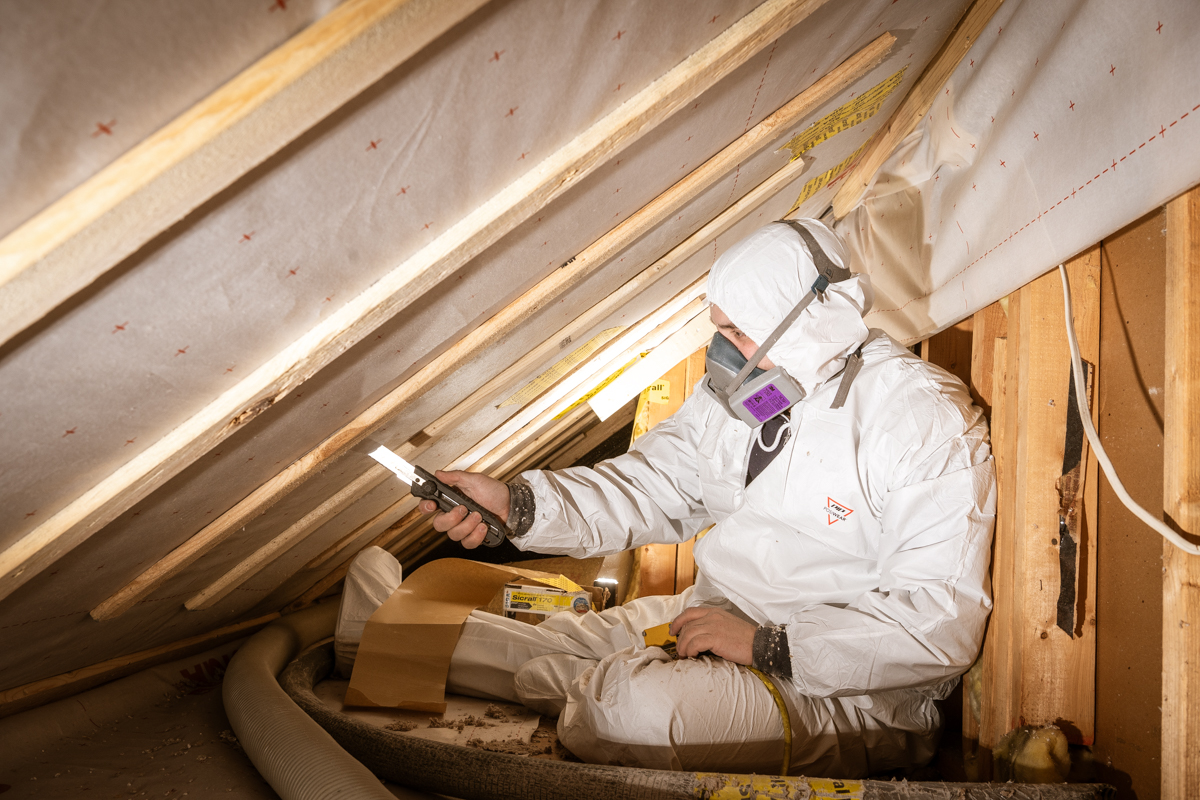
This is the foundation. Before any mechanical systems get replaced, the building envelope needs to perform. We seal every penetration and bypass in the attic floor, rim joists, and basement. Then we insulate to target levels.
For attic retrofits, we install blown-in cellulose to R-50. For walls, we dense-pack cellulose into existing cavities. For basements, we use rigid foam board on flat concrete walls and coordinate closed-cell spray foam for rubble or stone walls.
We use blower door testing at the beginning and end of the air sealing work to measure the improvement and identify any remaining leakage points.
Mechanical System Replacement
With the envelope tight and well-insulated, we size the new heating system to match the home's reduced heat loss. This is where the deep retrofit pays off mechanically. A home that needed an 80,000 BTU boiler before the envelope work might only need 40,000 BTU after. That means a smaller, less expensive, more efficient system.
Heating options include a whole-home cold-climate heat pump system or a hybrid setup with a high-efficiency boiler as the primary heat source and cold-climate heat pumps for cooling and supplemental heat.
Ventilation
A tight home needs controlled ventilation. We typically install an HRV (heat recovery ventilator) that brings in filtered fresh air while recovering 70 to 85 percent of the heat from outgoing air. Ventilation is not optional after a deep retrofit. It is part of the plan from day one.
Electrical
If the electrical panel needs capacity for heat pumps, a heat pump water heater, and an HRV, we coordinate that upgrade as part of the project.
What It Costs
A deep energy retrofit for a typical 2,000 to 2,500-square-foot Maine home ranges from $25,000 to $50,000 before rebates. The wide range reflects differences in home size, condition, scope of heating system replacement, and whether window or electrical work is included.
Efficiency Maine rebates apply to insulation, air sealing, heat pumps, and heat pump water heaters. Each program pays separately, by income tier: insulation and air sealing up to $8,600 per home ($5,600 per mobile home), and heat pumps up to $9,000. We apply all rebates directly to your invoice.
Editor's note (March 2026): Rebate amounts in this article reflect conditions at the time of publication. See current rebates.
Financing through Efficiency Maine's Green Bank is available at rates starting at 0% APR for bridge loans and 5.99% for five-year terms. Both programs are unsecured, meaning no lien on your home.
The payback timeline depends on your current energy costs, but homeowners spending $4,000 or more annually on heating typically see the net project cost (after rebates) paid back in 5 to 8 years through energy savings alone. That does not account for increased home value, reduced maintenance, or improved comfort.
Deep Retrofit vs. Phased Approach
We are honest about this: a deep energy retrofit is not the right choice for every homeowner. Many people benefit more from a phased approach, tackling the highest-impact improvements first and adding more over time.
The advantage of a deep retrofit is that everything is designed and installed as a system. The insulation, air sealing, heating, and ventilation all work together from day one. There is no period where a heat pump is fighting a leaky house or insulation is trapping moisture without ventilation to manage it.
The advantage of a phased approach is lower upfront cost and the ability to spread the investment over several years. We are happy to help homeowners plan either path.
See What Is Possible for Your Home
Whether you are thinking about a full deep energy retrofit or just want to understand what your home needs most, the first step is the same.
Schedule your free energy assessment and we will walk through your home, identify every opportunity for improvement, and help you decide the right approach for your goals and budget. Or call us at (207) 221-3221.
Find our guides faster: add Horizon Homes as a preferred source on Google.
Free Home Energy Assessment
Ready to Lower Your Energy Bills?
We identify the improvements that will have the biggest impact on your home's energy use, with clear pricing and rebate estimates.
- Free walkthrough, no equipment, no disruption
- Efficiency Maine rebates identified for you
- Written improvement plan with pricing
Schedule Your Free Assessment
We call within 1 business day.