Your Heating Bill Was $1,200 Last Month. Here Is Where That Money Went.
Editor's note (March 2026): Rebate amounts referenced in this article are approximate and income-dependent. See current Efficiency Maine rebates for details specific to your household.
Twelve hundred dollars for a single month of heat. If you burn oil in Maine, you have seen that number on a bill at least once this winter. At $4.50 to $5.00 per gallon, a 275-gallon tank fill runs $1,200 to $1,375. Many homes go through two or three fills between November and March.
But here is the question most homeowners never ask: where is all that heat going? Your boiler or furnace generates it. Your radiators or baseboards distribute it. And then a significant percentage of it escapes through your walls, attic, basement, and air leaks before it ever warms your living space.
At Horizon Homes, we have performed hundreds of energy assessments across Greater Portland over the past 20+ years. The patterns are consistent. Heat loss follows predictable paths, and understanding those paths is the first step toward spending less.
The Heat Loss Breakdown
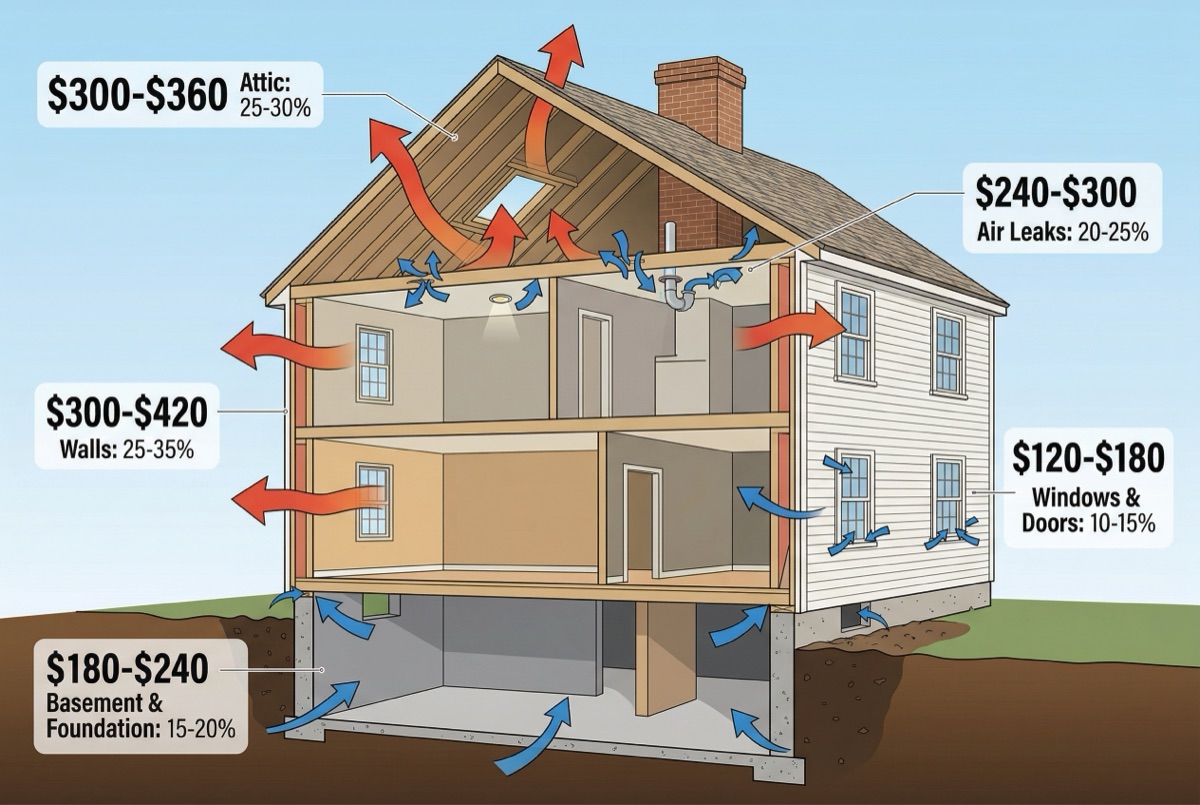
Every home is different, but the proportions in a typical unimproved Maine home fall into consistent ranges. Here is where your $1,200 heating bill is going.
The Attic: 25-30% ($300-$360 of your bill)
Heat rises. In a home with inadequate attic insulation, a large share of your heating dollars go straight up through the ceiling and into the attic, where they warm your roof instead of your rooms.
Most Maine homes built before 1990 have 3 to 6 inches of insulation in the attic. The current recommendation for Maine's climate zone is R-50, which requires roughly 14-15 inches of blown-in cellulose. The gap between what most homes have and what they should have represents the single largest opportunity to reduce heat loss.
Why it matters: The attic is also the easiest and most cost-effective area to insulate. It is open, accessible in most homes, and the work can often be completed in a single day.
Exterior Walls: 25-35% ($300-$420 of your bill)
Your walls are the largest surface area separating inside from outside. In many older Maine homes, the wall cavities have minimal insulation, sometimes none at all. Even homes with original batt insulation often have gaps, compression, and settling that reduce the effective R-value well below what the label says.
Dense-pack cellulose is the best retrofit option for existing walls. It fills the cavity completely, resists settling, and can be installed by drilling small holes from the exterior without tearing open the interior walls.
Why it matters: Wall insulation is a bigger project than attic work, but the payoff is substantial. Walls account for the largest heat loss surface in most two-story homes.
Air Leaks: 20-25% ($240-$300 of your bill)
This is the one that surprises most homeowners. Air leakage - the uncontrolled flow of air through gaps, cracks, and penetrations in your home's envelope - accounts for roughly a quarter of heat loss in a typical older home. And unlike conductive heat loss through walls and ceilings, air leaks move heat fast.
The biggest culprits:
- Attic floor penetrations: Gaps around wiring, plumbing, chimneys, and recessed lights allow warm air to flow directly into the attic
- Basement rim joists: The band of framing where your foundation meets the first floor is one of the leakiest areas in most homes
- Recessed can lights: Older non-IC-rated fixtures are essentially open holes in your ceiling
- The attic hatch: An unweathered attic hatch leaks as much air as leaving a window open year-round
- Electrical outlets and switch plates on exterior walls: Small individually, but they add up across a whole house
Why it matters: Air sealing is the highest-ROI improvement you can make. It is relatively inexpensive, and it makes your insulation work better because insulation loses effectiveness when air moves through or around it.
The Basement and Foundation: 15-20% ($180-$240 of your bill)
Heat loss through the basement happens in two ways. First, the concrete or stone foundation conducts heat directly to the cold ground. Second, the rim joist area (where the framing sits on the foundation) is typically uninsulated and leaky.
For finished basements or those used as living space, insulating the foundation walls with polyiso rigid foam makes a measurable difference. For unfinished basements, the priority is sealing and insulating the rim joist area, which is where most of the heat loss concentrates.
Why it matters: Basement improvements are often bundled with attic work to maximize Efficiency Maine rebates. Addressing both the top and bottom of your home's envelope delivers the biggest overall improvement.
Windows and Doors: 10-15% ($120-$180 of your bill)
Windows get blamed for a lot of heat loss, and they do contribute. But in most homes, they account for a smaller share than homeowners expect. A single-pane window has an R-value of about 1. A modern double-pane window sits around R-3. Neither is great, but the total area of windows is small compared to your walls and attic.
Why it matters: Replacing windows is expensive ($500-$1,500 per window) and delivers a modest return compared to insulation and air sealing. In most cases, improving the insulation and air sealing around windows - and in the walls and attic above and below them - solves the comfort issues homeowners attribute to the windows themselves.
Which Fixes Have the Best ROI?
Not every improvement delivers the same return. Here is how the common energy efficient home improvements rank based on what we see in Greater Portland homes.
Tier 1: Best Return (do these first)
Attic air sealing + insulation to R-50. This combination addresses two of the top three heat loss categories at once. Cost for a typical 1,500-square-foot attic ranges from $4,000 to $8,000 before rebates. Many homeowners see 20-40% reductions in heating costs.
Rim joist air sealing and insulation. Targeted, affordable, and often completed as part of the attic project. Typical cost is $1,000 to $2,500.
Tier 2: Strong Return
Dense-pack wall insulation. A bigger investment ($5,000 to $10,000 for a full house) but addresses 25-35% of your heat loss. The payback period is longer, but the comfort improvement is immediate.
Cold-climate heat pump installation. Switching from oil to a cold-climate heat pump can cut heating costs by 40-60%, depending on the home. Best results come after the envelope is improved first, which allows you to right-size the system and avoid overspending on equipment. See our guide on the whole-home approach for why sequencing matters.
Tier 3: Moderate Return
Basement wall insulation. Worth doing if you use your basement as living space or plan to. Otherwise, prioritize the rim joists and attic.
Window replacement. Usually not cost-justified purely for energy savings. Consider it when your windows are failing (broken seals, rotted frames) rather than as an energy upgrade.
A Real Example
A 1,800-square-foot Colonial in Scarborough was spending $3,800 per year on heating oil. After an energy assessment, we identified:
- Attic insulation at R-11 (should be R-50)
- No air sealing in the attic
- Rim joists uninsulated
- Wall insulation sparse and settled
Phase 1: Attic air sealing + blown cellulose to R-50, plus rim joist insulation. Cost: $6,200 before rebates. Heating bill dropped to $2,600 per year - a $1,200 annual savings.
Phase 2 (the following year): Dense-pack cellulose in exterior walls. Cost: $7,500 before rebates. Heating bill dropped to $2,100 per year - another $500 in annual savings.
Total investment after Efficiency Maine rebates: approximately $8,700. Annual savings: $1,700. Payback: just over five years. And the home went from drafty and uneven to comfortable in every room.
Stop Paying to Heat the Outdoors
Every dollar on your heating bill represents heat that either stayed in your home or escaped through one of these paths. The good news is that the biggest sources of loss are also the most fixable.
You don't need to do everything at once. A phased approach, starting with the highest-ROI improvements, lets you see results immediately while spreading the investment over time.
Start With an Assessment
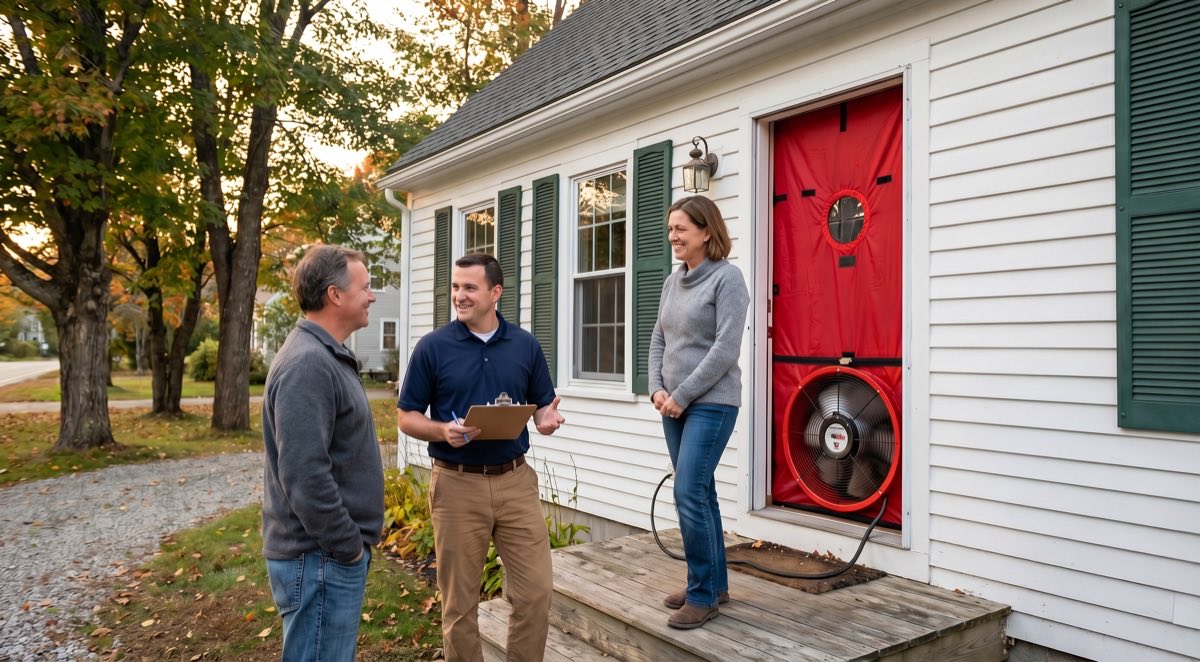
A free energy assessment from Horizon Homes is a visual walkthrough of your home, 1-3 hours, where our advisor checks your insulation, identifies air leaks, evaluates your heating system, and maps out a prioritized plan.
As a Top-Rated Efficiency Maine Vendor for 10+ years, we handle the rebate paperwork and help you understand which improvements deliver the best return for your specific home.
Schedule Your Free Energy Assessment
Or call us at (207) 221-3221. We have been helping Greater Portland homeowners cut their heating bills since 2006, and we would be glad to show you where your money is going and how to keep more of it.
Find our guides faster: add Horizon Homes as a preferred source on Google.
Free Home Energy Assessment
Ready to Lower Your Energy Bills?
We identify the improvements that will have the biggest impact on your home's energy use, with clear pricing and rebate estimates.
- Free walkthrough, no equipment, no disruption
- Efficiency Maine rebates identified for you
- Written improvement plan with pricing
Schedule Your Free Assessment
We call within 1 business day.