Do Heat Pumps Work in Maine Winters? What the Data Says
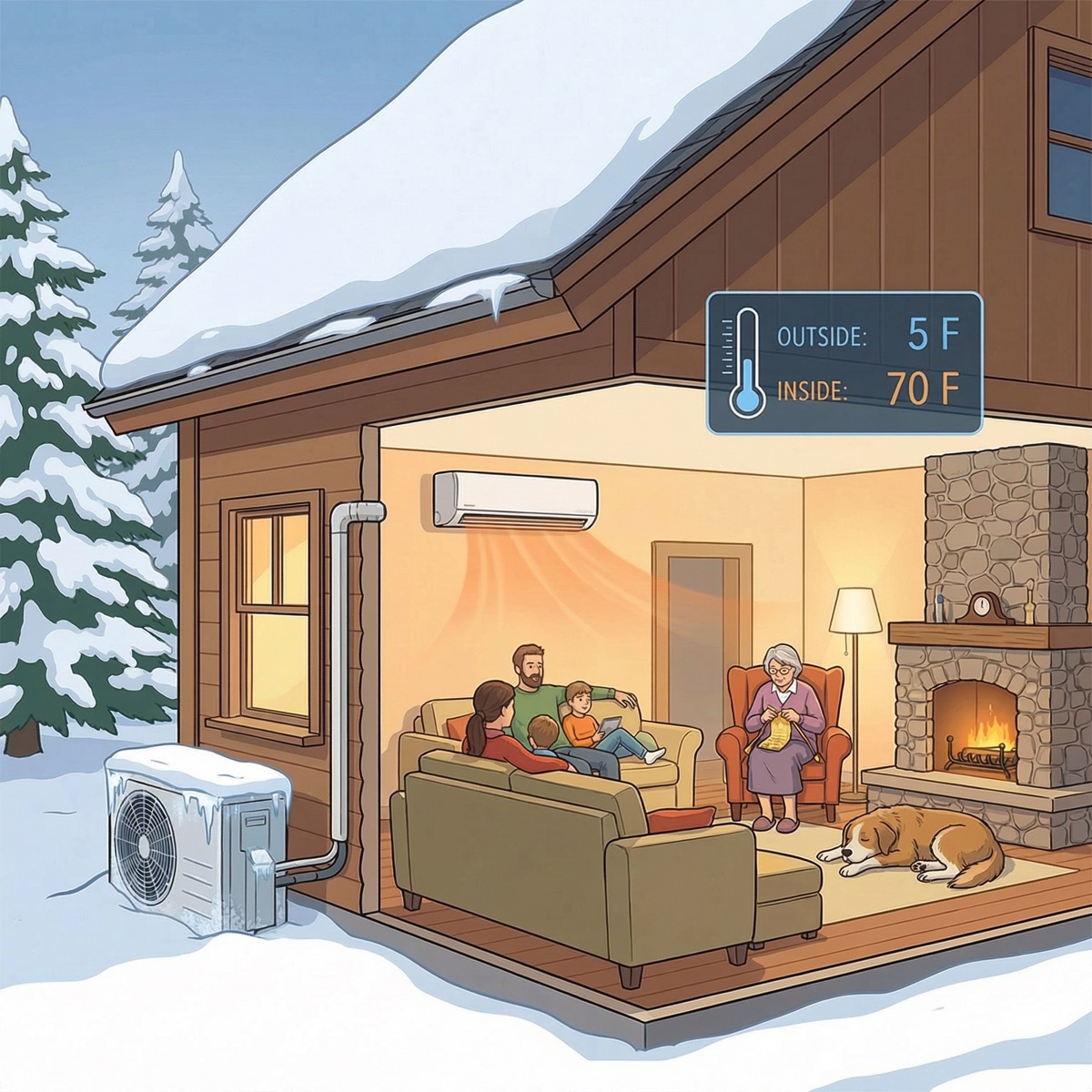
143,000 heat pumps are already running in Maine. Here’s what the data shows.
It’s the most common question we hear: “Do heat pumps really work when it’s negative ten outside?” Fair question. Maine isn’t North Carolina. We get extended stretches below zero, and a heating system that can’t keep up isn’t just uncomfortable. It’s dangerous.
The good news is that this question has been thoroughly tested, not in a lab, but in actual Maine homes, through actual Maine winters. Let’s look at what the data says.
The RAP/Efficiency Maine Field Study
In 2021, the Regulatory Assistance Project (RAP) and Efficiency Maine partnered with DNV to meter 10 Maine homes using heat pumps as their primary heat source through a full winter. The results:
- 7 out of 10 homes didn’t use supplemental heating at all. The heat pump carried the entire winter load.
- All 10 participants reported being “satisfied” or “very satisfied” with comfort.
- Homeowners consistently praised the “evenness of heat” with no hot-and-cold cycling like oil systems.
- One participant said they stayed “toasty even as temperatures dropped well below zero.”
This wasn’t a marketing study. It was an independent field validation with metered data from real homes.
How Cold-Climate Heat Pumps Perform at Every Temperature
Modern cold-climate heat pumps don’t just “still run” in the cold. They maintain impressive efficiency well below freezing. Here’s what the performance curve looks like:
Outside Temperature | COP (Efficiency) | What That Means |
47°F (fall day) | 3.5 – 4.0 | 350-400% efficient. 3.5-4x more heat than electricity consumed. |
32°F (freezing) | 2.8 – 3.5 | Still nearly 3x more efficient than electric resistance. |
5°F (cold Maine night) | 2.2 – 2.8 | Producing nearly 3x more heat than the electricity it draws. |
-5°F | 2.0 – 2.5 | Still 2x more efficient than any combustion system. |
-15°F (extreme cold) | 1.8 – 2.4 | Reduced capacity but still producing more heat than electricity input. |
-22°F (rated minimum) | ~1.5 | Operating at reduced output. Backup heat may be needed for comfort. |
The key takeaway: even at 5°F (a temperature Portland hits regularly in January and February) a cold-climate heat pump is delivering nearly three times more heat than the electricity it uses. Your oil boiler can’t match that efficiency at any temperature.
But What About the “40% Gap”?
Here’s where honesty matters. A 2024 Efficiency Maine impact evaluation found that average heat pump performance delivered about 40% less heating energy than expected. Sounds alarming, right?
Dig into the data, and the picture changes: about 50% of homeowners shut off their heat pumps at 15°F, and 70% shut off by 1°F. The technology performed fine. The operators didn’t trust it.
Many of these homeowners had older, non-cold-climate models or had been told by well-meaning friends and family that heat pumps “don’t work in the cold.” So they switched to backup heat long before they needed to. The homes in the study that kept their heat pumps running through the cold performed as expected.
The lesson: three things matter as much as the heat pump itself: equipment selection, homeowner education, and insulation.
The Insulation Factor: Why It Changes Everything
This is something most heat pump discussions overlook entirely: the condition of your home’s insulation has a direct impact on how well your heat pump performs and how comfortable you feel.
Here’s the building science: your body doesn’t just sense air temperature. You’re actually more sensitive to mean radiant temperature, which is the average temperature of the surfaces around you (walls, ceiling, floor, windows). If those surfaces are cold because the walls and ceiling are poorly insulated, you’ll feel cold even if the air temperature is 70°F. You’ve probably experienced this standing near a large window in winter. The air in the room is warm, but you feel a chill radiating from the cold glass.
The same thing happens with under-insulated walls and ceilings. A heat pump can bring the air to 70°F, but if the wall surface behind you is 55°F because there’s minimal insulation, your body registers the average of those temperatures. You feel cold, so you crank the thermostat higher, the heat pump works harder, and you conclude that heat pumps “don’t keep up.”
In a well-insulated home, the wall and ceiling surfaces stay close to the air temperature. At 70°F air with properly insulated R-50 walls and ceiling, the surface temperatures might be 67-69°F. Your body reads an average closer to 69°F, and you feel genuinely warm and comfortable. The heat pump runs less, uses less electricity, and maintains even comfort throughout the house.
This is why we take a whole-home approach: insulate and air seal first, then install the heat pump. A heat pump on a leaky, under-insulated house will work harder, cost more to run, and leave you less comfortable. A heat pump on a properly insulated house performs the way the technology is designed to. It’s the same equipment with a completely different result.
We install Mitsubishi Hyper-Heat systems (rated for cold-climate performance) and walk every customer through how to use them properly. But we also make sure the building envelope is right before the heat pump goes in. That’s the difference between a system that disappoints and one that exceeds expectations.
143,000 Heat Pumps in Maine and Counting
Maine hit its goal of 100,000 installed heat pumps two years ahead of schedule. By the end of 2024, over 143,000 heat pumps were running in Maine homes. Governor Mills set a new target: 275,000 by 2027.
For context, Nordic countries like Sweden, Finland, and Norway, with climates as cold or colder than Maine, have 40+ heat pumps per 100 households. The technology isn’t experimental. It’s been the standard heating solution in cold climates around the world for years.
In February 2026, a $450 million New England Heat Pump Accelerator launched across five states, including Maine, to expand bulk purchasing, standardize installations, and train more contractors.
What About When the Power Goes Out?
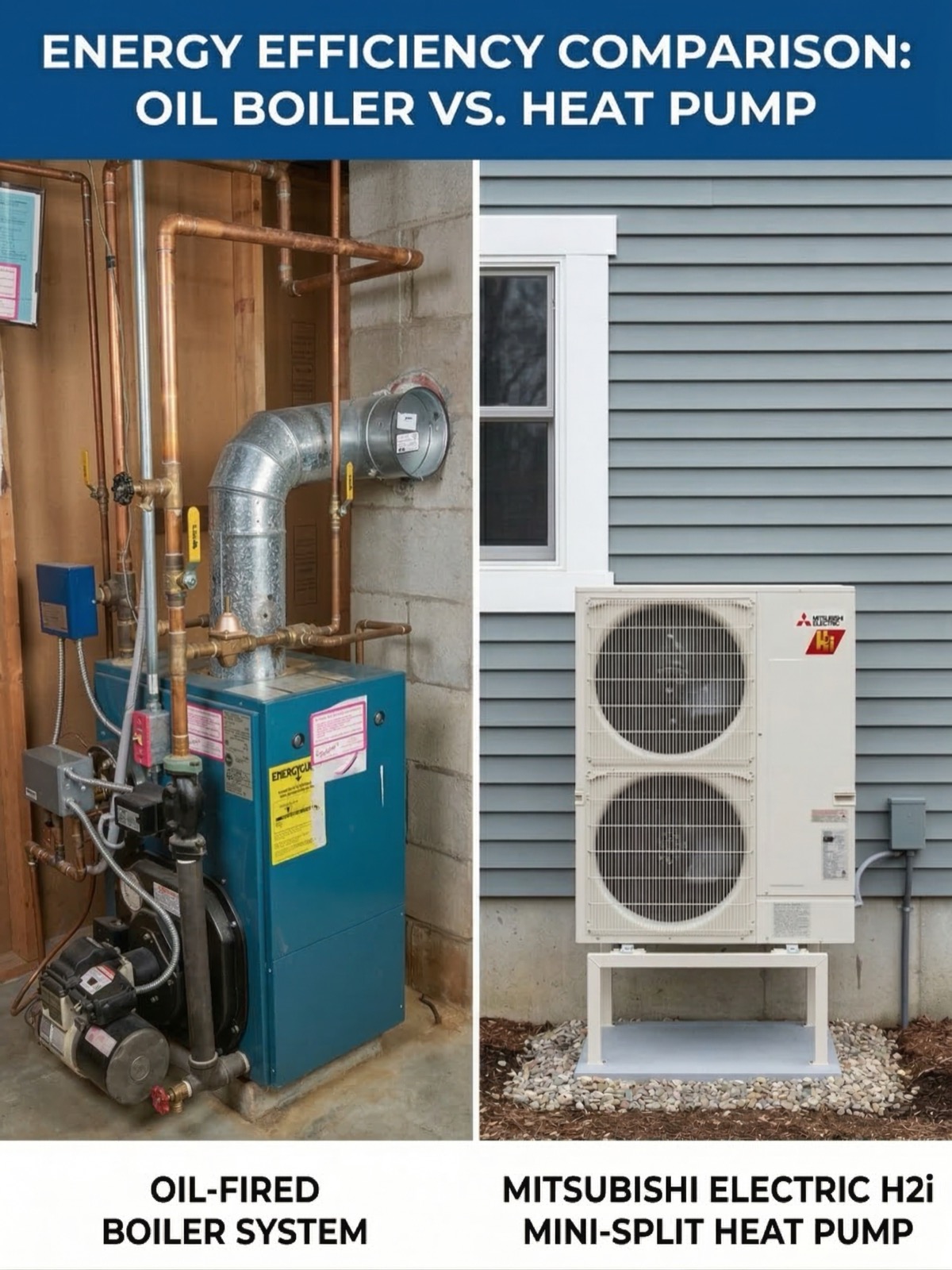
This concern comes up regularly, and it’s worth addressing directly: your oil boiler also needs electricity. It needs power for the ignition system, the circulator pump, and the fan. If the power goes out, your oil boiler doesn’t run either.
Heat pumps pair well with battery backup systems and solar panels. If energy independence is a priority, a heat pump plus solar plus battery gives you heating capability even during grid outages. Oil heat can’t offer that path.
The “Right Equipment” Piece
Not all heat pumps are cold-climate heat pumps. This is an important distinction. The ENERGY STAR cold-climate certification (updated in 2025) requires a minimum COP of 1.75 at 5°F and at least 70% heating capacity retention at that temperature.
As a Mitsubishi Diamond Contractor (the highest tier of dealer certification) we install Hyper-Heat systems specifically designed for Maine’s climate. These units are rated for continuous operation down to -22°F and maintain near-full output well below freezing. The equipment matters, and so does proper sizing and installation.
Frequently Asked Questions
{ "@context": "https://schema.org", "@type": "FAQPage", "mainEntity": }
Do heat pumps work below zero in Maine?
Yes. Cold-climate models maintain near-full capacity down to -5°F and keep operating at -22°F. In a RAP/Efficiency Maine field study, 7 out of 10 Maine homes didn’t use supplemental heat at all through winter. Proper insulation also plays a major role: well-insulated walls and ceilings keep surface temperatures warm, which directly affects comfort.
How many heat pumps are installed in Maine?
Over 143,000 by end of 2024, surpassing the 100,000 goal two years early. New target: 275,000 by 2027.
What’s the most efficient heat pump for Maine?
Look for ENERGY STAR cold-climate certified models. We install Mitsubishi Hyper-Heat systems as a Diamond Contractor, and they’re rated for continuous operation down to -22°F.
Do I need backup heat?
A whole-home cold-climate heat pump system is sized for the full heating load. In a hybrid system, the boiler remains the primary heat source and cold-climate heat pumps provide cooling and supplemental heat. Your system design determines the need for emergency heating or power.
Why do some people say heat pumps don’t work in the cold?
Two reasons: older non-cold-climate models that genuinely struggled, and homeowner behavior. A 2024 study found half of owners shut off their heat pumps at 15°F, well before the equipment needed help. Modern cold-climate units are a different animal.
See If a Heat Pump Makes Sense for Your Home
The data is clear: cold-climate heat pumps work in Maine. The question is whether they make sense for your specific home: your layout, your current system, and your goals. That’s what our free energy assessment answers.
Find Out What the Numbers Look Like for Your Home
We’ll assess your home’s heating needs, review your current system, and give you a straight answer about whether a heat pump is the right move. Including all available Efficiency Maine rebates.
Book Your Free Heat Pump Assessment or call us at (207) 221-3221.
Find our guides faster: add Horizon Homes as a preferred source on Google.
Free Home Energy Assessment
Considering Heat Pumps for Your Home?
We evaluate your home's insulation, heating system, and electrical capacity, then give you a clear recommendation with pricing and rebate estimates.
- Free walkthrough, no equipment, no disruption
- Efficiency Maine rebates identified for you
- Written improvement plan with pricing
Schedule Your Free Assessment
We call within 1 business day.