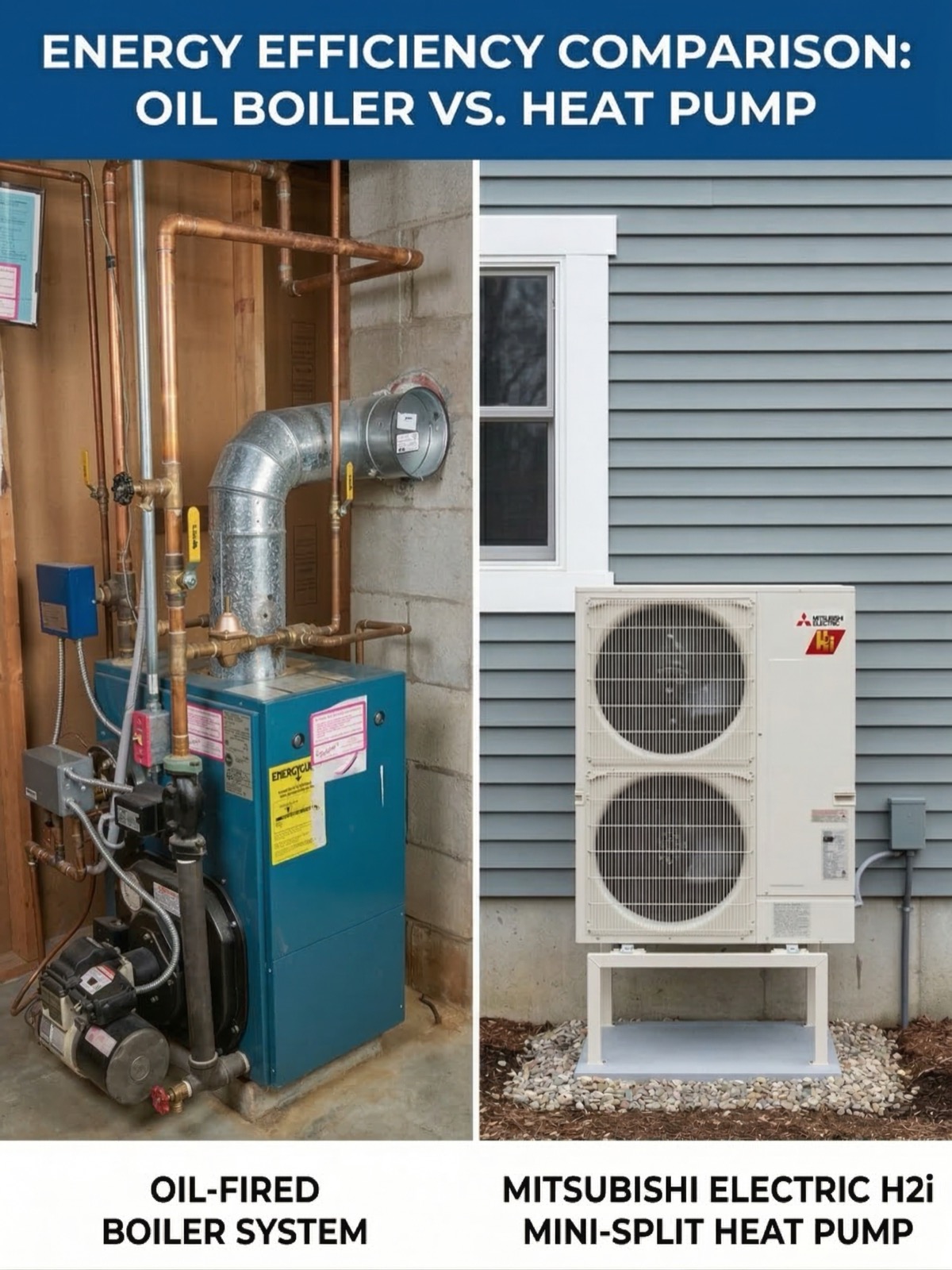
Not Ready for a Heat Pump? Try a Boiler Instead
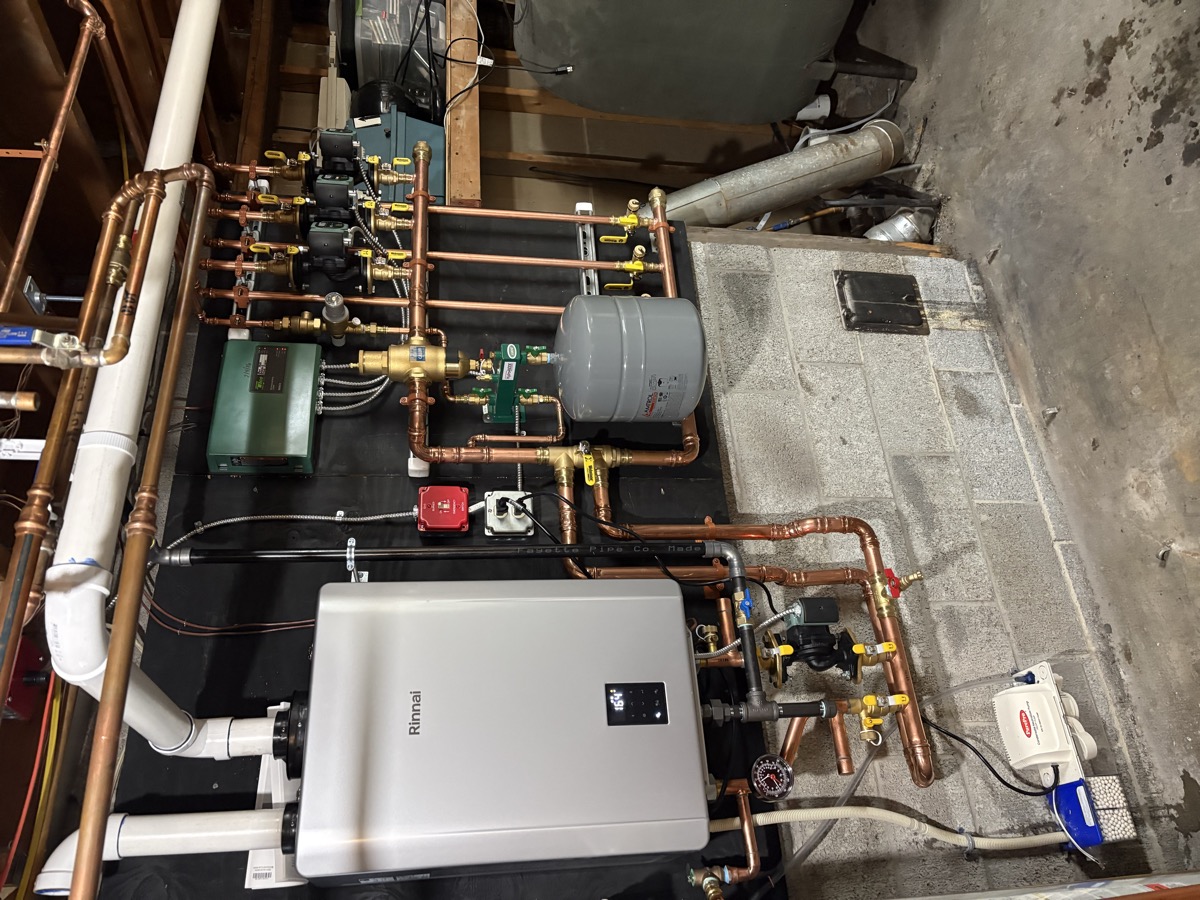
Not every home needs a heat pump today. Some homes are better served by a boiler upgrade first. The math is often straightforward once you look at the whole picture.
Take a home we commonly see: well-insulated attic and walls, a working baseboard hydronic system, and a 25-year-old cast iron boiler running at 80% efficiency. Cold-climate heat pumps would work in that home. But given the existing hydronic distribution, the comfort preferences of the occupants, and a typical upgrade budget, a wall-hung condensing boiler is often the better move. Going from 80% to 95%+ efficiency, keeping the radiant heat the family prefers, cutting fuel costs by roughly 20%, all without touching a single baseboard.
When a Boiler Makes More Sense
Cold-climate heat pumps are the future of heating in Maine. We install them regularly, and they perform well even in our coldest weather. But there are situations where a high-efficiency boiler is the more practical choice:
You have a working hydronic system you like. If your home has baseboard radiators, radiant floor heat, or a hydro-air handler, that distribution system has value. Replacing a boiler keeps all of it in place. Switching to heat pumps means adding wall-mounted heads or ductwork, which changes the look and feel of your rooms.
Your old boiler is failing and you need heat now. A boiler swap can happen in a day. A whole-home heat pump installation takes longer to plan, size, and install, especially if your home needs insulation work first (and it usually does). If your boiler dies in January, a new condensing unit gets you back up fast.
Your budget is limited. A wall-hung condensing boiler installed on existing piping costs less than a whole-home cold-climate heat pump system. If the budget only stretches so far, upgrading the boiler and putting the remaining funds toward insulation and air sealing often delivers better total savings.
You are on natural gas. Natural gas is the lowest-cost heating fuel in Maine right now. A 95% efficient condensing boiler burning natural gas is competitive with heat pump operating costs in many scenarios, especially in older homes with higher heat loads.
What Changed in Boiler Technology
If your mental image of a boiler is a hulking cast iron unit in the basement, the modern version will surprise you. Wall-hung condensing boilers are:
- 95-98% AFUE efficient versus 80-85% for standard cast iron boilers. That means 15-18 cents of every fuel dollar that used to go up the chimney now heats your home.
- Modulating, meaning they adjust their output to match the actual heat demand. Old boilers run at full blast, overshoot, shut off, and repeat. Condensing boilers throttle down to 20-30% capacity on mild days and ramp up only when needed.
- Compact. They mount on a wall, freeing up floor space. The venting is PVC through a sidewall, so you do not need a chimney.
- Available in natural gas and propane (LP) models. Same unit, different gas valve.
The efficiency gain is not theoretical. On a $3,500 annual fuel bill, going from 80% to 95% efficiency saves roughly $550 per year. That is real money, and the boiler pays for itself over its lifespan.
The Honest Comparison: Boiler vs. Cold-Climate Heat Pump
We install both systems. Here is how we think about the decision:
Operating cost: Cold-climate heat pumps typically cost less to operate than any combustion system, including a condensing boiler, because they move heat rather than create it. A heat pump delivering a COP of 2.5 effectively gets 250% "efficiency" from each unit of electricity. But this advantage narrows when electricity rates are high relative to gas prices, or when the home has a high heat load and the heat pump relies on backup resistance heat during the coldest stretches.
Comfort: This is personal. Some homeowners prefer radiant heat from baseboards or in-floor systems. Others like the flexibility of heat pumps that also provide air conditioning in summer. Neither is wrong.
Upfront cost: A boiler replacement on existing piping runs $8,000-$14,000 installed, depending on the unit and venting complexity. A whole-home cold-climate heat pump system (3-4 indoor units, 1-2 outdoor units) typically runs $18,000-$30,000 before rebates.
Rebates: Efficiency Maine offers rebates for cold-climate heat pumps (up to $9,000 for ducted whole-home systems, income-dependent). There are currently no Efficiency Maine rebates for boiler replacements. This tilts the math toward heat pumps for many homeowners, but it does not erase the other factors.
Schedule a free energy assessment and we can walk through both options for your specific home. There is no pressure toward one system or the other.
The Staged Approach: Boiler Now, Heat Pump Later
For many Maine homeowners, the best path is not either/or. It is both, in the right order.
Here is a common sequence we recommend:
Year 1: Insulate and air seal the home. Reduce the heating load so any system you install can be smaller and more efficient. Attic insulation to R-50, basement rim joists, and air sealing are the priority.
Year 1 or 2: Replace the failing boiler with a wall-hung condensing unit. Your fuel bills drop immediately. Your existing distribution stays in place.
Year 3-5: Add cold-climate heat pumps for cooling and supplemental heat. Because the home is now well-insulated, you need fewer indoor units and the system runs more efficiently. The boiler remains the primary heat source.
This staged approach spreads the cost over time, maximizes Efficiency Maine rebates at each step (weatherization rebates for the insulation, heat pump rebates for the heat pump), and avoids the trap of installing a heat pump in a poorly insulated home where it has to work twice as hard.
What We Install
Horizon Homes installs wall-hung condensing boilers from major manufacturers in both natural gas and propane configurations. We handle the full scope: removing the old boiler, installing the new unit, upgrading venting to PVC sidewall, and testing the system.
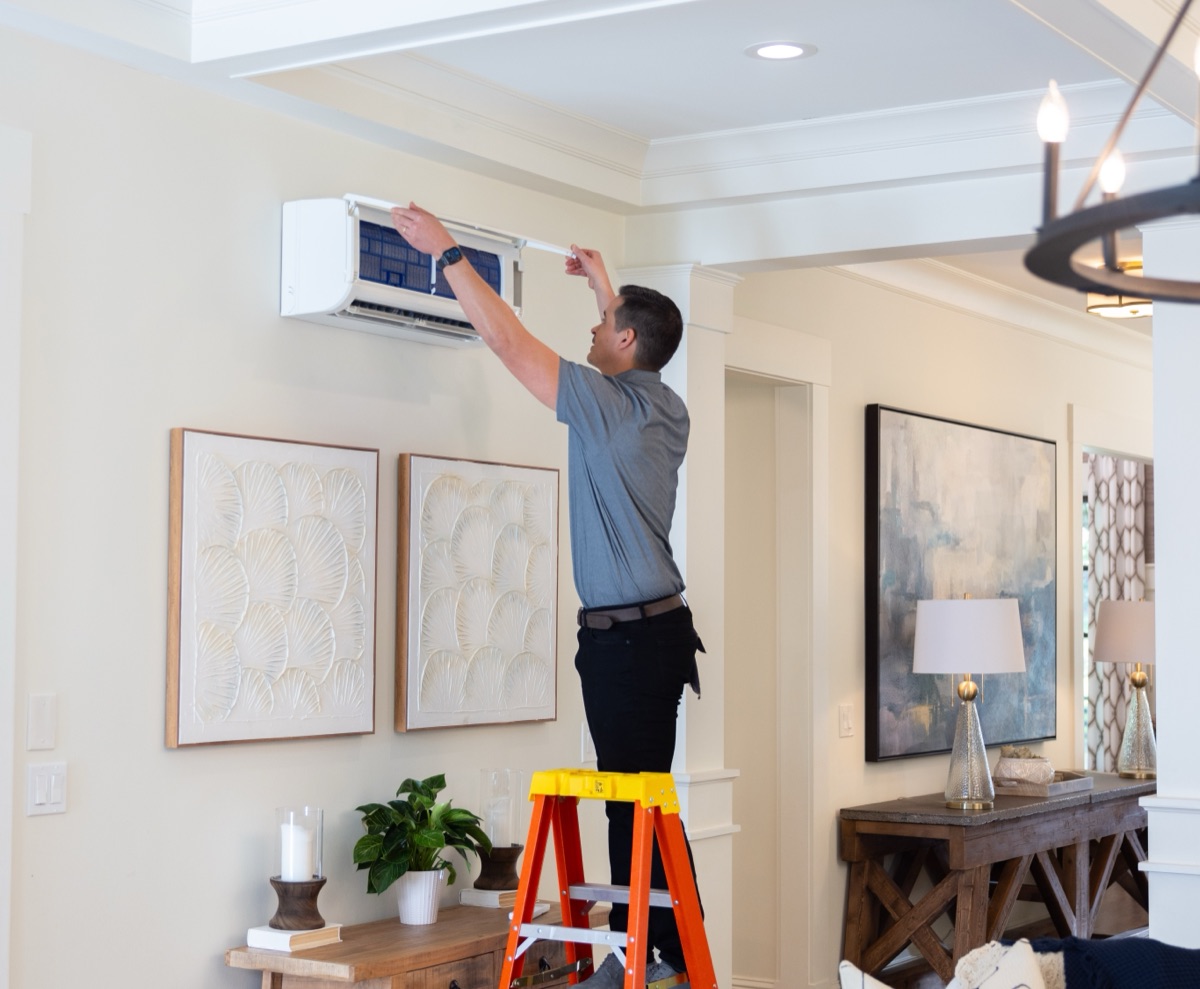
We also install cold-climate heat pump systems from Mitsubishi, Fujitsu, and other manufacturers. When you are ready for that step, we will be here.
If your home needs insulation work before either upgrade makes sense, we do that too. Horizon Homes has been an Efficiency Maine Top-Rated Vendor for 10+ years, and we approach every home as a whole system, not as a single equipment sale.
No Judgment, Just Options
There is a lot of pressure in the energy world right now to electrify everything. And for many homes, that is the right direction. But we have been doing this work in Maine since 2006, and we know that the best heating system is the one that matches your home, your budget, and your comfort needs today.
If a boiler is the right next step, we will say so. If heat pumps make more sense, we will say that instead. If insulation should come first, we will start there.
Schedule your free energy assessment and we will look at the whole picture. Or call us at (207) 221-3221 to talk through your options. No sales pitch, just honest guidance from people who install both systems every week.
Find our guides faster: add Horizon Homes as a preferred source on Google.
Free Home Energy Assessment
Considering Heat Pumps for Your Home?
We evaluate your home's insulation, heating system, and electrical capacity, then give you a clear recommendation with pricing and rebate estimates.
- Free walkthrough, no equipment, no disruption
- Efficiency Maine rebates identified for you
- Written improvement plan with pricing
Schedule Your Free Assessment
We call within 1 business day.