Cold-Climate Heat Pump Guide for Maine Homeowners
We were finishing a single-zone install in Gorham on a Tuesday in January. The outdoor temperature had been below zero since Sunday evening. The homeowner's neighbor watched us mount the condenser, run the lines, and power up the system. Twenty minutes later, warm air was blowing from the indoor head. He walked over and asked, genuinely puzzled, "How is that making heat? There is no heat outside to pump."
It is a reasonable question. And the answer gets to the heart of what makes cold-climate heat pumps different from the ones that gave heat pumps a bad reputation in Maine a decade ago.
The Physics of Extracting Heat from Cold Air
Every substance above absolute zero (-459.67 degrees Fahrenheit) contains thermal energy. When outdoor air is 5 degrees, or -5 degrees, or even -15 degrees, there is still usable heat energy in that air. A heat pump extracts that energy using a refrigerant cycle.
Here is the simplified version: a refrigerant fluid circulates between the outdoor unit and the indoor unit. Outside, the refrigerant is colder than the ambient air, so heat flows from the air into the refrigerant - even when that air feels bitterly cold to you. The refrigerant, now carrying that absorbed heat, travels to the indoor unit where a compressor concentrates the heat energy and releases it into your home at a useful temperature.
The colder the outdoor air gets, the less heat energy is available and the harder the compressor has to work to extract it. This is where standard heat pumps fail and cold-climate heat pumps succeed.
What Makes Cold-Climate Heat Pumps Different
Standard heat pumps use a single-speed or basic two-speed compressor. As outdoor temperatures drop below 25 or 30 degrees, these compressors lose capacity rapidly. By the time it hits 10 degrees, a standard heat pump might be producing only 40-50% of its rated capacity. Below zero, many standard units simply shut down and switch to expensive electric resistance backup heating.
Cold-climate heat pumps solve this problem with three key technologies:
Inverter-driven variable-speed compressors. Instead of running at one fixed speed, the compressor adjusts its speed continuously to match heating demand. When temperatures drop and more capacity is needed, the compressor speeds up. This is far more efficient than the start-stop cycling of a conventional compressor and allows the system to maintain output at much lower temperatures.
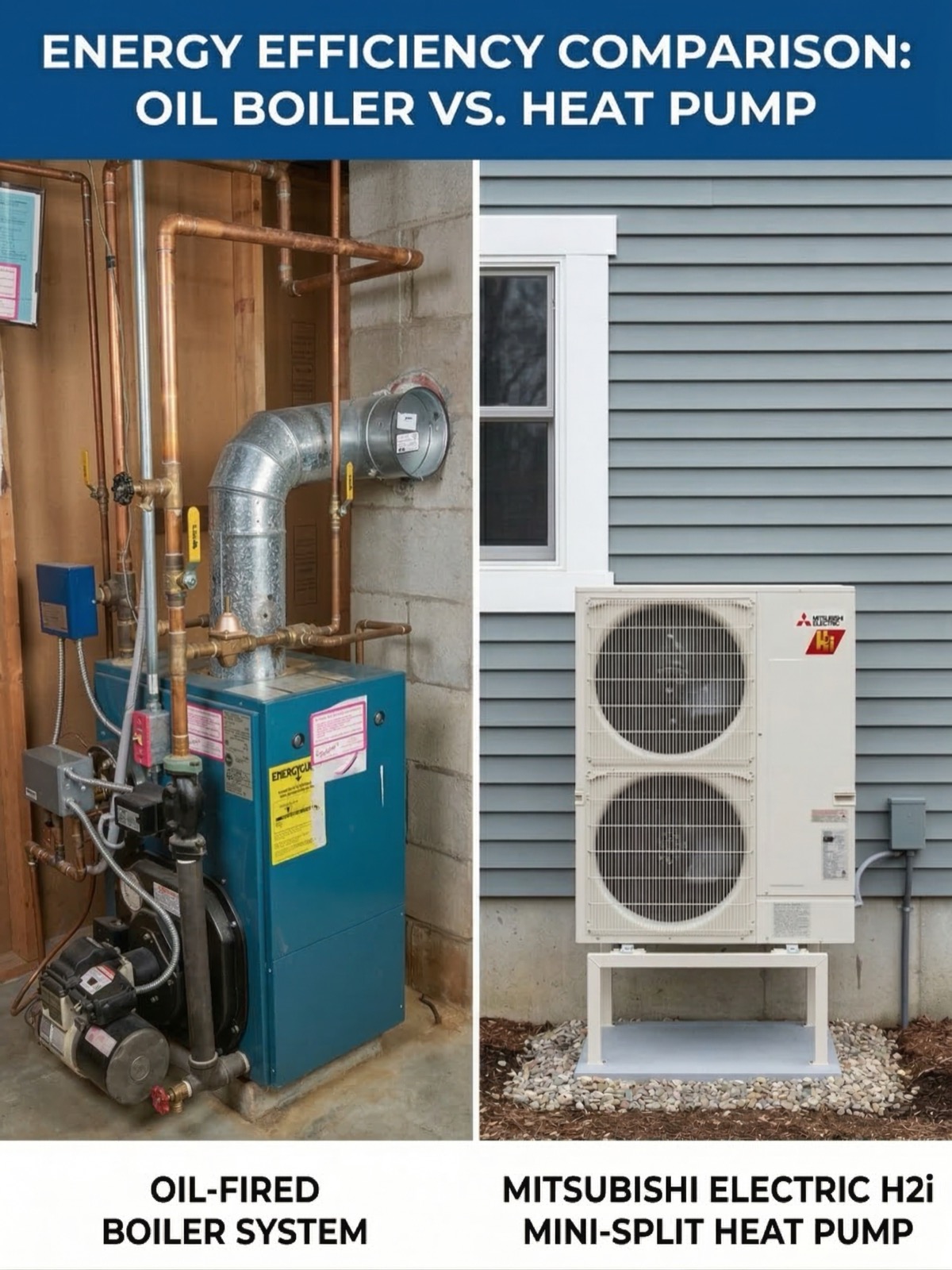
Flash injection (vapor injection) technology. This is the breakthrough that made cold-climate heat pumps viable for Maine. At low outdoor temperatures, a portion of the refrigerant is diverted through an additional heat exchanger and injected into the compressor as a superheated vapor. This increases the compressor's ability to generate heat at low ambient temperatures by 15-25%. Mitsubishi's Hyper-Heat line uses this technology, which they call Flash Injection.
Enhanced defrost cycles. All heat pumps occasionally need to defrost the outdoor coil when frost accumulates. Cold-climate units use intelligent defrost algorithms that monitor actual frost buildup rather than running defrost on a fixed timer. This means less wasted energy on unnecessary defrost cycles and faster recovery when defrost does occur.
Mitsubishi Hyper-Heat: The Numbers
At Horizon Homes, we primarily install Mitsubishi Hyper-Heat cold-climate mini-split systems. After 20+ years in the business, we have installed thousands of these units across Greater Portland, and we have real-world performance data to share.
Rated minimum operating temperature: -13 degrees Fahrenheit (the units continue to operate below this, but at significantly reduced capacity)
COP (Coefficient of Performance) at various temperatures:
| Outdoor Temperature | Approximate COP | What This Means |
|---|---|---|
| 47 degrees F | 3.5 - 4.0 | 3.5 to 4 times more efficient than electric heat |
| 30 degrees F | 2.5 - 3.0 | Still 2.5 to 3 times more efficient |
| 17 degrees F | 2.0 - 2.5 | Twice as efficient as electric resistance |
| 5 degrees F | 1.5 - 2.0 | Still more efficient than baseboard electric |
| -5 degrees F | 1.2 - 1.5 | Slightly above electric resistance efficiency |
| -13 degrees F | 1.0 - 1.2 | At or near electric resistance equivalence |
These numbers tell a story that surprises many homeowners. Even at 5 degrees Fahrenheit - a temperature we see regularly in December, January, and February - a cold-climate heat pump is producing roughly twice as much heat per dollar as electric baseboard heating. It is only in the extreme low temperatures, below about -10 degrees, that efficiency approaches parity with electric resistance.
And here is the key insight: Portland's average January low is about 14 degrees. The heat pump is running at high efficiency for the vast majority of the heating season. The -13 degree rating covers the outlier nights, not the average.
Capacity Retention: The Number That Matters Most
COP tells you how efficiently the system converts electricity to heat. But there is another number that matters just as much: capacity retention. This tells you how much of the unit's maximum heating output is still available as temperatures drop.
A Mitsubishi Hyper-Heat unit rated at 18,000 BTU at 47 degrees typically retains:
- 100% capacity at 30 degrees F
- 87-90% capacity at 17 degrees F
- 75-80% capacity at 5 degrees F
- 60-70% capacity at -5 degrees F
- 50-60% capacity at -13 degrees F
This is why proper sizing matters so much. If we size your system to produce exactly 18,000 BTU at 47 degrees, you will only have about 11,000 BTU available at -13 degrees. We size for the design temperature - the coldest temperature your area typically reaches - to ensure the heat pump can carry the load when you need it most.
Heating System Strategy
A heating plan should define each system's role. In a hybrid setup, the boiler provides primary heat and the cold-climate heat pump provides cooling and supplemental heat. Here are three configurations to consider.
Scenario 1: Boiler for primary heat, cold-climate heat pump for cooling and supplemental heat. This hybrid approach keeps the hydronic system in regular use. The cold-climate heat pump adds cooling and zone control, with supplemental heating where needed.
Scenario 2: Heat pump with electric resistance backup. Some heat pump models include a small electric resistance heater as a factory option. This kicks in automatically when the heat pump cannot meet the thermostat's demand. It is less efficient, but it ensures the home stays warm during extreme cold snaps without requiring a separate heating system.
Scenario 3: Whole-home heat pump system, no backup. For well-insulated homes with low heat loads, a properly sized cold-climate heat pump system can be the sole heat source. We see this most often in newer homes or homes that have undergone comprehensive weatherization - insulation, air sealing, and window upgrades. The reduced heat load means the heat pump's available capacity at -13 degrees is sufficient to maintain comfort.
We help you choose the right strategy during your energy assessment. The answer depends on your home's insulation levels, its total heat load at design temperature, and how much you want to invest upfront.
The Insulation Connection
Here is something that does not get enough attention in heat pump conversations: the better your home is insulated and air sealed, the smaller and more efficient your heat pump system can be.
A drafty 1950's Cape Cod with no wall insulation and leaky windows might need 60,000 BTU of heating capacity at design temperature. Insulating the attic and walls with blown-in cellulose and performing air sealing might reduce that load to 35,000 BTU. That is the difference between needing three outdoor units and needing two. Lower heat loss helps both standalone cold-climate heat pump systems and hybrid systems with primary boiler heat.
This is why we approach every project as a whole-home system. Insulation, air sealing, and heating equipment are connected. Investing in the building envelope first makes the heating system smaller, less expensive, and more effective.
What to Look for in a Cold-Climate Heat Pump
If you are researching cold-climate heat pumps on your own, here are the specifications that matter for Maine:
- Minimum operating temperature. Look for units rated to at least -13 degrees F. Anything rated only to 5 or 10 degrees is not a cold-climate unit, regardless of marketing claims.
- HSPF2 rating. This is the Heating Seasonal Performance Factor, version 2. Higher is better. Look for 10.0 or above for cold-climate units.
- Capacity at low temperature. Check the specification sheet for heating capacity at 5 degrees F and -5 degrees F, not just the rated capacity at 47 degrees.
- Inverter compressor. Non-inverter cold-climate heat pumps exist, but they are less efficient and less comfortable. Variable-speed inverter technology is standard on quality cold-climate units.
- ENERGY STAR Cold Climate certification. This designation means the unit has been tested and verified to perform at low temperatures.
Related Guides
- Single-Zone Ductless Heat Pump Guide - Starting with one zone
- Heat Pump Sizing and Manual J for Maine Homes - Why sizing at design temperature matters
- Switching from Oil to Heat Pump in Maine - Making the transition
- Heat Pump + Boiler Hybrid Systems in Maine - Combining heat pump and boiler
Ready to learn whether a cold-climate heat pump can handle your Maine home? Schedule your free energy assessment or call us at (207) 221-3221. We have been installing Mitsubishi Hyper-Heat systems across Greater Portland since 2006, and we will show you exactly how the system will perform in your home - with real numbers, not marketing claims.
Find our guides faster: add Horizon Homes as a preferred source on Google.
Free Home Energy Assessment
Considering Heat Pumps for Your Home?
We evaluate your home's insulation, heating system, and electrical capacity, then give you a clear recommendation with pricing and rebate estimates.
- Free walkthrough, no equipment, no disruption
- Efficiency Maine rebates identified for you
- Written improvement plan with pricing
Schedule Your Free Assessment
We call within 1 business day.