Basement Insulation Guide for Maine Homeowners
Editor's note (October 2026): Efficiency Maine changed its insulation and air sealing rebates for work completed on or after October 1, 2026. They are now a fixed amount per zone of the house (attic, walls, basement) instead of a percentage of project cost, so the insulation rebate figures, combined totals, and cost examples below reflect the program when this article was published. See current Efficiency Maine rebates.
Editor's note (August 2026): The federal 25C tax credits referenced in this article expired December 31, 2025 and are only available for qualifying work completed before that date. Efficiency Maine rebates remain available and are now the primary incentive for basement insulation projects.
Your Feet Know Before Your Thermostat Does.
If your kitchen floor feels cold in October, your living room socks are a November-through-April wardrobe staple, or your kids avoid the playroom in the basement because it feels like a cave, you are dealing with the same issue that affects most Maine homes built before 2000: an uninsulated basement.
The basement is the part of the home that homeowners think about last when it comes to insulation. Attics get all the attention. Walls are a close second. Basements get forgotten because people think of them as storage or utility space, not as part of the home's thermal envelope. But your basement is in direct contact with the ground and exposed to outside air through the foundation walls and rim joist. In a typical uninsulated Maine home, the basement accounts for 20-30% of total heat loss.
That cold floor above isn't a floor problem. It is a basement problem.
Moisture Comes First
Before we talk about insulation materials and R-values, we need to talk about water. In Maine, moisture management is the number one priority in any basement insulation project. Get this wrong and you create a worse problem than you started with.
Why Moisture Matters So Much
When you insulate a basement wall, you are trapping moisture between the insulation and the foundation. If the foundation is allowing water to seep through (either as liquid water or as water vapor), that moisture has nowhere to go. It collects behind the insulation, creates a perfect environment for mold growth, and can rot out any wood framing it contacts.
This is why material selection matters so much in basements. The wrong insulation traps moisture. The right insulation manages it.
What We Look for Before Insulating
During every basement assessment, we check for these conditions:
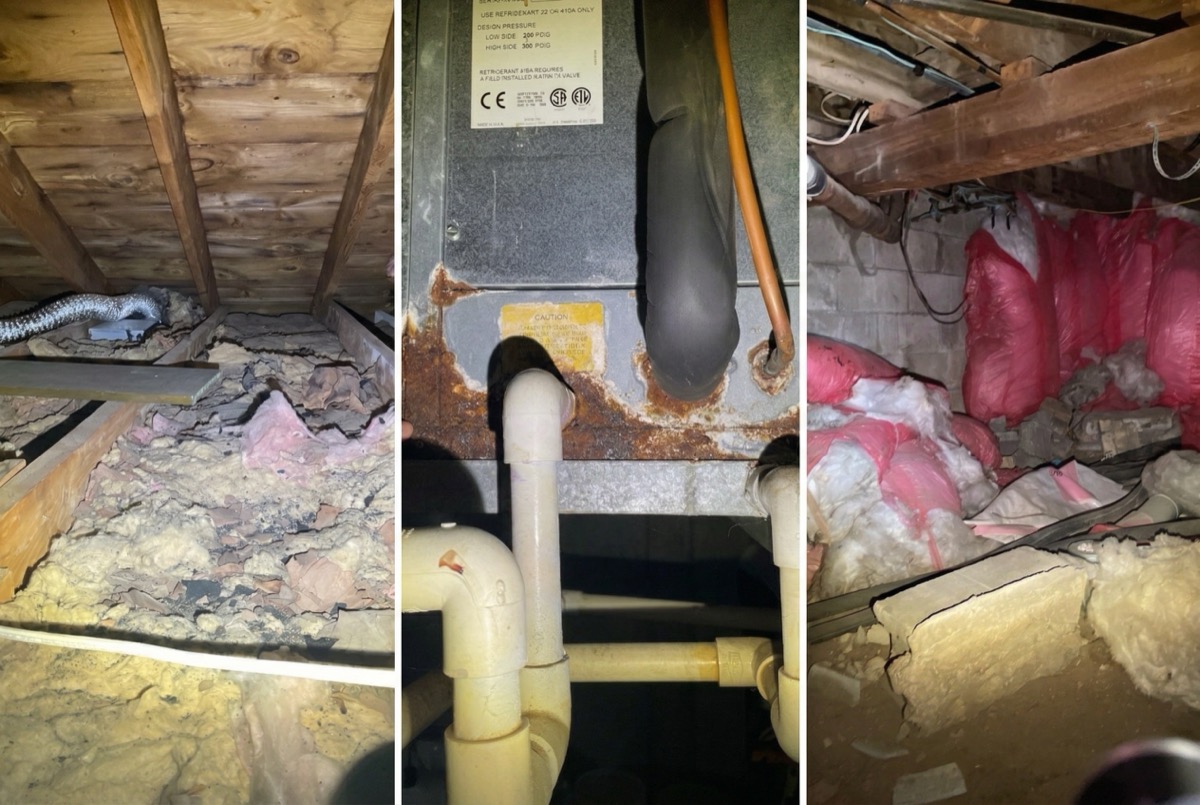
Active water intrusion. Stains on the floor, white mineral deposits (efflorescence) on the foundation walls, standing water or damp spots, and musty odors. If water is coming in, that problem gets fixed first. No amount of insulation fixes a wet basement.
Grading and drainage. How does the ground slope away from the foundation? Are gutters and downspouts directing water away from the house? Is there a functioning perimeter drain system?
Foundation condition. Cracks, deteriorating mortar, crumbling concrete, and any structural concerns. A compromised foundation needs repair before insulation.
Relative humidity. A basement running above 60% relative humidity needs dehumidification as part of the insulation plan.
Once moisture sources are identified and addressed, we can insulate with confidence.
Insulation Options by Foundation Type
Not all basements are the same, and the right insulation approach depends on what kind of foundation you have.
Poured Concrete or Concrete Block Walls
This is the most common foundation type in Maine homes built from the 1950's onward. For flat, structurally sound concrete walls, we use polyiso rigid foam board.
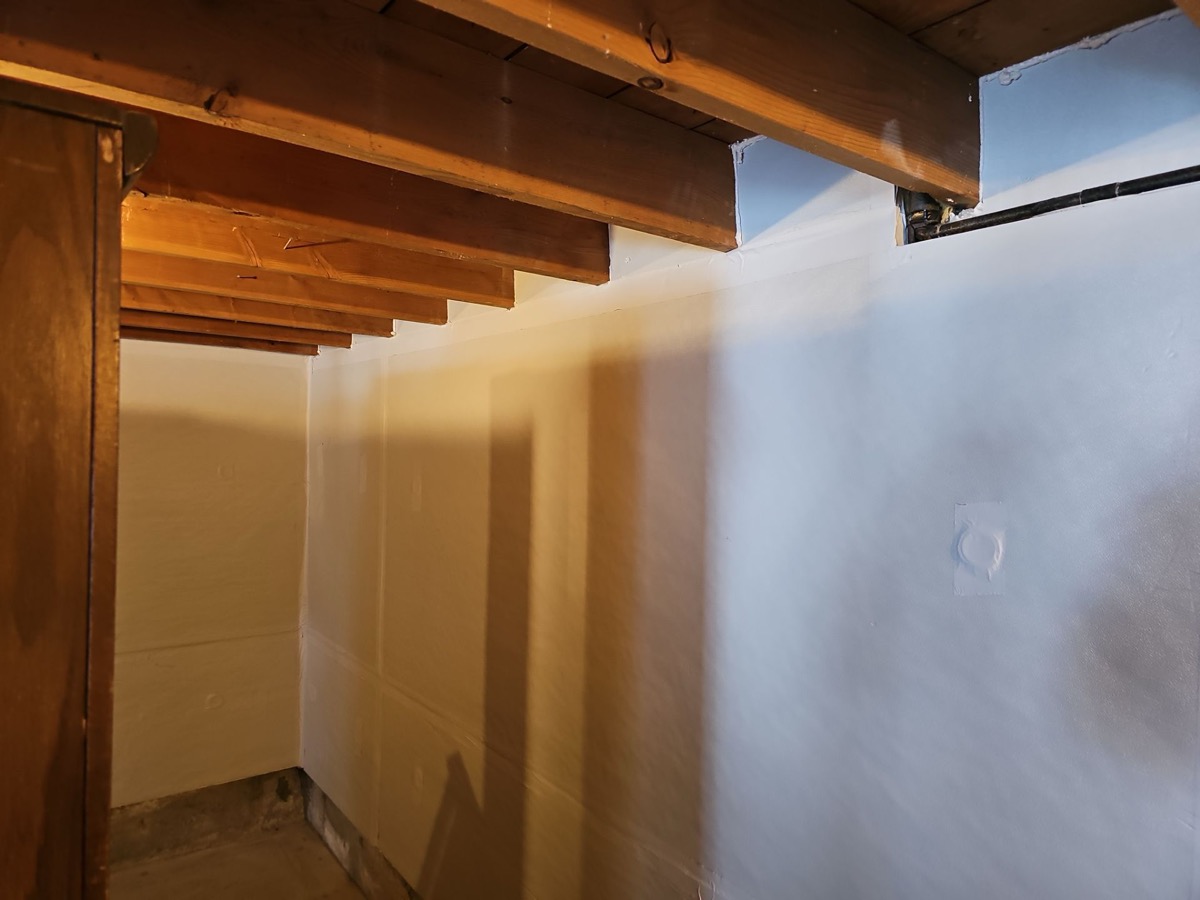
How it works: Polyiso foam panels are cut to fit and attached directly to the foundation wall. The seams between panels are sealed with foam-compatible tape or canned spray foam. A stud wall is framed in front of the foam to support drywall if the space will be finished.
R-value: Polyiso delivers approximately R-6 per inch. Two inches of polyiso gives you R-12. Three inches gets you to R-18, which meets code for basement walls in Climate Zone 6.
Why polyiso: It provides a continuous layer of insulation with no gaps. The rigid foam acts as both insulation and a vapor retarder, managing moisture migration from the foundation into the living space. It does not absorb water if the surface gets damp, and it does not support mold growth.
The rim joist detail: The rim joist - where the floor framing sits on top of the foundation wall - is one of the leakiest spots in any Maine home. We seal and insulate this area as part of every basement project. Canned spray foam and cut pieces of rigid foam close the gaps and stop cold air infiltration.
Not sure what kind of foundation you have? Schedule a free energy assessment and we will inspect your basement, identify moisture issues, and recommend the right insulation approach. Call (207) 221-3221 or book online.
Rubble Stone Foundations
Many of Maine's oldest homes, those built before 1920, sit on fieldstone or rubble stone foundations. These walls are irregular, uneven, and full of gaps between the stones. Rigid foam board can't conform to these surfaces, and cellulose can't achieve proper density against them.
For rubble stone foundations, closed-cell spray foam is the appropriate insulation material. It adheres directly to the irregular stone surface, fills gaps, and provides both insulation and an air and moisture barrier in a single application.
We coordinate spray foam work with experienced subcontractors who specialize in foundation applications. This is one of the specific situations where spray foam is the right material for the job. We manage the project from assessment through completion, including the spray foam portion, so the homeowner works with one contractor, not two.
Crawlspaces
Maine homes with crawlspaces present a unique challenge. These low, often damp spaces are difficult to access and prone to moisture problems. There are two approaches.
Encapsulation (preferred): Seal the crawlspace vents, install a heavy-duty vapor barrier on the floor and walls, insulate the perimeter walls with rigid foam or spray foam, and condition the space with a dehumidifier or a small amount of conditioned air from the home. This turns the crawlspace into part of the building envelope rather than a vented, outdoor-temperature space.
Floor insulation (alternative): Insulate the floor above the crawlspace from below, keeping the crawlspace outside the thermal envelope. This approach is less effective in Maine's climate because it leaves plumbing vulnerable to freezing and doesn't address moisture issues in the crawlspace itself.
We strongly recommend encapsulation for Maine crawlspaces. The moisture control benefits alone make it worthwhile, and the energy savings from a properly sealed crawlspace are significant.
Basement Windows and Doors
Basement windows and exterior basement doors are part of the insulation scope when we address a basement. These are often single-pane, poorly sealed, and sometimes broken or stuck.
Basement windows: We replace or weatherize basement windows as part of the project. Hopper-style or awning windows with double-pane glass and proper weatherstripping make a real difference in air sealing and comfort.
Exterior basement doors: Bilco doors, bulkhead doors, and walk-out basement doors all need attention. Weatherstripping, insulation of the door itself, and sealing the frame are included in the scope.
These details matter because a well-insulated basement wall with a drafty single-pane window or a leaking bulkhead door still lets cold air pour in. Every opening in the basement envelope needs to be addressed for the insulation to perform as designed.
The Rim Joist: The Most Overlooked Area
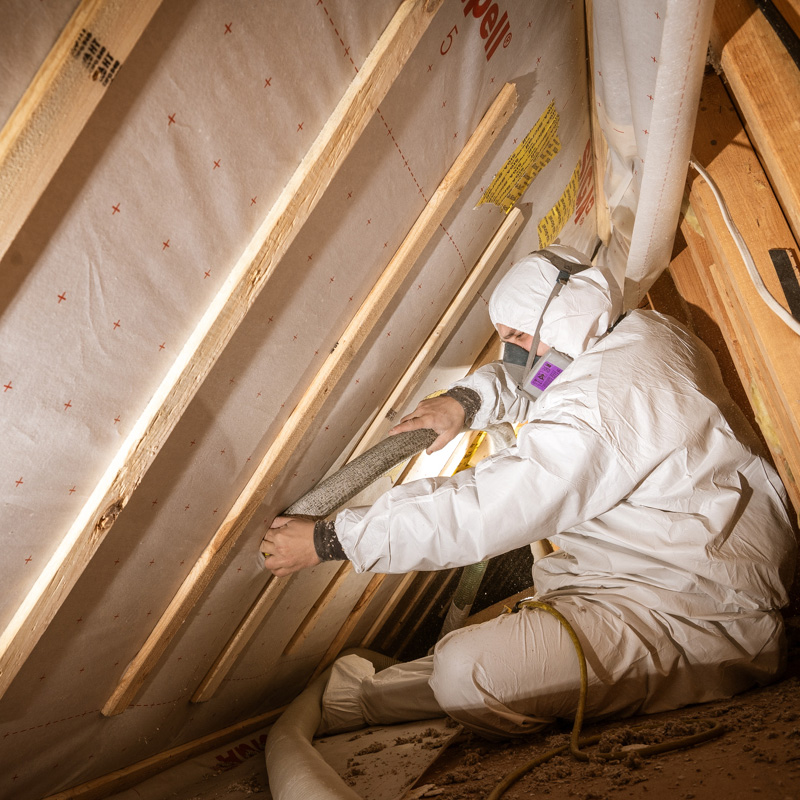
If you do nothing else to your basement, seal and insulate the rim joist. This is the horizontal band of wood that sits on top of the foundation wall at the perimeter of each floor. In most Maine homes, the rim joist is completely uninsulated and unsealed.
Why this matters so much: the rim joist has gaps where each floor joist meets the band. Cold outside air flows through these gaps, through the basement, and up into the living space through gaps in the floor above. You feel this as cold feet and drafts at the base of exterior walls on the first floor.
Sealing and insulating the rim joist with canned spray foam and rigid foam cut-and-cobble is a relatively quick improvement that delivers immediate comfort benefits. Homeowners consistently tell us the cold floor problem improves within days of the rim joist work.
How Basement Insulation Connects to the Rest of Your Home
A basement insulation project doesn't exist in isolation. The basement is the bottom of your home's thermal envelope, and what happens there affects everything above it.
The Stack Effect
Warm air rises. In winter, warm air in your home pushes upward and escapes through the attic and upper floors. As that warm air leaves, it creates negative pressure at the bottom of the home that pulls cold outside air in through the basement and lower-level gaps. This is the stack effect, and it drives a surprising amount of your heating costs.
Insulating and air sealing the basement reduces the stack effect by closing off the entry points for cold replacement air. Combined with attic air sealing and insulation, you address both ends of the stack and slow the entire convective loop.
Comfort on the First Floor
Cold floors on the first level are almost always caused by what is happening (or not happening) in the basement below. Insulating basement walls and the rim joist warms the basement space from the low 40's to the mid-50's or higher, even without direct heating. That warmer basement air against the underside of your first floor means warmer floors above. If you would rather leave the basement cold and insulate the floor assembly itself, our guide to insulating floors over unconditioned spaces covers that approach and when it makes sense.
Heat Pump Efficiency
If you have or are considering a cold-climate heat pump, basement insulation directly affects its performance. A heat pump in an uninsulated basement works harder and runs longer to overcome the constant cold-air influx from the foundation. Insulating the basement first lets the heat pump do its job more efficiently and can reduce the size of the system you need.
Rebates and Costs
Basement insulation qualifies for Efficiency Maine rebates as part of a weatherization project. The rebate amount depends on your household income, but all homeowners qualify for some level of support. Efficiency Maine pays a fixed amount per zone of the house, set by income tier, up to $8,600 per home ($5,600 per mobile home), for insulation and air sealing.
We handle the rebate application and apply the amount directly to your invoice. No waiting for reimbursement, no separate paperwork.
Federal tax credits (25C) also apply: 30% of insulation costs up to $1,200 per year. Between Efficiency Maine rebates and federal credits, the net cost of basement insulation is often a fraction of the full project price.
A typical basement insulation project for a 1,200 to 1,600 square foot foundation in Greater Portland ranges from $4,000 to $10,000 before rebates, depending on the foundation type, condition, and scope of work.
Horizon Homes has been insulating and air sealing Maine basements since 2006. As an Efficiency Maine Top Contractor for 10+ years, we understand what works for every type of Maine foundation. Schedule your free energy assessment or call (207) 221-3221 to find out what your basement needs.
Find our guides faster: add Horizon Homes as a preferred source on Google.
Free Home Energy Assessment
Wondering Where Your Home Is Losing Heat?
We walk through your home, identify insulation gaps and air leaks, and give you a prioritized plan with pricing and Efficiency Maine rebates.
- Free walkthrough, no equipment, no disruption
- Efficiency Maine rebates identified for you
- Written improvement plan with pricing
Schedule Your Free Assessment
We call within 1 business day.