Insulating Homes with Knob-and-Tube Wiring
Pre-1940 homes in Greater Portland frequently get turned away by insulation contractors because of knob-and-tube wiring. "You need to rewire the whole house first, $25,000 minimum, before anyone can touch the insulation." We hear this from homeowners regularly. Some have been sitting on no wall insulation and 3 inches of attic cellulose for years, spending $4,000-plus annually on oil heat in homes under 1,800 square feet.
The answer is not that simple, in either direction. Knob-and-tube wiring and insulation can coexist, but the details matter. The right answer depends on the condition of the wiring, the type of insulation, and what electrical code actually requires.
What Is Knob-and-Tube Wiring?
Knob-and-tube (K&T) was the standard residential electrical wiring method from the 1880's through the early 1940's. If your Maine home was built before World War II, there is a reasonable chance it has some K&T wiring - either as the primary system or mixed with later additions.
The system uses two separate conductors (hot and neutral) run through ceramic knobs mounted to framing and ceramic tubes where wires pass through joists and studs. The wires are spaced apart from each other and from the surrounding structure, and they are insulated with a rubber and cloth sheathing.
K&T was a solid system for its era. The key design principle was air circulation: the wires were intended to dissipate heat into the open air around them. This is where insulation creates a potential conflict.
The Actual Concern: Heat Dissipation
When K&T wiring carries current, it generates heat. In open air, that heat dissipates safely. The rubber and cloth insulation on the wires was designed for this condition - exposed to air, not buried in material.
The concern with insulation is straightforward: if you pack insulating material around energized K&T wiring, the heat generated by the wire cannot dissipate. If the wire is overloaded (carrying more current than it was designed for), or if the rubber insulation has deteriorated, the trapped heat can raise temperatures to the point where the degraded wire sheathing could ignite the surrounding insulation material.
This is a real safety concern, not a theoretical one. But the risk depends on specific conditions, not on the mere presence of K&T wiring.
What Maine Electrical Code Says
The National Electrical Code (NEC), which Maine adopts, addresses this directly. Section 394.12 prohibits insulation from being installed around K&T wiring in certain conditions. However, the code does not say K&T and insulation can never coexist. The distinction comes down to the condition and status of the wiring.
When Insulation Cannot Be Installed Around K&T
- Active, energized K&T circuits that will remain in service. If the K&T wiring is still carrying current, the NEC does not allow thermal insulation to be installed in a way that encloses the wiring. This is the general rule, and it is the rule that leads contractors to say "you need to rewire first."
When Insulation Can Be Installed
- Decommissioned K&T. If the K&T circuits are disconnected from the electrical panel and verified as de-energized, they are no longer carrying current and no longer generating heat. At that point, they are inert wires in a wall cavity, and insulation can be installed around them safely. The wiring does not need to be physically removed - it just needs to be disconnected.
- Partial decommissioning. In many older homes, the K&T has been partially replaced over the decades. Some circuits may already be inactive while others are still live. A licensed electrician can identify which circuits are active and decommission specific runs to allow insulation in those areas.
The Practical Path Forward
For most pre-1940's homes in Greater Portland, the answer falls somewhere between "rewire everything" and "insulate everything as-is." Here is what the realistic path looks like.
Step 1: Electrical Assessment
Before any insulation work, a licensed electrician needs to assess the K&T wiring. This is not something an insulation contractor should evaluate on their own. The electrician will determine:
- Which circuits are still active. Many K&T systems have been partially updated over the years. An electrician can trace circuits and identify which K&T runs are live and which are already abandoned.
- The condition of the wiring. Rubber and cloth wire sheathing degrades over time. After 80-100 years, some K&T wiring is in surprisingly good condition while other sections are cracked, brittle, or missing insulation entirely. The physical condition matters.
- The load on active circuits. K&T was designed for the electrical loads of the 1920's and 1930's - a few lights and maybe a radio. A modern household running air conditioners, microwaves, and space heaters on those same circuits can overload them. Overloaded circuits generate more heat, which amplifies the risk of burying them in insulation.
Step 2: Selective Decommissioning
In many cases, full rewiring is not necessary to allow insulation. If the K&T in the attic serves only a few light fixtures, an electrician can run new Romex circuits to those fixtures and disconnect the K&T runs. The cost to decommission attic K&T circuits and replace them with modern wiring typically runs $1,500-$4,000 - a fraction of a whole-house rewire.
Wall cavities are trickier because the K&T runs vertically through stud bays. Decommissioning wall circuits may require more extensive work, but again, the scope depends on which circuits are active and which have already been replaced.
The goal is targeted: decommission the K&T in areas where insulation will be installed, while leaving the rest of the electrical system for a future full rewire if the homeowner chooses.
Step 3: Insulate the Cleared Areas
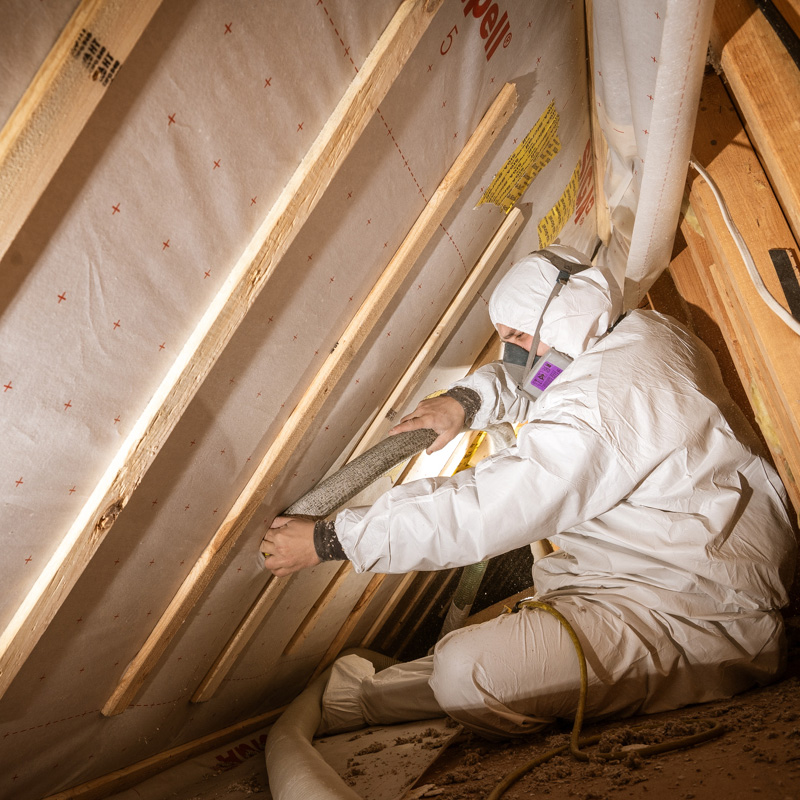
Once the K&T in the target area is decommissioned and verified de-energized, insulation can proceed normally. We install blown-in cellulose in these situations for several reasons:
Cellulose and K&T wiring work well together (when the wiring is decommissioned). Cellulose is treated with borate, which provides Class 1 fire resistance. Unlike some insulation types, cellulose does not melt or sustain combustion. If there were ever an electrical issue with a nearby wire, cellulose would char rather than ignite - an important safety characteristic in older homes.
Cellulose fills irregular cavities. Pre-1940's construction features balloon framing, irregular stud spacing, plaster lath, and decades of modifications. Blown-in cellulose fills around all of these obstructions, including the ceramic knobs and tubes of decommissioned K&T wiring, without gaps or voids.
Dense-pack cellulose for walls. When insulating wall cavities in older homes, we use dense-pack cellulose installed at 3.5 pounds per cubic foot. This density prevents settling over time and completely fills the stud bay, even around the irregular obstructions common in balloon-frame walls.
Step 4: Address the Attic Separately
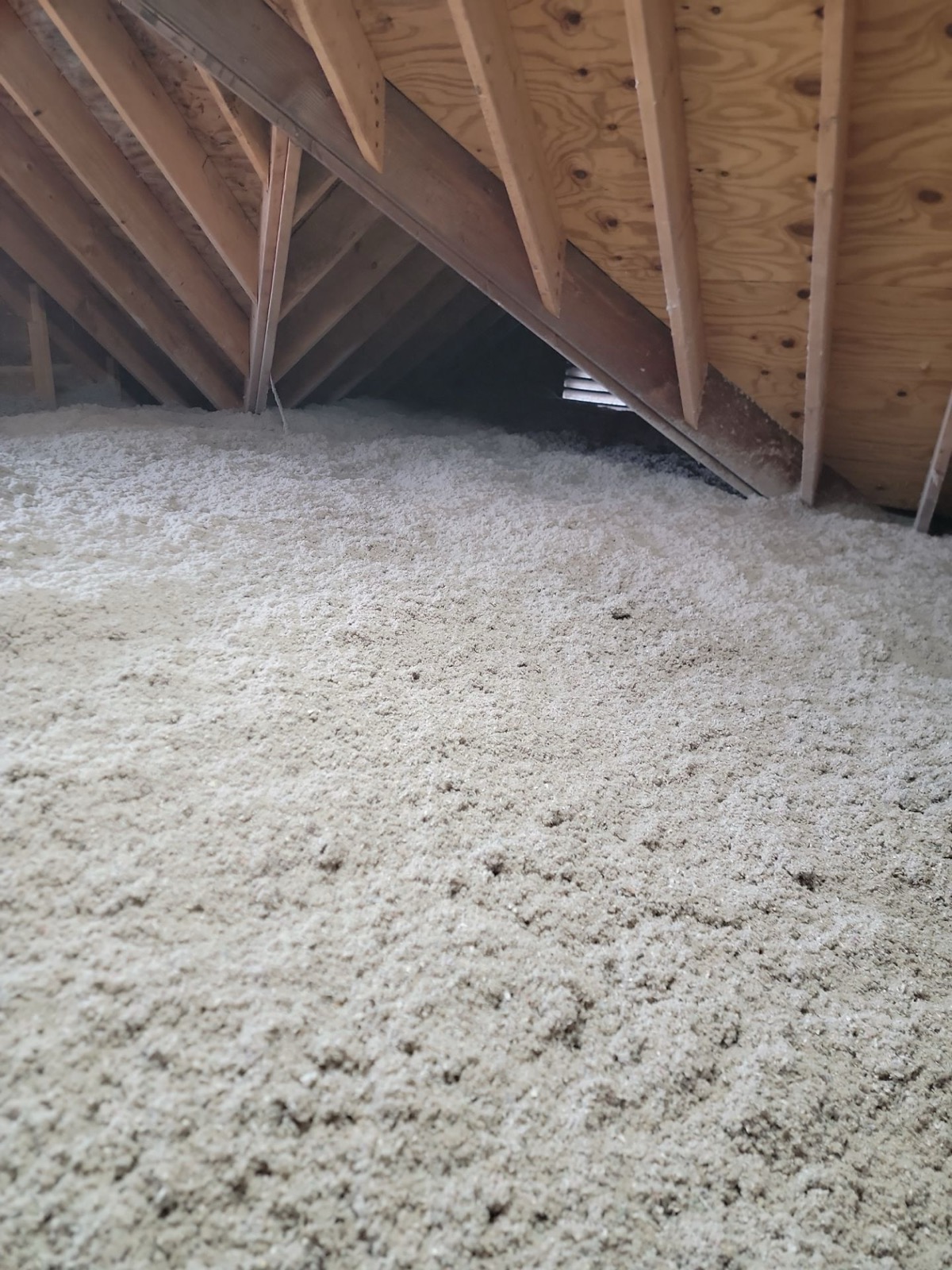
The attic is often the biggest opportunity. In homes where K&T runs through the attic, decommissioning those circuits clears the way for the most impactful insulation upgrade: taking the attic from whatever minimal insulation exists to R-50 with blown-in cellulose.
On a recent West End project, decommissioning three K&T attic circuits cost $2,200. The attic insulation and air sealing project cost $5,800, with Efficiency Maine covering $3,480 in rebates.
When Full Rewiring Is Actually Needed
A full rewire is the right call when the entire system is K&T with no modern circuits, when the wiring condition is poor throughout, when the panel is an outdated fuse box undersized for modern loads, or when a major renovation is opening walls anyway.
A full rewire of a 1,500-square-foot home typically runs $15,000-$30,000. If that is in your future but not your current budget, the targeted approach works: decommission K&T in the attic, insulate now, plan the full rewire for a later phase.
What to Watch For
Insurance. Some carriers have specific policies around K&T wiring - a few will not insure homes with active K&T, while others require an inspection. Check with your carrier before starting work. Decommissioning K&T can sometimes improve your insurance standing.
Permits. Electrical work to decommission K&T requires a permit and inspection in most Maine municipalities. Your electrician handles this.
Mixed systems. Many older homes have a mix of original K&T and later Romex or BX cable from partial rewiring in the 1950's and 1960's. Do not assume that modern wiring in one area means the whole house is updated. A circuit-by-circuit assessment is the only way to know.
Moisture. In homes with K&T, moisture in wall cavities or attics accelerates degradation of the rubber wire sheathing. Address moisture sources before insulating. At Horizon Homes, identifying moisture issues is part of our standard energy assessment process.
What the Numbers Look Like
A targeted approach on a pre-war Portland home: $2,200 for selective electrical decommissioning, $5,800 for insulation and air sealing. After Efficiency Maine rebates, total out of pocket was $4,520.
First winter with new insulation, oil consumption dropped from approximately 800 gallons to around 520 gallons. At current oil prices, that is $900-$1,100 in annual savings. The project pays for itself in 4-5 years, and the comfort improvement is immediate: no more cold drafts upstairs, no more ice on the inside of bedroom windows.
A full rewire can follow in a later phase. The insulation does not have to wait for it.
Next Steps
If you have been told your home cannot be insulated because of knob-and-tube wiring, get a second opinion. The answer may not be "no" - it may be "not yet, but here is how to get there."
Plan the steps before insulating. Request your free energy assessment to discuss your attic, comfort concerns, and priorities for insulation and air sealing. Our visit is a visual walkthrough only, with no diagnostic testing or obligation. A licensed electrician must evaluate the wiring and confirm which areas are ready for insulation; the energy assessment does not replace that electrical evaluation.
Already have an electrician's findings? Contact our team to discuss the next step or call (207) 221-3221. We can help you plan insulation work in phases for your Greater Portland home.
Find our guides faster: add Horizon Homes as a preferred source on Google.
Free Home Energy Assessment
Wondering Where Your Home Is Losing Heat?
We walk through your home, identify insulation gaps and air leaks, and give you a prioritized plan with pricing and Efficiency Maine rebates.
- Free walkthrough, no equipment, no disruption
- Efficiency Maine rebates identified for you
- Written improvement plan with pricing
Schedule Your Free Assessment
We call within 1 business day.