How to Choose an Insulation Contractor in Maine

Editor's note (October 2026): Efficiency Maine changed its insulation and air sealing rebates for work completed on or after October 1, 2026. They are now a fixed amount per zone of the house (attic, walls, basement) instead of a percentage of project cost, so the insulation rebate figures, combined totals, and cost examples below reflect the program when this article was published. See current Efficiency Maine rebates.
Editor's note (August 2026): The federal 25C tax credits referenced in this article expired December 31, 2025 and are only available for qualifying work completed before that date. Efficiency Maine rebates remain available and are now the primary incentive for insulation projects.
Three estimates for attic insulation that are wildly different from each other are not unusual. We see ranges like $2,800 for fiberglass batts, $11,000 for spray foam, and a third contractor insisting a roof replacement comes first. Those quotes cannot all be right, and they are not all responding to the same problem. The insulation industry in Maine is busy right now, and with new federal tax credits taking effect in 2023, demand is only growing. More demand means more contractors entering the market. Some are excellent. Some are not.
Here is how to tell the difference.
Why This Matters More Than Ever in 2023
The Inflation Reduction Act introduced new federal energy tax credits that make insulation and air sealing more affordable than they have been in years. Homeowners can now claim up to $1,200 per year for insulation work through the 25C tax credit. That is real money back on your tax return.
Combine that with Efficiency Maine rebates that pay a fixed amount per zone of the house (depending on income), and the financial case for insulating your home is stronger than it has ever been. But those savings only materialize if the work is done right.
A poorly installed insulation job can leave gaps that allow air to move freely through your walls and attic. You spend the money, claim the credits, and still end up with cold rooms and high heating bills. The contractor you choose determines whether you get real results or an expensive disappointment.
The Eight-Point Contractor Checklist
1. BPI Certification
Building Performance Institute (BPI) certification is the gold standard for home energy professionals. A BPI-certified contractor has been trained and tested on building science principles - how heat moves through a home, how moisture behaves, and how different systems interact.
This matters because insulation is not a standalone product. It is part of a system that includes your air barrier, ventilation, and heating equipment. A contractor who understands the full picture will get better results than one who treats insulation as a simple commodity installation.
Ask any contractor you are considering whether their technicians hold BPI certification. If they do not know what BPI is, that tells you something.
2. Blower Door Testing Capability
A blower door test measures how much air leaks through your home's envelope. It is a diagnostic tool that tells a contractor exactly how tight or leaky your home is, both before and after their work.
The best contractors run a blower door test before starting a project to establish a baseline. They run it again when the work is complete to verify the improvement. This is quality assurance you can measure with a number, not a gut feeling.
If a contractor does not own a blower door or does not include testing as part of their process, you have no way to verify that their work reduced air leakage. At Horizon Homes, we use blower door testing at the beginning and end of every project to confirm results and address any remaining problem areas.
3. Efficiency Maine Registration
Any contractor applying for Efficiency Maine rebates on your behalf must be a registered Efficiency Maine contractor. This is not optional. If a contractor says they can "help you get rebates" but is not registered with the program, that is a red flag. Our Efficiency Maine energy audits and contractors guide explains how registration works and how the rebate process runs start to finish.
Registered contractors understand the program requirements, paperwork, and quality standards. They know which materials qualify and which installation methods meet the program's specifications.
Horizon Homes has been an Efficiency Maine Top Contractor for 10+ years. We handle the entire rebate process and apply the rebate amount directly to your invoice, so you never have to wait for reimbursement or deal with paperwork.
4. Insulation Material Knowledge
Not every insulation material is right for every situation. A good contractor should be able to explain which material they recommend for each area of your home, and why.
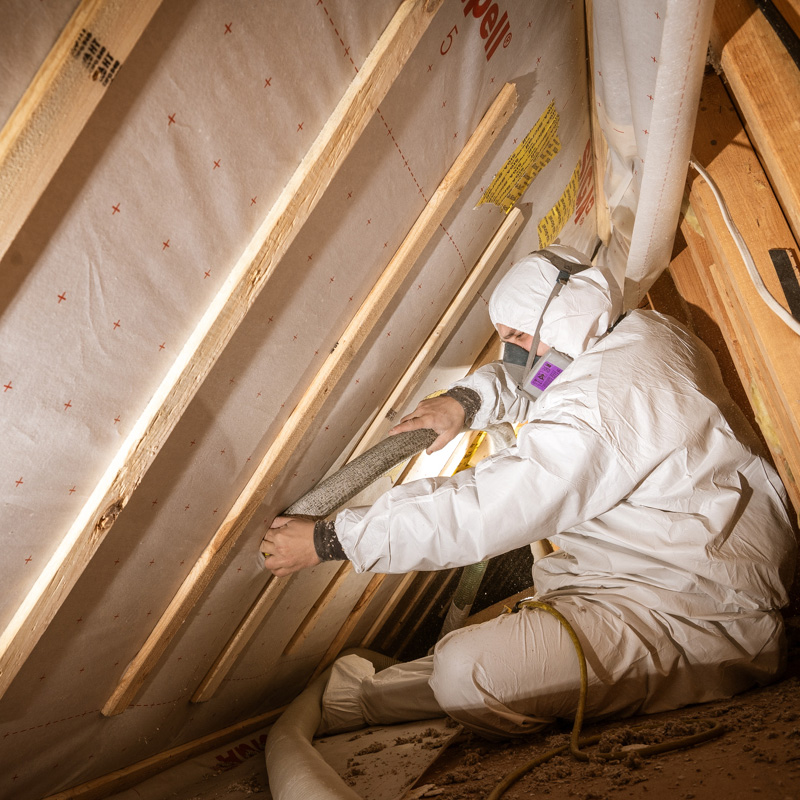
For most Maine homes, blown-in cellulose insulation is the workhorse. It is made from 85% recycled newspaper, has a Class 1 fire rating, produces zero off-gassing, and costs 40-70% less than spray foam. It fills wall cavities and attic spaces effectively without requiring walls to be opened up.
For flat basement walls, polyiso rigid foam board is often the right choice. And for specific situations like rubble basements, crawlspaces, and rim joists, closed-cell spray foam may be the best option.
Be cautious of contractors who push a single material for every application. A contractor who only installs spray foam will recommend spray foam for everything, even when a less expensive material would perform equally well. A contractor who only installs fiberglass batts may not mention that blown-in cellulose fills gaps and voids far more effectively.
Schedule a free energy assessment and we will walk through your home to identify which insulation materials are right for each area.
5. Air Sealing Expertise
Here is a detail that separates good insulation contractors from great ones: they understand that air sealing and insulation work together as a system.
Insulation slows heat transfer through your walls and ceilings. Air sealing stops warm air from physically moving through gaps and cracks in your home's envelope. Without air sealing, even new insulation will underperform because air can still bypass it.
Ask your contractor whether they include air sealing as part of their insulation work. If they look confused or say "that's a separate service," consider looking elsewhere. The best energy performance comes from doing both at the same time.
6. Clear, Itemized Estimates
You should receive a written estimate that breaks down exactly what work will be done, what materials will be used, and what each component costs. This includes square footage of insulation, R-value targets, and any air sealing work included.
A one-line estimate that says "Insulate attic - $4,500" does not give you enough information to compare against other bids or to verify what was done after the fact.
At Horizon Homes, our estimates are detailed line items. We also present a roadmap of recommended improvements in priority order, so you can phase the work over time if budget is a concern.
7. Insurance and Licensing
This one is straightforward but often overlooked. Your contractor should carry general liability insurance and workers' compensation coverage. Ask for a certificate of insurance.
In Maine, insulation contractors should also have any applicable trade licenses for the work they perform. Verify this before signing a contract.
8. References and Reviews
Check online reviews on Google and read them carefully. Look for patterns rather than individual complaints. A contractor with hundreds of five-star reviews and one upset customer is probably doing good work. A contractor with a handful of reviews and recurring themes about missed appointments or sloppy work is a risk.
Ask for references from recent projects similar to yours. If you have a 1960's Cape Cod, ask for references from other Cape Cod owners. If you have a colonial built in the 1850's, ask for references from older homes.
Questions to Ask During Your First Call
Keep this list handy when you start calling contractors:
- Are your technicians BPI certified?
- Do you perform blower door testing before and after the job?
- Are you a registered Efficiency Maine contractor?
- What insulation materials do you typically use, and why?
- Do you include air sealing as part of your insulation work?
- Can you provide an itemized estimate with R-values and square footage?
- Do you handle the Efficiency Maine rebate paperwork?
- Can you provide references from homes similar to mine?
A good contractor will answer these questions confidently and without hesitation. They will appreciate that you are asking because it signals you are a serious homeowner who values quality work.
Red Flags to Watch For
- Pressure to sign immediately. A reputable contractor will give you time to review an estimate and compare options.
- Cash-only or no contract. Always get a written scope of work and payment terms.
- No mention of air sealing. Insulation without air sealing leaves money on the table.
- Only one material for every application. Different areas of your home may need different solutions.
- Cannot explain Efficiency Maine rebates. Any experienced Maine insulation contractor should know this program inside and out.
- No pre-work or post-work testing. If they cannot measure improvement, they cannot guarantee it.
What About Pricing?
A typical whole-home insulation and air sealing project in the Greater Portland area ranges from $10,000 to $30,000 before rebates. Your free energy assessment shows the Efficiency Maine rebates that apply to your home and the cost after rebates.
Get at least three estimates so you can compare scope, materials, and pricing. The lowest bid is not always the best value. Compare what is included in each estimate, especially regarding air sealing, testing, and material quality.
Start With an Assessment
The easiest way to figure out what your home needs is to have a qualified contractor walk through it with you. A good assessment identifies the biggest opportunities for improvement and gives you a clear roadmap for the work.
Get Your Home Ready for Next Winter
Spring is the best time to schedule insulation work. Contractors have more availability, you can lock in current rebate levels, and the work will be complete well before heating season starts.
Schedule your free energy assessment or call us at (207) 221-3221. We will walk through your home, show you where energy is being wasted, and give you a clear plan with pricing - no pressure, no obligation.
Find our guides faster: add Horizon Homes as a preferred source on Google.
Free Home Energy Assessment
Wondering Where Your Home Is Losing Heat?
We walk through your home, identify insulation gaps and air leaks, and give you a prioritized plan with pricing and Efficiency Maine rebates.
- Free walkthrough, no equipment, no disruption
- Efficiency Maine rebates identified for you
- Written improvement plan with pricing
Schedule Your Free Assessment
We call within 1 business day.