Dense-Pack Cellulose for Walls: Maine Homeowner Guide
We were working on a 1960's colonial in South Portland last fall. The homeowner had asked us to insulate the attic, and while we were there, he pointed at an exterior wall and asked if we could check what was inside it.
We pulled off a small section of baseboard trim and drilled a half-inch hole through the plaster. Pushed a borescope camera in and looked around.
Empty. Completely empty. Three and a half inches of open air cavity between the exterior sheathing and the interior plaster. No insulation of any kind. On the other side of that plaster, his family was separated from Maine winter by some clapboard siding, a layer of board sheathing, and nothing else.
He had lived in the house for eleven years. He knew the house was cold. He knew the heating bills were high. He assumed that was just what you got with an older home.
It is not. And the fix does not require tearing walls apart.
What We Find Inside Maine Walls
After 20+ years of insulating homes in Greater Portland, we have a good sense of what is behind the walls in different eras of construction.
Pre-1940s homes - Almost universally empty. Balloon-frame construction with no insulation. The wall cavities may run continuously from the basement to the attic, which creates a highway for air movement through the entire structure.
1940s-1960s homes - A mix. Some have early mineral wool or rock wool, which was the standard insulation of that era. Some have nothing. A few have been retroactively insulated at some point with blown material, though the quality varies widely.
1960s-1980s homes - Often have fiberglass batt insulation, installed during construction. This is the pink or yellow rolled insulation most people picture. The problem with fiberglass batts in wall cavities is what happens to them over 40-60 years: they sag, they compress, they pull away from framing members, and they develop gaps. A batt that was R-13 when installed in 1972 may be performing at R-6 or R-8 today due to settling and air gaps around the edges.
Post-1980s homes - Generally better insulated, though not always to current code standards. Many still have fiberglass batts with the same settling issues.
The pattern is consistent: most homes built before 1980 in southern Maine either have no wall insulation or have insulation that is significantly underperforming. Walls represent 25-35% of the total surface area of your building envelope, so when they are empty or poorly insulated, the impact on comfort and energy costs is substantial.
Dense-Pack Cellulose: How It Works
Dense-pack cellulose insulation is the standard method for retrofitting wall cavities in existing homes. It is the approach recommended by the Building Performance Institute (BPI), and it is what we use at Horizon Homes for wall insulation projects across Greater Portland.
The Material
Cellulose insulation is made from recycled newspaper - roughly 85% post-consumer recycled content. It is treated with borate for fire resistance (Class 1 fire rating), pest deterrence, and mold resistance. It produces zero off-gassing and contains no formaldehyde.
The "Dense-Pack" Difference
The critical distinction is density. Loose-fill cellulose blown into an attic sits at roughly 1.5 pounds per cubic foot. It works well in attics because gravity holds it in place on a flat surface.
Wall cavities are vertical. Loose-fill material in a vertical space settles over time, leaving empty gaps at the top. This happened in homes where low-density blown insulation was installed in the 1970s and 1980s - insulation packed at the bottom, cold spots at the top.
Dense-pack cellulose is installed at 3.5 pounds per cubic foot - more than double the density of attic fill. At this density, the material locks in place. It does not settle, shift, or leave gaps. It fills around wires, pipes, and electrical boxes because it is blown in under pressure as fibers that pack tightly into every available space.
This density also dramatically slows air movement through the wall cavity. Dense-pack cellulose resists airflow enough to substantially reduce convective heat loss - something fiberglass batts cannot do, regardless of their R-value.
The R-Value
Dense-pack cellulose in a standard 2x4 wall cavity (3.5 inches deep) delivers approximately R-13. In a 2x6 wall (5.5 inches), it delivers approximately R-20.
For context, Maine's current code for new construction requires R-20 walls. Most pre-1980 homes have 2x4 walls, so R-13 is the practical maximum for retrofit without adding exterior insulation. R-13 is a significant improvement over R-0 (empty) or R-6 (degraded fiberglass), and the air-slowing properties of dense-pack add effective performance beyond the R-value number alone.
The Installation Process
This is where dense-pack cellulose stands apart from every other wall insulation option: it goes in without removing your drywall or plaster.
Step 1: Identify Wall Cavities
We map the wall bays - the spaces between each pair of studs. In a typical home, studs are spaced 16 inches on center, creating roughly 14.5-inch-wide cavities between them. We identify any blocking, fire stops, or obstacles within the cavities that might require additional access points.
Step 2: Drill Access Holes
For each wall bay, we drill a hole roughly 2-2.5 inches in diameter through either the exterior siding or the interior wall surface. Most of the time, we work from the exterior because it minimizes disruption inside the home and patches are less visible.
For clapboard or wood siding, we remove a course of siding, drill through the sheathing, insulate, and replace the siding. For vinyl or aluminum, the process is similar. When exterior access is impractical, we drill from the interior and patch to match.
Step 3: Blow the Cellulose
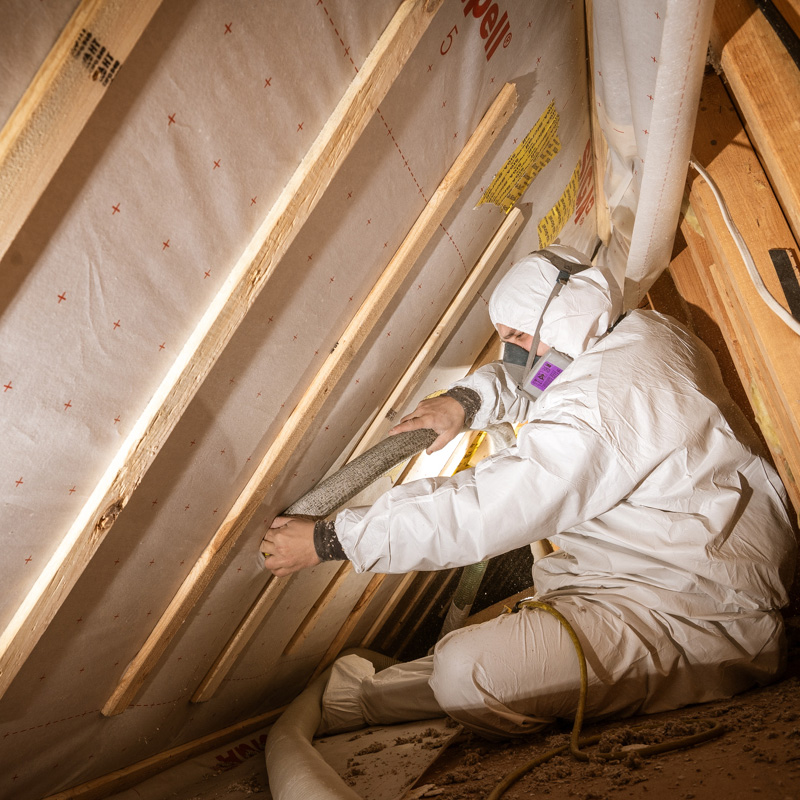
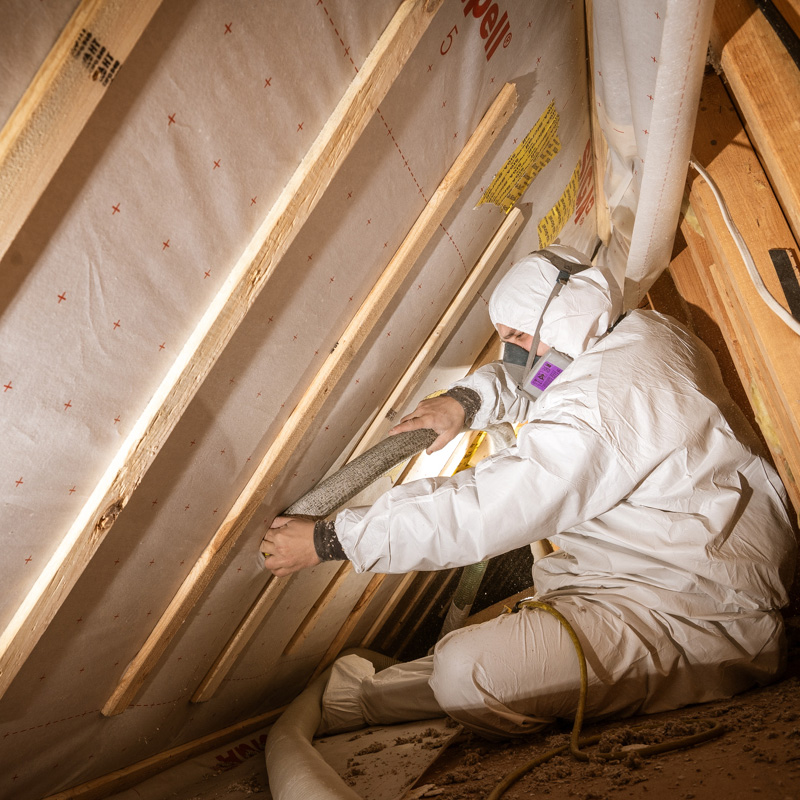
A fill tube is inserted through each hole and pushed to the far end of the cavity. Cellulose is blown in under pressure from a truck-mounted machine. As the cavity fills, the installer slowly withdraws the tube, packing material tightly to 3.5 lb/ft3. If the installer hits an obstruction - a fire stop or cross brace - an additional hole is drilled above or below to ensure complete coverage.
Step 4: Plug and Patch
Holes are plugged with tight-fitting wooden plugs or foam, and the exterior finish (siding, shingle) is replaced. For interior holes, the plugs are covered with joint compound and sanded smooth for painting.
A full wall insulation project on a typical 1,500-square-foot Cape or colonial takes one to two days.
Vapor Considerations in Maine's Climate
Maine sits in Climate Zone 6, which means cold, dry winters and humid summers. This creates specific moisture dynamics in wall cavities that matter when choosing insulation.
In winter, warm humid indoor air migrates toward the cold exterior side of the wall. If that moisture reaches a surface cold enough to cause condensation, it can accumulate and cause problems. In summer, the flow reverses - humid outdoor air can drive moisture inward toward the cooler interior.
Dense-pack cellulose handles this well for several reasons:
It is vapor-permeable. Cellulose allows water vapor to pass through it rather than trapping it. Maine homes need wall assemblies that can dry in both directions, and cellulose accommodates that.
It absorbs and releases moisture. Cellulose fibers buffer modest moisture without losing thermal performance, managing the daily and seasonal humidity swings that Maine's climate produces.
The borate treatment resists mold. Even if temporary moisture events occur, borate-treated cellulose inhibits mold growth - a safety margin other materials do not offer.
Dense-pack slows convective moisture transport. The tight packing resists air movement, reducing the primary mechanism by which moisture enters wall cavities in cold climates.
For the vast majority of existing Maine homes with wood siding or vinyl over wood sheathing, dense-pack cellulose is a safe, effective, and well-proven wall insulation method with decades of performance data in our climate zone.
Why Dense-Pack Outperforms Old Fiberglass
If your home was built in the 1960s-1980s and has fiberglass batts in the walls, you might assume the insulation is doing its job. In many cases, it is not.
Fiberglass batts rely on being in full, continuous contact with the surfaces around them to perform at their rated R-value. When they sag, compress, pull away from studs, or develop gaps from settling, their real-world performance drops significantly. A 1/4-inch gap along the side of a fiberglass batt can reduce its effective insulating value by 30-40%.
Dense-pack cellulose does not have this problem. It fills the entire cavity uniformly under pressure. There are no gaps, no edges to pull away, no opportunity for settling. The material conforms to every irregularity in the framing and fills around every wire, pipe, and electrical box.
We do not remove existing fiberglass batts when installing dense-pack. The cellulose blows in around and through the old fiberglass, compressing it and filling the gaps that have developed over the decades. The result is a wall cavity that is fully and continuously insulated for the first time.
What It Costs
Wall insulation costs vary based on the number of exterior walls, the wall height (single story vs. two stories), siding type, and accessibility. For a typical Greater Portland home, wall insulation with dense-pack cellulose ranges from $3,000-$8,000 for the full exterior.
Efficiency Maine offers rebates on qualifying insulation work, which can reduce the out-of-pocket cost. Rebate amounts are income-dependent and change periodically. We check current availability as part of your project planning and apply rebates directly to your invoice.
Combined with attic insulation and air sealing, a comprehensive envelope project typically delivers a 20-40% reduction in heating costs.
Start with an Assessment
If your home was built before 1980, there is a reasonable chance your walls are empty or under-insulated. The only way to know for certain is to look.
During a free energy assessment, we check your walls along with your attic, basement, and the rest of the building envelope. When needed, we use a borescope to look inside the walls without causing any damage.
Horizon Homes has been insulating Maine homes since 2006. We are an Efficiency Maine Top Contractor for 10+ years, and dense-pack cellulose wall insulation is one of the core services we perform every week across Greater Portland.
Call (207) 221-3221 or schedule your free assessment online. We will tell you what is in your walls, what it is costing you, and what it would take to fix it.
Find our guides faster: add Horizon Homes as a preferred source on Google.
Free Home Energy Assessment
Wondering Where Your Home Is Losing Heat?
We walk through your home, identify insulation gaps and air leaks, and give you a prioritized plan with pricing and Efficiency Maine rebates.
- Free walkthrough, no equipment, no disruption
- Efficiency Maine rebates identified for you
- Written improvement plan with pricing
Schedule Your Free Assessment
We call within 1 business day.