Cold-Climate Heat Pump Performance: Real Maine Data
Somebody on a Maine subreddit posted last month that their neighbor's heat pump "stopped working at 10 degrees." The post got 200 comments. About a third of them were people sharing similar stories. Another third were people saying their heat pumps worked fine all winter. The remaining third were arguing about whether anyone's numbers were real.
This is the problem with the heat pump conversation in Maine right now. There is no shortage of opinions, but there is a shortage of data. Anecdotes travel faster than measurements. A neighbor who had a bad experience with a budget heat pump installed by a general contractor shapes the conversation more than a decade of field performance data from purpose-built cold-climate systems.
So here is the data. Not marketing claims, not manufacturer spec sheets, not what someone heard at the hardware store. Real performance numbers from Maine installations, from independent field studies, and from what happened during the coldest temperatures we have seen in recent years.
The Basics: What COP Means and Why It Matters
Before getting into the numbers, a quick primer on how heat pump efficiency is measured. The key metric is the Coefficient of Performance, or COP. It represents the ratio of heat energy output to electrical energy input.
- A COP of 1.0 means the system produces one unit of heat for every unit of electricity consumed. This is what an electric space heater or baseboard delivers - converting electricity directly to heat at a 1:1 ratio.
- A COP of 2.0 means you get twice as much heat energy as the electricity you pay for.
- A COP of 3.0 means three times the heat for the same electricity.
The higher the COP, the less electricity it takes to heat your home. And here is the critical point: even a COP of 1.5 means the heat pump is 50% more efficient than electric resistance heating. A COP above 1.0 at any outdoor temperature means the heat pump is producing heat for less money per BTU than a straight electric heater would.
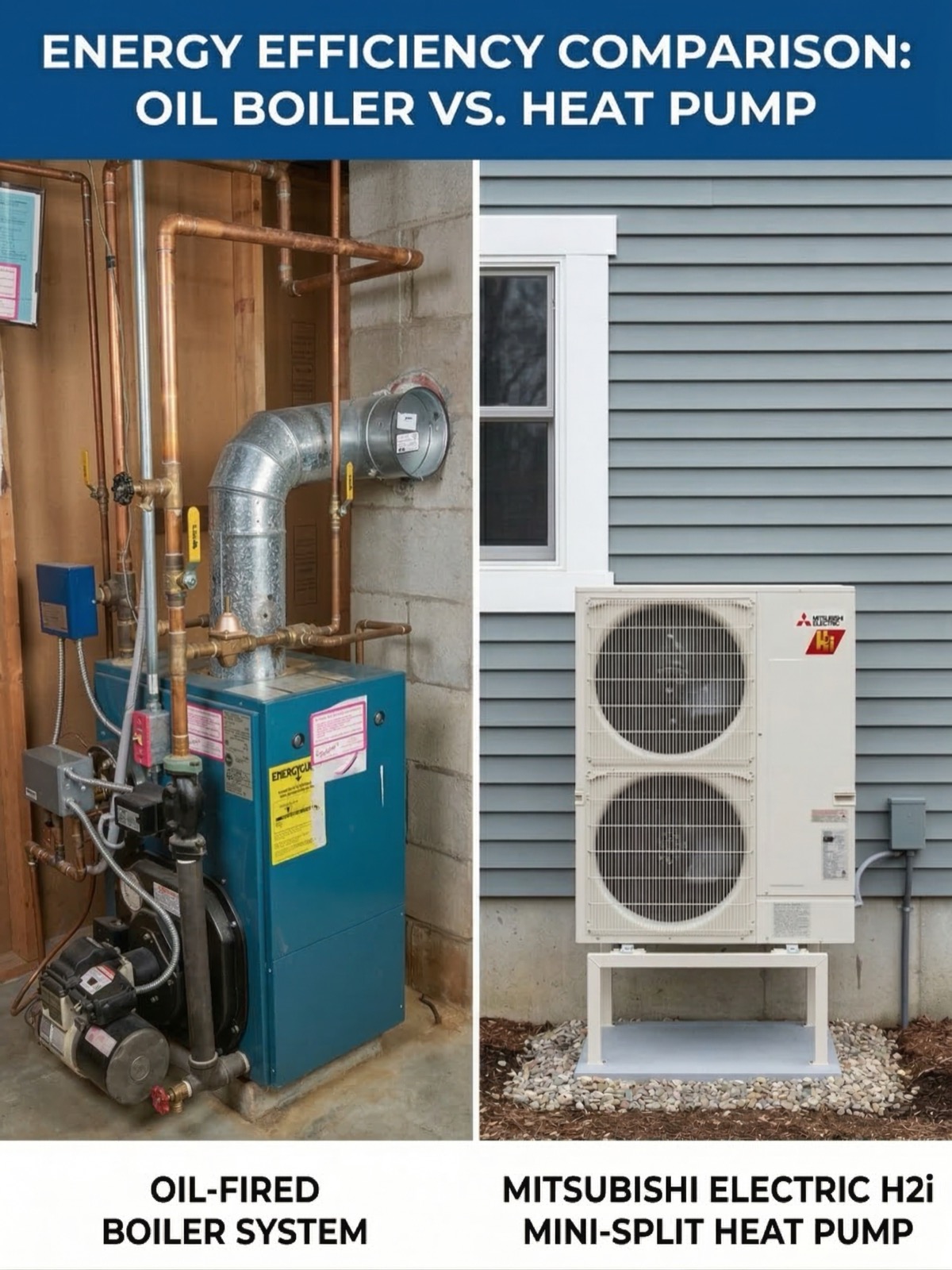
Oil and propane boilers, for reference, typically operate at 80-95% efficiency, meaning their effective COP is 0.8 to 0.95. A heat pump running at a COP of 2.0 in cold weather is still roughly twice as efficient as a high-efficiency oil boiler.
Cold-Climate Heat Pump COP at Various Temperatures
The Mitsubishi Hyper-Heat systems we install at Horizon Homes are rated for continuous operation down to -13 degrees Fahrenheit. Here is what their real-world COP looks like across the range of Maine winter temperatures:
| Outdoor Temperature | Approximate COP | Heat Output (% of rated capacity) | Context |
|---|---|---|---|
| 47 degrees F (mild day) | 3.5 - 4.0 | 100% | Peak efficiency, shoulder season |
| 32 degrees F (freezing) | 2.8 - 3.2 | 90-100% | Typical November/March day |
| 17 degrees F (cold) | 2.2 - 2.6 | 80-90% | Average January temperature, Portland |
| 5 degrees F (very cold) | 1.8 - 2.2 | 65-80% | Cold snap, still highly efficient |
| -5 degrees F (extreme) | 1.4 - 1.8 | 50-65% | Rare extreme cold |
| -13 degrees F (rated minimum) | 1.1 - 1.4 | 40-55% | System limit, still producing heat |
Several things stand out in this data. First, the COP stays above 2.0 for the vast majority of a Maine winter. Portland's average January temperature is around 22 degrees F. At that temperature, a cold-climate heat pump operates at roughly 2.3-2.8 COP - producing more than twice the heat energy compared to the electricity it consumes.
Second, even at -13 degrees F, the system maintains a COP above 1.0. It is still producing heat. It is still more efficient than electric resistance heating. The capacity is reduced, but it has not "stopped working."
Third, the drop-off is gradual, not sudden. There is no cliff where the system goes from working to not working. Performance decreases incrementally as the temperature drops.
Independent Field Study Data
Our installation experience aligns with larger independent studies. Several are worth highlighting:
Northeast Energy Efficiency Partnerships (NEEP) Cold-Climate Heat Pump Database
NEEP maintains a specification database of cold-climate heat pumps that have been tested and verified for performance at low temperatures. Their qualifying criteria require that systems maintain at least 70% of their rated heating capacity at 5 degrees F. The Mitsubishi Hyper-Heat systems meet this standard comfortably.
Efficiency Maine Heat Pump Data
Maine is one of the most significant heat pump markets in the country. As of early 2026, there are over 143,000 heat pumps installed in Maine - a state with roughly 580,000 households. That means approximately one in four Maine homes now has at least one heat pump. This is not a pilot program or an early-adopter experiment. It is a proven, widely deployed technology operating in one of the coldest states in the country.
Efficiency Maine has tracked heat pump adoption and performance since the program's inception. Their data consistently shows that properly installed cold-climate heat pumps reduce heating costs for Maine homeowners, with savings varying based on the fuel being displaced, the home's insulation level, and the system's sizing.
The January 2024 Cold Snap
In January 2024, the Greater Portland area experienced an extended cold stretch with overnight lows reaching -10 to -15 degrees F for several consecutive days. Daytime highs barely reached single digits. This was exactly the kind of weather event that heat pump skeptics point to.
Here is what we observed across our customer base during that period:
- Systems continued to operate and produce heat throughout the event
- Electrical consumption increased (as expected - lower COP means more electricity per BTU of heat)
- No systems failed or shut down due to temperature
- Customers with well-insulated homes (those who had done air sealing and insulation before or alongside the heat pump installation) maintained comfortable indoor temperatures throughout
- Customers who relied solely on heat pumps without supplemental heat in poorly insulated homes reported that the system ran continuously but struggled to maintain temperature in the coldest rooms during the lowest overnight temperatures
That last point is important and worth discussing honestly.
The Honest Conversation: When Heat Pumps Need Help
A cold-climate heat pump installed in a well-insulated home can serve as the primary heat source for a Maine winter. A cold-climate heat pump installed in a poorly insulated home will work hard, use more electricity, and may not keep every room at your target temperature during the coldest stretches.
This is not a heat pump problem. It is a building envelope problem. When a home is losing heat faster than the system can replace it - through uninsulated walls, a drafty attic, or air leaks throughout the structure - no heating system performs well. An oil boiler in the same house would be running constantly and burning through fuel.
The difference is that an oil boiler produces the same BTU output regardless of outdoor temperature (it just cycles on and off), while a heat pump's capacity decreases as the temperature drops. In an under-insulated home, that reduced capacity at low temperatures can create a gap between heat production and heat loss.
This is exactly why we advocate for the insulation-first approach. Address the building envelope, reduce the heating load, and then the heat pump can handle the job even during the coldest weather. We have customers with well-insulated homes running Mitsubishi cold-climate systems as their sole heat source through multiple Maine winters with no issues.
For homes where the envelope cannot be fully addressed (budget constraints, historic preservation, structural limitations), we consider a hybrid system: an existing or high-efficiency propane or natural gas boiler for primary heat, with cold-climate heat pumps for cooling and supplemental heat. Fully electric systems may use electric resistance heating for backup.
Thinking about a cold-climate heat pump for your home? The first step is understanding your building envelope. Schedule a free energy assessment and we will evaluate both your insulation and your heating needs together. Call (207) 221-3221 or book online.
Seasonal COP: The Number That Actually Matters
Individual temperature-point COP values are useful for understanding how the system behaves at a specific moment. But what most homeowners care about is the overall efficiency across an entire heating season. This is called the Heating Seasonal Performance Factor (HSPF) or, in newer testing standards, HSPF2.
For a cold-climate heat pump in Maine's Climate Zone 6, the seasonal COP - accounting for the full range of temperatures from mild fall days to the coldest January nights - typically lands between 2.0 and 2.8 depending on the specific model, installation quality, and home characteristics.
What that means in practical terms: over the course of an entire Maine heating season, a cold-climate heat pump produces roughly 2 to 2.8 units of heat for every unit of electricity consumed. Compare that to:
- Electric baseboard: seasonal COP of 1.0
- Oil boiler (85% efficient): effective seasonal COP of ~0.85
- Propane boiler (92% efficient): effective seasonal COP of ~0.92
- Natural gas boiler (95% efficient): effective seasonal COP of ~0.95
Even at the low end of the range, a cold-climate heat pump is more than twice as efficient as any combustion heating system across a full Maine winter.
Energy Cost Comparison
Efficiency matters, but what homeowners really want to know is cost. Here is how the economics work out at current Maine energy prices:
| Heating Source | Fuel Cost | Seasonal Efficiency | Cost per Million BTU |
|---|---|---|---|
| Oil boiler | ~$3.80/gallon | 85% | ~$32.20 |
| Propane boiler | ~$3.20/gallon | 92% | ~$38.00 |
| Electric baseboard | ~$0.22/kWh | 100% | ~$64.50 |
| Cold-climate heat pump | ~$0.22/kWh | COP 2.4 (seasonal avg) | ~$26.90 |
System fit depends on the home's heating distribution and comfort needs. In a hybrid setup, the boiler provides primary heat through the existing distribution system, while a cold-climate heat pump adds cooling, zone control, and supplemental heat.
The savings vary by home. A typical Maine home that converts from oil to a cold-climate heat pump system (with proper insulation) can expect heating cost reductions of 30-50%. For a home currently spending $4,000 per year on oil, that translates to $1,200-$2,000 in annual savings.
System Sizing: Why It Matters for Performance
One factor that significantly affects real-world performance is system sizing. An oversized heat pump short-cycles (turns on and off frequently), which reduces efficiency and causes temperature swings. An undersized system runs continuously during cold weather and may not maintain temperature.
Proper sizing requires a load calculation that accounts for the home's insulation level, air leakage rate, window area, and other factors. This is another reason the building envelope matters - a home with good insulation and air sealing has a lower heating load, which means a smaller, less expensive heat pump can do the job.
At Horizon Homes, we size heat pump systems based on the home's actual heating load, not rules of thumb or square footage estimates. For homes where we are doing both weatherization and heat pump installation, we size the heat pump for the improved envelope - not the current one. This means the system is right-sized for the home it will actually be heating, which translates to better efficiency, longer equipment life, and more consistent comfort.
The 143,000 Heat Pump Baseline
Here is perhaps the most compelling data point of all: Maine has over 143,000 heat pumps installed. The state's climate is one of the coldest in the country. If cold-climate heat pumps did not work in Maine winters, we would know by now. There would not be 143,000 of them running.
The technology works. The data proves it. The remaining questions are not about whether heat pumps can handle Maine winters - they clearly can - but about whether your specific home is ready for one and what the right system looks like for your situation.
That is a question we can answer. Schedule a free energy assessment or call (207) 221-3221. We will look at your home, evaluate the building envelope, and give you honest numbers on what a cold-climate heat pump would do for your heating costs and comfort. We have been doing this in Greater Portland since 2006 - through some of the coldest winters on record - and the data from our own installations matches what the studies show.
Find our guides faster: add Horizon Homes as a preferred source on Google.
Free Home Energy Assessment
Considering Heat Pumps for Your Home?
We evaluate your home's insulation, heating system, and electrical capacity, then give you a clear recommendation with pricing and rebate estimates.
- Free walkthrough, no equipment, no disruption
- Efficiency Maine rebates identified for you
- Written improvement plan with pricing
Schedule Your Free Assessment
We call within 1 business day.