Radon, Moisture, and Mold: What Every Maine Basement Needs
Editor's note (October 2026): Efficiency Maine changed its insulation and air sealing rebates for work completed on or after October 1, 2026. They are now a fixed amount per zone of the house (attic, walls, basement) instead of a percentage of project cost, so the insulation rebate figures, combined totals, and cost examples below reflect the program when this article was published. See current Efficiency Maine rebates.
We were insulating a basement in Scarborough last fall when the homeowner mentioned something offhand: "We tested for radon a few years ago. It was high, but we never did anything about it."
That is more common than you might think. Maine ranks among the top states in the country for residential radon exposure. The EPA estimates that nearly one in three Maine homes tested above the action level of 4 pCi/L. And the basement is where it starts.
Here is what most homeowners do not realize: basement insulation and air sealing do not just lower your heating bills. Done correctly, they also reduce how easily radon, moisture, and mold enter your living space. These are connected problems, and addressing one often helps with the others.
Why Maine Basements Are Different
Maine's geology is the root cause. Granite bedrock and glacial soils across southern and central Maine contain naturally occurring uranium, which decays into radon gas. That gas seeps up through soil, enters your home through cracks in the foundation, gaps around pipes, sump pits, and dirt floors, and accumulates in the basement.
Most older Maine homes have one of three basement types:
- Poured concrete (post-1960's): Fewer cracks, but still vulnerable at the floor-wall joint, pipe penetrations, and any settling cracks.
- Block or cinder block (1940's-1970's): Porous by nature. Radon and moisture pass through the block itself, not just through cracks.
- Fieldstone or rubble (pre-1940's): The most permeable. Gaps between stones provide direct pathways for soil gas and moisture.
All three types share one thing in common: without insulation and air sealing, the basement acts as an open door between the soil and your living space.
The Connection Between Insulation, Radon, and Moisture
Think of your basement as the lungs of your house. Due to the stack effect, warm air rises through the house and exits at the attic. Replacement air gets pulled in at the lowest point, which is the basement. If your basement has gaps, cracks, and open pathways to the soil, you are pulling radon-laden, moisture-heavy air directly into your home's airflow.
Proper basement insulation and air sealing reduce this pathway. When we insulate a basement, we are doing several things at once:
- Sealing rim joists with polyiso rigid foam and caulk, closing off the largest air leaks at the top of the foundation wall
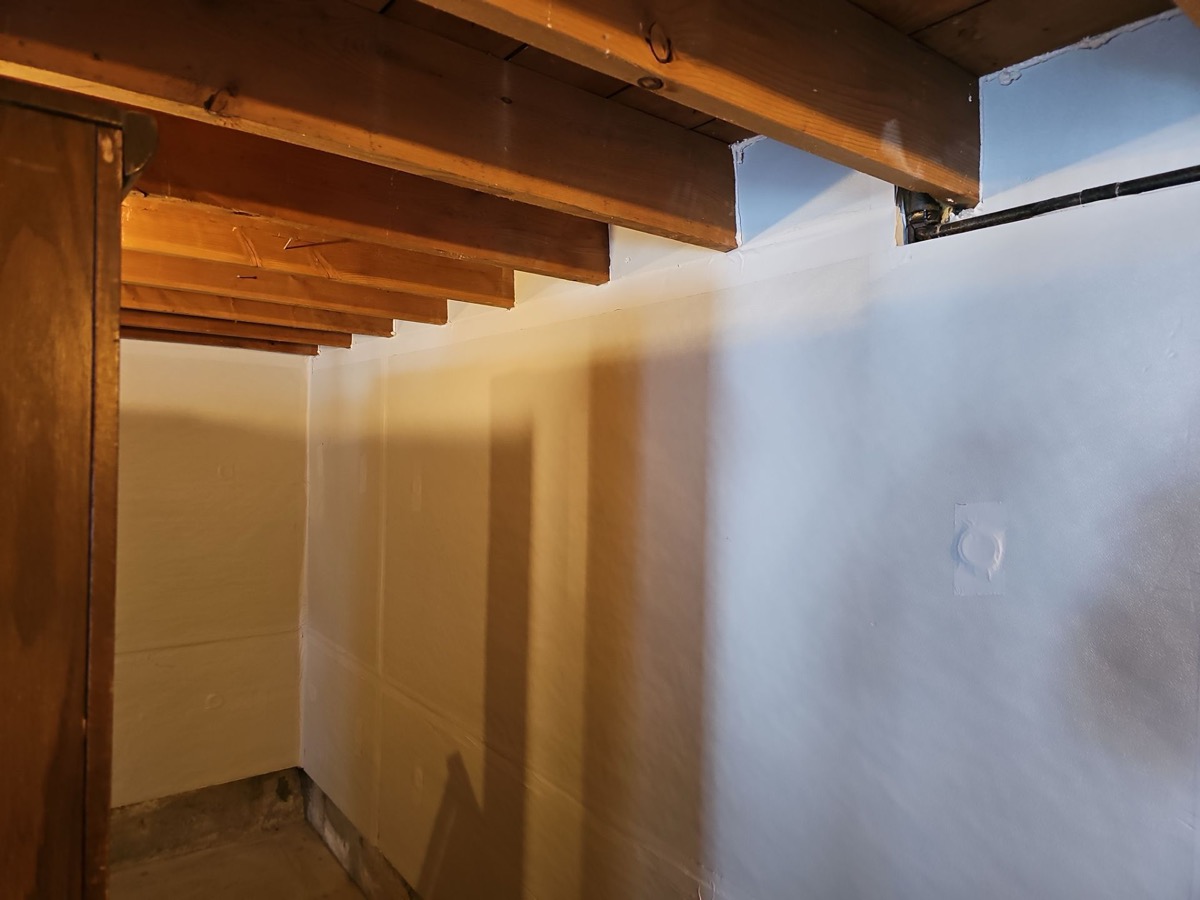
- Insulating foundation walls to reduce condensation (cold surfaces attract moisture from warm indoor air)
- Air sealing penetrations where pipes, wires, and ducts pass through the floor framing
- Reducing the pressure difference that draws soil gas up through the foundation
This does not replace a radon mitigation system if your levels are high. We do not install radon systems. But it does reduce the volume of unconditioned, potentially contaminated air entering your home through the basement.
Moisture: The Problem You Can See (and Smell)
Radon is invisible and odorless. Moisture is not. If your basement smells musty, has visible condensation on walls or pipes during summer, or shows white mineral deposits (efflorescence) on the foundation, you have a moisture problem.
In Maine, basement moisture comes from two sources:
Bulk water enters through cracks, window wells, and foundation joints during rain or snowmelt. This is a drainage problem. Insulation does not fix it. You need gutters, grading, and sometimes interior or exterior drainage before insulation work begins.
Vapor and condensation occur when warm, humid air contacts cold foundation walls. In summer, outdoor humidity condenses on cool basement surfaces. In winter, warm indoor air condenses on cold, uninsulated walls. This is where insulation makes a direct difference.
By insulating foundation walls with rigid foam, you raise the surface temperature of the wall above the dew point. No condensation forms. No moisture feeds mold growth. The basement stays drier without a dehumidifier running around the clock.
Schedule a free energy assessment and we will walk through your basement to identify insulation gaps, air leaks, and moisture issues. This is a visual walkthrough of your home, not a diagnostic test.
Mold: The Result of Ignoring Both
Mold needs three things: moisture, organic material, and temperatures above 40 degrees. A Maine basement in spring and summer provides all three. Moisture from condensation or seepage feeds mold that grows on wood framing, paper-faced drywall, cardboard boxes, and even dust on concrete.
The health effects are real. Mold spores travel upward through the house on the same airflow that carries radon. If 40-60% of the air you breathe on the first floor originated in the basement (a widely cited building science figure), then mold in the basement is mold in your living room.
Insulating the basement breaks the cycle. Warmer walls mean less condensation. Sealed rim joists mean less humid outside air infiltrating in summer. Reduced stack effect means less basement air circulating through the house.
What a Basement Insulation Project Looks Like
Every basement is different, but here is a general outline of what we do:
Assessment: We evaluate the foundation type, moisture history, existing insulation (or lack of it), and air leaks at the rim joist and penetrations.
Moisture first: If there are active water intrusion issues, those need to be resolved before insulation. We will tell you if grading, drainage, or waterproofing work is needed first.
Rim joist insulation and air sealing: This is the highest-impact step. The rim joist area (where the floor framing meets the top of the foundation) is the leakiest part of most basements. We seal it with cut-and-cobble polyiso rigid foam, caulked at all edges.
Foundation wall insulation: For concrete and block foundations, rigid foam board applied to the wall interior. For rubble and fieldstone foundations, we subcontract spray foam, which is the only material that can conform to irregular stone surfaces.
Penetration sealing: Every pipe, wire, and duct that passes through the floor or foundation gets sealed with appropriate materials.
The result is a basement that is warmer, drier, and far less connected to the soil beneath it.
Rebates for Basement Insulation
Basement insulation qualifies for Efficiency Maine weatherization rebates. Efficiency Maine pays a fixed amount per zone of the house, depending on your household income. For a large basement zone with at least 500 square feet insulated, you can receive:
- Any income: $2,000
- Moderate income: $3,000
- Low income: $4,000
Rebate amounts are income-dependent. Smaller zones (250 to 499 square feet) pay $1,000, $1,500, and $2,000, and air sealing earns a separate amount. The limit is $8,600 per home over the life of the building, across all weatherization work (attic, walls, and basement combined). We handle all the Efficiency Maine paperwork and deduct the rebate directly from your bill.
A Note on Radon Testing
If you have not tested your home for radon, do it. Test kits are available at most hardware stores for under $20, or you can order one from the Maine CDC. If your results come back above 4 pCi/L, contact a licensed radon mitigation contractor to install a sub-slab depressurization system.
Then call us about the basement insulation. The two projects work together. A radon system creates negative pressure under the slab to vent gas outside. Basement air sealing reduces the number of pathways gas can use to bypass that system. Neither one alone is as effective as both together.
Start With What You Can See
Your basement is telling you something. Musty smells, condensation, cold floors above, mineral stains on the walls. These are all signs that air, moisture, and potentially radon are moving freely between the soil and your living space.
Fixing it starts with understanding what is happening down there.
Schedule your free energy assessment and we will evaluate your basement alongside the rest of your home. Or call us at (207) 221-3221. Horizon Homes has been insulating Maine basements for 20+ years, and we have seen every foundation type this state has to offer.
Find our guides faster: add Horizon Homes as a preferred source on Google.
Free Home Energy Assessment
Dealing With This in Your Home?
Most comfort problems trace back to insulation, air sealing, or heating system issues. A free walkthrough identifies the root cause.
- Free walkthrough, no equipment, no disruption
- Efficiency Maine rebates identified for you
- Written improvement plan with pricing
Schedule Your Free Assessment
We call within 1 business day.