What Is R-Value and Why It Matters in Maine
We were at a neighborhood cookout in Westbrook when someone said, "My contractor told me R-30 is plenty for Maine."
Three of us turned around at the same time. Two were homeowners who had recently insulated. One was an insulation installer (not from our company). All three said the same thing: R-30 is not enough for a Maine attic.
That exchange stuck with me because it captures the core problem with R-value. It is the single most important number in home insulation, but most homeowners have never heard a clear explanation of what it means, what numbers to aim for, or how to check what they currently have.
This guide is that clear explanation.
R-Value in Plain Language
R-value measures a material's ability to resist heat flow. The higher the number, the better the material slows heat from moving through it.
Think of it like a winter coat. A thin fleece jacket has a low R-value - heat passes through it quickly. A thick down parka has a high R-value - it holds heat in and keeps cold out. Insulation works the same way for your house.
R-value is additive. If you have an existing layer of R-15 insulation in your attic and add R-35 on top, your total is R-50. Each layer contributes its own resistance to heat flow, and the layers stack. The scale is linear, so R-50 is roughly twice as effective as R-25.
Why R-Value Matters More in Maine
Maine sits in Climate Zone 6, one of the coldest climate zones in the United States. The colder it gets outside, the harder heat pushes to escape your home. This is basic physics - heat always moves toward cold, and the bigger the temperature difference, the faster it moves.
On a January night in Portland when it is 5 degrees outside and 68 degrees inside, you have a 63-degree temperature differential driving heat through every surface of your building envelope. In a milder climate like Virginia (Zone 4), that differential might be 30-40 degrees. The same insulation works twice as hard in Maine because the driving force is twice as strong.
This is why Maine's recommended R-values are higher than national averages. The climate demands more insulation to achieve the same level of comfort and energy efficiency.
Maine Zone 6 R-Value Targets
Here are the current recommended R-values for Maine homes. These come from the International Energy Conservation Code (IECC) as adopted by the state.
Attic / Ceiling: R-49 to R-60. This is the single most important number. Heat rises, and your attic floor is where the most heat escapes. We recommend R-50 as the target for attic retrofits, with R-60 for new construction.
Walls: R-20 for new construction. For existing 2x4 walls filled with dense-pack cellulose, you get approximately R-13. This is a significant improvement over empty cavities, even though it falls short of the new construction target. Adding exterior rigid foam during a siding replacement can bring walls to R-25 or higher.
Basement / Crawlspace Walls: R-15 to R-20. Rigid foam board (polyiso) on flat basement walls delivers approximately R-6 per inch. Two to three inches gets you into the target range.
Rim Joist: R-20 minimum. The rim joist is the perimeter of each floor where it meets the exterior wall. This area is a major source of air leakage and heat loss in older homes.
Floor Over Unconditioned Space: R-30. This applies to floors over unheated garages, open porches, or cantilevers.
How to Check Your Current R-Value
You don't need special equipment to get a rough sense of your insulation levels. Here is how to check the three main areas.
Attic
If you have an accessible attic, grab a flashlight and a tape measure. Open the hatch or pull-down stairs and look at the insulation on the attic floor.
Measure the depth. Push a ruler or tape measure straight down through the insulation to the drywall below. Record the depth in inches.
Identify the material. Loose gray or greenish material that looks like shredded paper is cellulose (approximately R-3.7 per inch). Loose yellow, white, or pink material that looks like cotton candy is fiberglass (approximately R-2.5 per inch). Pink, yellow, or white batts with a paper or foil facing are fiberglass batts (approximately R-3.1 per inch).
Calculate your R-value. Multiply the depth in inches by the R-value per inch for your material. Ten inches of cellulose is roughly R-37. Six inches of loose fiberglass is roughly R-15.
Most Maine homes built before 1990 have somewhere between R-11 and R-30 in the attic. Many older homes have less than R-11. The target is R-50, so any measurement below that represents an opportunity for improvement.
Walls
Wall insulation is harder to check without invasive testing. Here are a few indicators.
When was your home built? Homes built before 1960 often have no wall insulation. Homes built from the 1960's through the 1980's may have some fiberglass batts, often poorly installed. Homes built after 1990 are more likely to meet the insulation standards of their era, though those standards were lower than today's.
Remove an outlet cover on an exterior wall. Turn off the power to the circuit first. Then remove the outlet cover plate and shine a flashlight into the gap around the electrical box. You may be able to see whether there is insulation in the cavity, and what type.
Check for cold spots. On a cold day, feel the interior surface of your exterior walls. A well-insulated wall should feel close to room temperature. Noticeably cold walls suggest missing or inadequate insulation.
Want to know exactly where your insulation stands? Schedule a free energy assessment and we will check every accessible area of your home. We identify what you have, where the gaps are, and what improvements will make the biggest difference. Call (207) 221-3221 or book online.
Basement
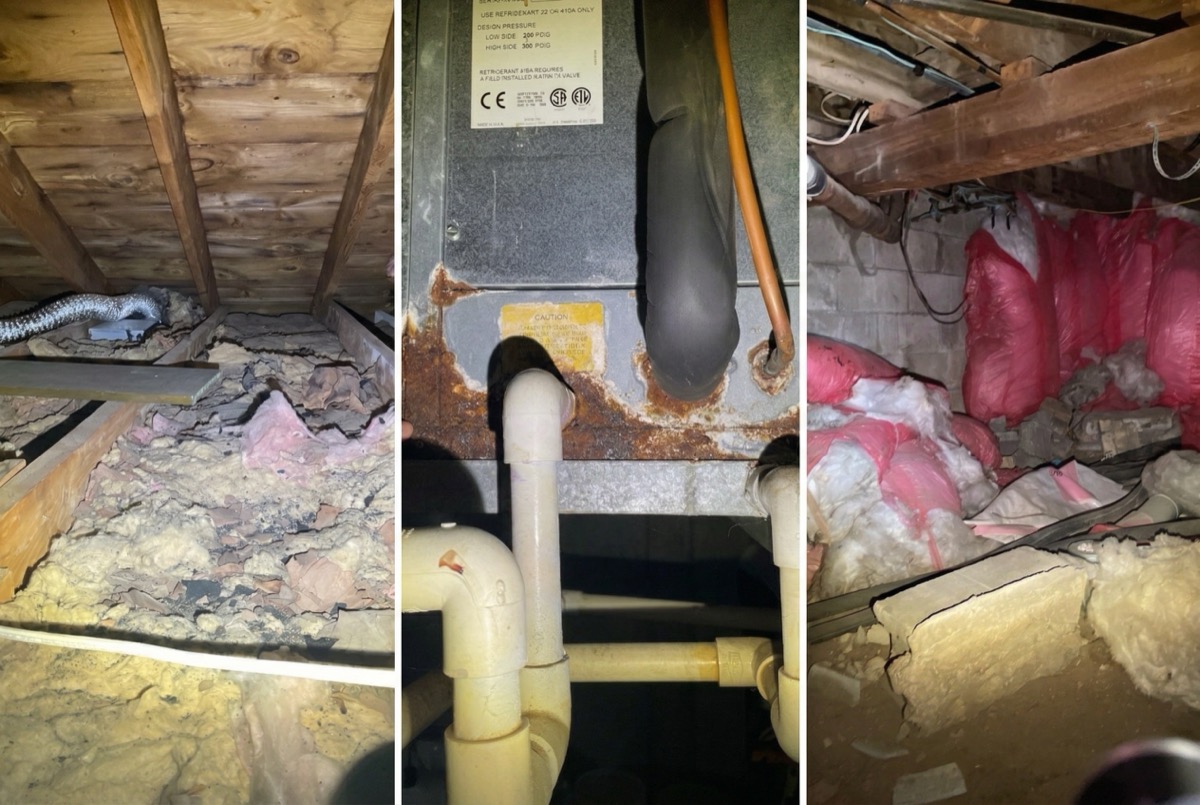
Walk your basement and look at the walls and rim joist area. Bare concrete or stone foundation walls with no covering mean zero insulation. The rim joist - where the wood framing begins atop the foundation wall - is the most commonly uninsulated area in Maine basements.
When Does Adding More Insulation Make Sense?
The law of diminishing returns applies to insulation. The first inch of insulation in an uninsulated space saves far more energy than the last inch added to an already-insulated space. Here is a rough guide.
High priority - the biggest savings:
- Attic below R-30 (topping up to R-50 is almost always worth doing)
- Empty wall cavities (going from R-0 to R-13 with dense-pack cellulose)
- Uninsulated basement walls and rim joists
Moderate priority:
- Attic at R-30 to R-38 (topping up to R-50 still pays back within 5-7 years in most Maine homes)
- Walls at R-13 where exterior foam is feasible during a siding project
Lower priority:
- Attic already at R-49 or higher (diminishing returns beyond this point)
- Walls at R-13 with no siding project planned (the cost of adding exterior foam to intact siding is hard to justify on energy savings alone)
The right priorities depend on your specific home, your heating costs, and what rebates you qualify for. An energy assessment puts all of this into context.
R-Value Is Not the Whole Story
R-value is critical, but it is only one part of how your home manages heat. Two other factors matter at least as much.
Air Sealing
Insulation resists heat flow through materials. Air sealing stops heat from escaping through gaps, cracks, and openings in your building envelope. A home can have R-50 in the attic and still lose enormous amounts of heat if there are air leaks around the attic hatch, plumbing penetrations, recessed light fixtures, and electrical boxes.
Air sealing and insulation work together. Neither one alone delivers the full benefit. This is why we always address air sealing as part of any insulation project, and it is a core part of our whole-home approach.
Installation Quality
The same insulation material installed two different ways can perform quite differently. Fiberglass batts that are compressed, gapped, or cut short lose a significant portion of their rated R-value. Dense-pack cellulose installed at less than the proper density (3.5 pounds per cubic foot for walls) will settle over time and leave gaps.
Proper installation is why we use cellulose almost exclusively for retrofit work. When blown at the correct density, cellulose fills cavities completely and maintains its performance for the life of the home - 30 years or more.
Common R-Value Misconceptions
"My home is well insulated - it was insulated when it was built." A home built in 1975 was insulated to 1975 standards, which were a fraction of today's requirements. Building codes have increased insulation requirements repeatedly over the decades, and for good reason.
"I added insulation five years ago, so I'm fine." Possibly. But if you added insulation to the attic without air sealing first, the insulation may be less effective than its R-value suggests. And if only the attic was addressed while walls and basement were left untouched, you still have major heat loss pathways.
"Higher R-value always means better." R-value measures one property - resistance to conductive heat flow. It doesn't account for air leakage, moisture management, or installation quality. The right insulation depends on where it is going and how it interacts with the rest of the building assembly.
What the Numbers Mean for Your Heating Bills
For a typical 1,800 square foot Maine home heated with oil, going from poor insulation (R-11 attic, empty walls, uninsulated basement) to proper levels (R-50 attic, R-13 walls, R-15 basement with air sealing) typically reduces heating costs by 20-40%. On a $3,500 annual heating bill, that translates to $700 to $1,400 per year in savings.
These savings compound with other improvements. Pairing insulation upgrades with a cold-climate heat pump can push total energy savings to 50% or more, because the heat pump runs more efficiently when the home retains heat better.
Take the First Step
Checking your insulation is something any homeowner can start on their own. Grab that flashlight, measure your attic depth, and see where you stand against the R-50 target. For walls and basement areas that are harder to assess, a professional walkthrough gives you the full picture.
Horizon Homes has been helping Maine homeowners understand and improve their insulation since 2006. As an Efficiency Maine Top Contractor for 10+ years, we know what works in this climate. Schedule your free energy assessment or call (207) 221-3221 to find out where your home stands.
Find our guides faster: add Horizon Homes as a preferred source on Google.
Free Home Energy Assessment
Wondering Where Your Home Is Losing Heat?
We walk through your home, identify insulation gaps and air leaks, and give you a prioritized plan with pricing and Efficiency Maine rebates.
- Free walkthrough, no equipment, no disruption
- Efficiency Maine rebates identified for you
- Written improvement plan with pricing
Schedule Your Free Assessment
We call within 1 business day.