Cathedral Ceiling Insulation Options for Maine
Editor's note (October 2026): Efficiency Maine changed its insulation and air sealing rebates for work completed on or after October 1, 2026. They are now a fixed amount per zone of the house (attic, walls, basement) instead of a percentage of project cost, so the insulation rebate figures, combined totals, and cost examples below reflect the program when this article was published. See current Efficiency Maine rebates.
The upstairs bedroom is sweltering in July and freezing in January. The homeowner cranks the heat but the room never catches up. Ice dams form along the eaves every winter, sometimes two feet thick. And the heating bill seems to climb every year no matter what they do.
If this sounds familiar and you have cathedral ceilings - where the finished ceiling follows the slope of the roof instead of having a flat attic above - the two problems are almost certainly connected. Cathedral ceilings are among the most challenging areas to insulate in any Maine home, and they are often the area where the existing insulation is most inadequate.
This guide walks through every option for insulating cathedral ceilings, step by step, including when to use each approach and how they combine into hybrid solutions for the trickiest situations.
Why Cathedral Ceilings Are the Hardest to Get Right
In a home with a flat ceiling and a full attic above, insulating is straightforward. You air seal the attic floor, blow in 14-16 inches of cellulose, and reach R-49 or better. The attic gives you all the depth you need.
Cathedral ceilings do not give you that depth. The rafter cavity - the space between the roof deck and the finished ceiling - is the only location for insulation, and it is limited by the lumber size:
| Rafter Size | Cavity Depth | Max R-Value (Cellulose) | Maine Target |
|---|---|---|---|
| 2x6 | 5.5 inches | R-20 | R-49 |
| 2x8 | 7.25 inches | R-26 | R-49 |
| 2x10 | 9.25 inches | R-33 | R-49 |
| 2x12 | 11.25 inches | R-41 | R-49 |
Most Maine Capes and A-frames built between the 1950's and the early 1980's have 2x6 or 2x8 rafters. That leaves you at roughly 40-50% of the target R-value even if the cavities are perfectly filled. And in our experience, they rarely are - many cathedral ceilings in this era were built with no insulation at all, or with compressed fiberglass batts that have shifted and left gaps.
The other challenge is ventilation. A properly functioning roof assembly needs a path for air to move from the soffits to the ridge above the insulation. In a cathedral ceiling, this ventilation channel shares space with the insulation cavity, further reducing the available depth for insulation.
Step 1: Assess the Existing Roof Assembly
Before choosing an insulation approach, we need to understand what we are working with. The assessment covers:
Rafter size and spacing. This determines how much insulation depth is available. We measure from accessible areas - typically from the knee wall attic spaces on a Cape Cod or from the eave area.
Existing insulation. We check for current insulation type, depth, and condition. Some cathedral ceilings have compressed fiberglass, some have blown cellulose that has settled, and many have nothing at all.
Ventilation status. We check for soffit vents, ridge vents, and whether a clear air channel exists between the insulation and the roof deck. The presence or absence of ventilation paths affects the insulation approach significantly.
Roof condition and remaining life. If the roof is within 5-10 years of replacement, certain approaches (like adding rigid foam above the deck during re-roofing) become much more cost-effective.
Interior ceiling finish. Drywall, tongue-and-groove boards, or plaster - each affects access options and whether the insulation can be installed without removing the ceiling.
Signs of moisture problems. Water stains, mold, frost on nail tips in winter - all indicators of condensation issues that must factor into the insulation plan.
Step 2: Choose the Right Approach
Cathedral ceiling insulation is not one-size-fits-all. The right method depends on rafter depth, ventilation status, roof condition, and budget. Here are the options, from simplest to most comprehensive.
Option A: Dense-Pack Cellulose (When Depth Allows)
Best for: 2x10 or larger rafters with existing ventilation baffles, or when a ventilation channel can be installed.
If the rafter depth is sufficient to achieve reasonable R-value after accounting for a 1-inch minimum ventilation channel, dense-pack cellulose is our preferred approach. It fills the cavity completely with no gaps, provides excellent thermal performance, and handles moisture cycling well.
The process:
- Install rigid ventilation baffles in each rafter bay, running from the soffit to the ridge. These create a 1-inch minimum air channel between the insulation and the roof deck.
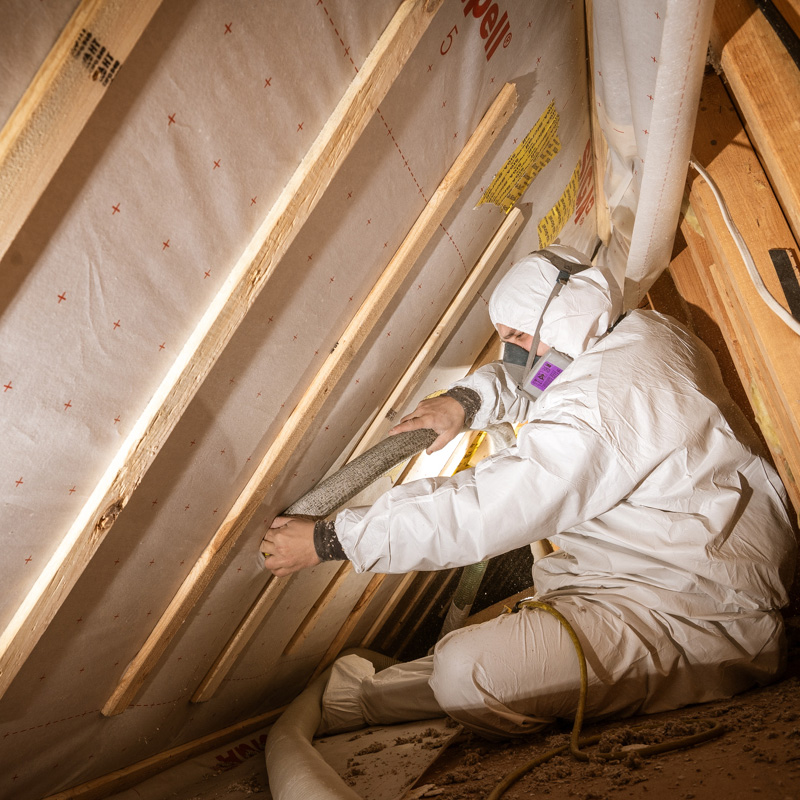
- Dense-pack cellulose into the remaining cavity depth through small holes drilled in the ceiling (or through the soffit area if accessible).
- Plug and patch the fill holes.
R-value achieved: For a 2x10 rafter with a 1-inch vent channel, approximately 8 inches of cellulose provides R-29. For a 2x12, approximately 10 inches provides R-36. Neither reaches R-49, but both represent major improvements.
Advantages: Lowest cost, no interior or exterior demolition, excellent moisture tolerance, no subcontracting needed.
Limitations: Not feasible in 2x6 or 2x8 rafters (too little depth after the vent channel).
Option B: Spray Foam (Subcontracted, for Shallow Rafters)
Best for: 2x6 or 2x8 rafters where cavity depth is too limited for cellulose with a vent channel.
Closed-cell spray foam provides R-6.5 to R-7 per inch - nearly double the R-per-inch of cellulose. In a shallow cavity where every inch counts, this higher R-value per inch makes spray foam the practical choice.
The process:
- Remove the interior ceiling finish (drywall or boards) to expose the rafter cavities. This is the disruptive part - the ceiling comes down.
- Our subcontracted spray foam specialists apply closed-cell foam to the desired thickness, typically filling the cavity or leaving a small gap depending on the assembly design.
- New drywall is installed over the foam.
R-value achieved: For a 2x6 rafter fully filled with closed-cell spray foam, approximately R-36 to R-38. For a 2x8, approximately R-47 to R-50.
Ventilation note: With closed-cell spray foam, the insulation creates its own air and vapor barrier directly against the roof deck. This is called an "unvented" or "hot roof" assembly. No ventilation channel is needed because moisture is prevented from reaching the roof deck by the spray foam barrier. This assembly must be designed correctly - it is not simply a matter of filling the cavity and hoping for the best.
Advantages: Highest R-value per inch, eliminates the need for a ventilation channel, provides air sealing and vapor barrier in one application.
Limitations: Requires ceiling removal, higher cost per square foot, requires subcontracted specialists, irreversible once applied.
Option C: Hybrid Approach (Spray Foam + Cellulose)
Best for: Situations where some spray foam is needed but full-cavity spray foam is cost-prohibitive.
The hybrid approach uses 2-3 inches of closed-cell spray foam against the roof deck (providing the air/vapor barrier and R-13 to R-20) followed by dense-pack cellulose filling the remainder of the cavity. This combines the air-sealing benefits of spray foam with the cost-effectiveness of cellulose.
The process:
- Remove interior ceiling to expose rafter cavities.
- Subcontracted specialists apply 2-3 inches of closed-cell spray foam directly to the roof deck.
- After the foam cures, we dense-pack cellulose into the remaining cavity depth.
- New drywall is installed.
R-value achieved: In a 2x8 rafter - 2 inches of spray foam (R-13) plus 5 inches of cellulose (R-18) = approximately R-31. In a 2x10 - 2 inches of spray foam (R-13) plus 7 inches of cellulose (R-25) = approximately R-38.
Advantages: Lower cost than full spray foam, better R-value than cellulose alone in shallow cavities, excellent air sealing at the critical roof deck interface.
Limitations: Still requires ceiling removal, still requires spray foam subcontractor.
Option D: Above-Deck Rigid Foam (During Re-Roofing)
Best for: Homes that need a new roof anyway.
When the roof is being replaced, rigid foam insulation can be added on top of the existing roof sheathing before the new roofing material goes on. This adds continuous insulation with zero thermal bridging through the rafters and does not require any work from inside the home.
The process:
- Strip old roofing down to the sheathing.
- Install one or more layers of rigid foam board (polyiso, typically 2-4 inches) over the sheathing.
- Install a second layer of sheathing (plywood or OSB) over the foam.
- Install new roofing (underlayment, shingles, or metal) over the new sheathing.
R-value achieved: 2 inches of polyiso adds R-12 to R-13. Combined with whatever is in the rafter cavities below, this can bring the total assembly to R-40 or higher.
Advantages: No interior disruption, adds continuous insulation (no thermal bridging), can be combined with cavity insulation for maximum R-value.
Limitations: Only practical during a re-roofing project, adds cost to the roofing budget, requires careful attention to fastener patterns and load paths.
Step 3: Address Air Sealing
Regardless of which insulation approach is used, air sealing at the ceiling plane is critical. Air leakage through a cathedral ceiling drives heat loss and moisture problems in roughly equal measure.
Key air sealing points include:
- Penetrations through the ceiling (light fixtures, ceiling fans, smoke detectors)
- The junction between the cathedral ceiling and flat ceiling sections
- The junction between the cathedral ceiling and knee walls
- Any electrical boxes, wires, or pipes that pass through the ceiling plane
For dense-pack cellulose installations, the density of the packed cellulose (3.5-4.0 pounds per cubic foot) provides meaningful air sealing within the cavity itself. For spray foam installations, the foam is inherently air-tight. In both cases, we seal penetrations and junctions with caulk and canned spray foam.
Step 4: Verify Ventilation (Vented Assemblies Only)
For cathedral ceilings using the vented approach (Options A and some configurations of Option C), proper ventilation must be verified after insulation is complete:
- Soffit vents are clear and unblocked by insulation
- Ventilation baffles are continuous from soffit to ridge in every rafter bay
- Ridge vent is present and functional
- Minimum 1-inch air channel is maintained throughout
For unvented assemblies (Options B and D), ventilation is intentionally eliminated by design. The spray foam or above-deck rigid foam creates the moisture barrier that ventilation would otherwise provide.
Ice Dam Prevention
Cathedral ceiling insulation and ice dams are directly connected. Ice dams form when heat escaping through the roof melts snow on the upper portions of the roof. The meltwater runs down to the eaves (which are colder because they extend beyond the heated space), refreezes, and builds up into a dam that forces water under the shingles.
Proper cathedral ceiling insulation - at adequate R-value with thorough air sealing - keeps the roof deck cold in winter, which prevents the melt cycle that causes ice dams. Every insulation approach described above will reduce ice dam formation. The more R-value achieved, the more complete the elimination.
What It Costs
Cathedral ceiling insulation costs vary significantly by approach:
- Dense-pack cellulose (no ceiling removal): $3,000-$6,000 for a typical Cape Cod upper floor
- Full spray foam (subcontracted, with ceiling removal): $8,000-$15,000
- Hybrid spray foam + cellulose: $6,000-$12,000
- Above-deck rigid foam (during re-roofing): $4,000-$8,000 additional to the roofing cost
Efficiency Maine pays a fixed amount per zone of the house for insulation and air sealing, set by income tier, up to $8,600 per home ($5,600 per mobile home). Rebate amounts are income-dependent. We manage the entire rebate process and deduct the amount from your invoice.
Energy savings from properly insulating a cathedral ceiling typically run 15-30% of total heating costs, depending on how much of the home's ceiling area is cathedral and how poorly insulated it was before.
Schedule a Free Energy Assessment
Horizon Homes has been solving cathedral ceiling insulation challenges in Maine homes since 2006. With 20+ years of experience, we have worked through every combination of rafter depth, ventilation condition, and budget constraint that Greater Portland homes can present.
A free home energy assessment is the starting point. We will evaluate your cathedral ceiling from accessible areas, determine rafter depth and current insulation conditions, and recommend the approach that makes the most sense for your home and budget.
Call (207) 221-3221 or schedule your free energy assessment online.
Related Guides
- Knee Wall Insulation for Maine Cape Cods - Often connected to cathedral ceiling areas
- Insulating Flat and Low-Slope Roofs in Maine - A related challenge with unique solutions
- Attic Floor Insulation Guide for Maine Homes - For the flat sections of your ceiling
- Insulating Bonus Rooms Over Garages in Maine - Another multi-surface insulation challenge
Find our guides faster: add Horizon Homes as a preferred source on Google.
Free Home Energy Assessment
Wondering Where Your Home Is Losing Heat?
We walk through your home, identify insulation gaps and air leaks, and give you a prioritized plan with pricing and Efficiency Maine rebates.
- Free walkthrough, no equipment, no disruption
- Efficiency Maine rebates identified for you
- Written improvement plan with pricing
Schedule Your Free Assessment
We call within 1 business day.