How to Insulate a Bonus Room Over a Garage
Editor's note (October 2026): Efficiency Maine changed its insulation and air sealing rebates for work completed on or after October 1, 2026. They are now a fixed amount per zone of the house (attic, walls, basement) instead of a percentage of project cost, so the insulation rebate figures, combined totals, and cost examples below reflect the program when this article was published. See current Efficiency Maine rebates.
Editor's note (August 2026): The federal 25C tax credits referenced in this article expired December 31, 2025 and are only available for qualifying work completed before that date. Efficiency Maine rebates remain available and are now the primary incentive for bonus room insulation projects.
"We just use it for storage now." That is what the homeowner in Falmouth told us when we asked about the finished room above his garage. It had carpet, painted walls, a ceiling fan, and a baseboard heater. It was designed as a bedroom. But by mid-December each year, the family stopped using it because no amount of heat could keep it comfortable. The baseboard heater ran continuously and the room still hovered around 55 degrees on cold nights.
He had tried adding a second heater. He had tried closing the heating vent to force more air to the room. He had even put up thermal curtains on the windows. Nothing worked, and after a few winters, they moved the kid to a bedroom on the main floor and turned the bonus room into a storage closet with wall-to-wall carpeting.
This story repeats itself across Greater Portland. Bonus rooms over garages are the single hardest rooms to insulate properly in a residential home. They have more exposed surfaces than any other room, they sit directly above unheated space, and they are almost always under-insulated when originally built. But they can be fixed. It takes a systematic approach that addresses all five surfaces of the room - not just one or two.
Why Bonus Rooms Are the Hardest
A standard bedroom on the second floor of a house has heated space on four of its six surfaces - the room below, the rooms on either side, and the hallway. Only the exterior wall and the ceiling above are exposed to cold. That means only two surfaces need robust insulation.
A bonus room over a garage has cold exposure on up to five of its six surfaces:
- The floor - sitting over the unheated garage
- The knee walls - short walls on either side where the roof slope meets the floor
- The sloped ceiling sections - following the roof pitch from the knee walls upward
- The flat ceiling - the horizontal section at the top (if present)
- The gable end walls - the exterior walls at the front and back of the room
Only the wall that connects the bonus room to the main house (the "back wall") faces heated interior space. Every other surface is either directly exposed to outdoor temperature or to the unheated garage below. This is why bonus rooms get cold - they are essentially surrounded by cold on five sides.
The Five-Surface Approach
Fixing a bonus room requires addressing every exposed surface as a connected system. Insulating the floor but ignoring the knee walls leaves massive thermal gaps. Insulating the knee walls but skipping air sealing underneath leaves convective loops that defeat the insulation. Every surface matters, and they must be treated together.
Surface 1: The Floor (Garage Ceiling Below)
The floor of the bonus room is the ceiling of the garage below. This surface is covered in detail in our Garage Ceiling Insulation Guide, but here is the summary:
Air seal first. Every penetration through the floor - electrical wires, plumbing pipes, HVAC ducts, the garage door opener mounting - is sealed with fire-rated materials. The garage ceiling is a fire separation between the garage and living space, so all sealing materials and the drywall on the garage side must be fire-rated.
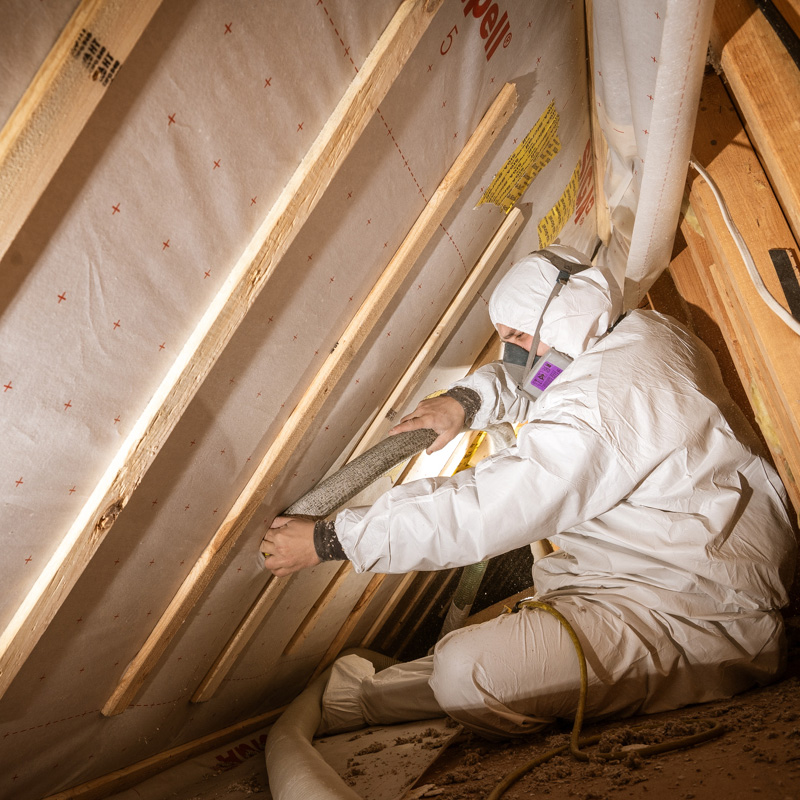
Blow cellulose. The floor joist cavities are filled with blown cellulose to the full cavity depth. For 2x10 joists, that is R-33. For 2x12 joists, R-41.
Do not skip the perimeter. The area where the floor joists meet the exterior walls (essentially the rim joist of the bonus room) must be insulated and sealed. This is often where the worst air leaks are concentrated.
Surface 2: The Knee Walls
The knee walls are the short vertical walls (typically 3-5 feet tall) on either side of the room where the roof slope meets the floor. Behind each knee wall is a triangular attic space that runs at close to outdoor temperature in winter.
This surface is covered in detail in our Knee Wall Insulation Guide. The essential steps:
Install an air barrier on the attic side. Rigid foam board or housewrap sealed at all edges, covering the entire attic face of the knee wall. This stops cold attic air from washing across the face of the insulation and destroying its effectiveness.
Dense-pack the stud cavities. Cellulose at 3.5-4.0 pounds per cubic foot fills the knee wall completely. R-13 for 2x4 walls, R-20 for 2x6 walls.
Insulate and air seal the knee wall attic floor. The floor of the triangular space behind the knee wall is also the ceiling of the room below the bonus room (or the garage ceiling extended). It must be air sealed and insulated just like any attic floor.
Surface 3: The Sloped Ceiling
The sloped ceiling sections run from the top of each knee wall up to where the flat ceiling begins (or up to the ridge if there is no flat ceiling). These are essentially cathedral ceiling sections, and they present the same depth limitations.
The approach depends on rafter size:
2x8 or larger rafters with ventilation baffles. Install rigid ventilation baffles in each rafter bay, then dense-pack cellulose in the remaining cavity depth. A 2x8 with a 1-inch vent channel provides approximately R-22. A 2x10 provides approximately R-29.
2x6 rafters (too shallow for cellulose with ventilation). Closed-cell spray foam (subcontracted) fills the cavity and provides higher R-value per inch. A fully filled 2x6 with spray foam provides approximately R-36.
Hybrid approach. 2-3 inches of spray foam against the deck (subcontracted) plus cellulose filling the remainder of the cavity combines the air-sealing benefits of foam with the cost-effectiveness of cellulose.
See our Cathedral Ceiling Insulation Guide for the full breakdown of options.
Surface 4: The Flat Ceiling
If the bonus room has a flat ceiling at the top (many do, with an attic space above), this is treated like any standard attic floor:
Air seal the attic floor. Seal all penetrations - wiring, light fixtures, ceiling fan mounts, HVAC connections.
Blow cellulose to R-49. The flat attic above the bonus room gets the same 14-15 inches of cellulose as any other attic floor. Install ventilation baffles at the eaves to maintain soffit-to-ridge airflow.
See our Attic Floor Insulation Guide for the complete process.
Surface 5: The Gable End Walls
The gable end walls are the full-height exterior walls at the front and back of the bonus room. These are standard exterior walls and are insulated with dense-pack cellulose using the same drilling and filling process described in our Exterior Wall Insulation Guide.
Dense-pack cellulose in 2x4 framing provides R-13. In 2x6 framing, R-20.
Air Sealing: The Thread That Connects Everything
The individual surfaces only perform well when air sealing ties them together into a continuous envelope. The connections between surfaces are where most air leakage occurs:
Floor-to-knee wall connection. Where the floor joists meet the knee wall framing, gaps allow air to travel from the cold space under the floor into the cold space behind the knee wall (and vice versa). These junctions must be blocked and sealed.
Knee wall-to-sloped ceiling connection. At the top of the knee wall where the sloped ceiling begins, the transition between wall insulation and rafter insulation must be continuous with no gaps. Air can bypass both assemblies at this junction if it is not sealed.
Sloped ceiling-to-flat ceiling connection. Where the rafter slope meets the flat ceiling, the insulation transitions from the rafter cavity to the attic floor. This junction must be sealed and insulated without gaps.
HVAC penetrations. Heating and cooling ducts that serve the bonus room often run through the knee wall attic spaces and the floor cavity. Every penetration through the building envelope must be sealed, and any ductwork running through unconditioned spaces should be insulated.
Heating and Cooling the Bonus Room (Single-Zone Heat Pump)
Even with proper insulation, bonus rooms may need their own heating and cooling because of their high ratio of exposed surface area to floor area. A standard bedroom might have 10% of its surface area exposed to cold. A bonus room can have 70% or more. The same geometry that makes the room hard to heat in January makes it bake under an unshaded roof in July, so most homeowners searching for how to heat a bonus room above a garage end up wanting cooling too.
The best answer for a room the main system cannot reach is almost always a single-zone (single-head) cold-climate heat pump. One outdoor unit paired with one indoor head, sized specifically for the room, handles both jobs: efficient heating down well below zero and dehumidified cooling in summer. Because it is ductless, there is no need to extend and insulate long duct runs through the cold knee wall attics, which is exactly where extended ductwork tends to lose its capacity.
Options for conditioning the room, from best to simplest:
- A single-zone cold-climate heat pump dedicated to the bonus room. This is our recommendation for rooms that are consistently underserved by the main system. It heats and cools, runs efficiently, and qualifies for Efficiency Maine rebates. Our single-zone heat pump guide walks through sizing and cost.
- Electric baseboard or radiant panels. Simpler and cheaper to install, but heating-only and far more expensive to run.
- Extended ductwork from the main system, if the existing equipment has spare capacity and the runs can be kept short and sealed.
The insulation work dramatically reduces the heating and cooling demand of the room, which lets a right-sized single-zone heat pump keep up easily and cheaply. Insulate first, then size the equipment to the improved room: a tighter, better-insulated bonus room needs a smaller heat pump, which lowers both the equipment cost and the running cost.
What It Costs
A complete bonus room insulation project (all five surfaces, air sealing, and cellulose) typically runs $6,000-$14,000 before rebates. The wide range reflects the variation in room size, number of surfaces, rafter depth, and whether spray foam is needed for shallow cathedral ceiling sections.
This is a bigger project than insulating a single attic or a set of walls. But the impact is proportionally larger - transforming an unusable room into comfortable living space effectively adds usable square footage to the home.
Efficiency Maine pays a fixed amount per zone of the house for insulation and air sealing, set by income tier, up to $8,600 per home. Rebate amounts are income-dependent. We manage the entire rebate process and deduct the amount from your invoice.
If you add a single-zone cold-climate heat pump to condition the room, that qualifies for its own Efficiency Maine rebate of $1,000 to $3,000 depending on income, on top of the insulation rebate.
A note on federal credits: the 25C Energy Efficient Home Improvement Credit, which used to add 30% of insulation costs (up to $1,200 per year), expired December 31, 2025. Work done in 2026 no longer qualifies. Efficiency Maine's state-funded rebates are unaffected and remain the primary savings for this kind of project. See our 2026 rebates update for the full picture.
What to Expect During the Work
A complete bonus room insulation project takes 2-3 days for a crew of two, assuming all five surfaces are addressed. The work involves:
- Day 1: Air sealing all surfaces, installing ventilation baffles, installing knee wall air barriers
- Day 2: Blowing cellulose (attic floor, knee wall floors, garage ceiling), dense-packing walls and knee wall cavities
- Day 3 (if needed): Spray foam subcontractor for sloped ceilings (if required), final patching and cleanup
Most of the work happens from inside the attic spaces and the garage, with minimal disruption to the bonus room itself.
Schedule a Free Energy Assessment
Horizon Homes has been fixing bonus rooms over garages since 2006. With 20+ years of experience in Greater Portland, we have worked through every configuration of bonus room construction that Maine homes present. We know where the heat is escaping and how to stop it on all five surfaces.
Our insulation service covers all five surfaces of the bonus room - blown-in cellulose for the floor and knee wall attic spaces, dense-pack for walls, and spray foam at the eave where the knee wall meets the floor framing. Efficiency Maine rebates apply to weatherization work like this, and Horizon Homes handles the paperwork.
A free home energy assessment includes a thorough evaluation of your bonus room - from the garage below to the attic above and the knee wall spaces on each side. We will show you exactly why the room is cold and give you a clear plan to fix it. See our insulation page for an overview of what we do and what rebates are available.
Call (207) 221-3221 or schedule your free energy assessment online.
Related Guides
- Insulating the Garage Ceiling in Maine Homes - Surface 1 in detail
- Knee Wall Insulation for Maine Cape Cods - Surface 2 in detail
- Cathedral Ceiling Insulation Options for Maine - Surface 3 in detail
- Attic Floor Insulation Guide for Maine Homes - Surface 4 in detail
Find our guides faster: add Horizon Homes as a preferred source on Google.
Free Home Energy Assessment
Wondering Where Your Home Is Losing Heat?
We walk through your home, identify insulation gaps and air leaks, and give you a prioritized plan with pricing and Efficiency Maine rebates.
- Free walkthrough, no equipment, no disruption
- Efficiency Maine rebates identified for you
- Written improvement plan with pricing
Schedule Your Free Assessment
We call within 1 business day.